In many B2B tech startups, content is created with clear goals but limited strategic connection.
Blogs support SEO, LinkedIn posts build visibility, and case studies follow closed deals. Individually, these efforts make sense. Collectively, they often lack a unifying system that guides buyers through a decision journey.
When content is treated as an activity instead of a system, founders feel it isn’t driving business, marketing teams publish without clarity, and sales teams ignore what’s created.
A strong content strategy for a B2B tech startup is not about volume or consistency alone. It is about alignment with business stage, buyer intent, sales motion, and long-term positioning.
This article breaks down how to build that strategy, step by step, with practical decisions that founders and early marketing leaders can apply.
Defining Content Strategy for a B2B Tech Startup
| What is Content Strategy? |
| Content strategy in a B2B tech context is a framework that aligns content with business goals, buyer intent, and the sales journey to influence decisions over time. |
It is often misunderstood as content planning. Planning deals with calendars and formats, whereas strategy deals with intent and alignment.
Content strategy answers four foundational questions:
- Why are we creating content right now?
- Who is it meant to influence?
- What decisions should it enable?
- How will it support business growth?
McKinsey’s latest B2B Pulse research shows that B2B buyers now use an average of 10 channels during their buying journey, up from five channels in 2016 1. This means your content is shaping opinions across multiple touchpoints long before a demo is booked.
In B2B tech, content is rarely about immediate conversion. It is about reducing uncertainty across a long, multi-stakeholder buying journey. This strategic clarity turns content from guesswork into impact.
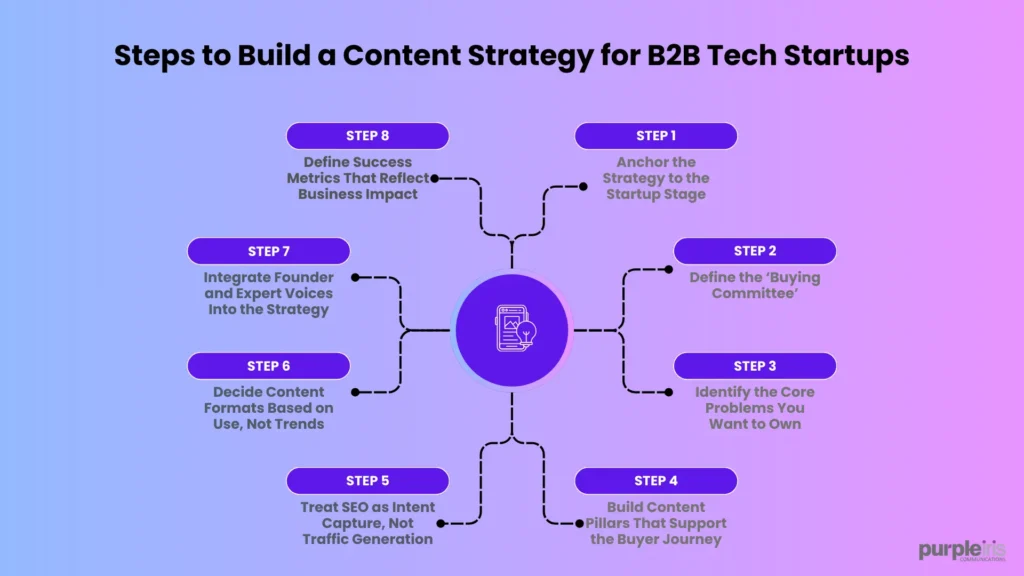
Step 1: Anchor the Strategy to the Startup Stage
Startups thrive when they develop original content strategies instead of following the playbooks of larger companies. Early stage and growth stage startups need different content outcomes.
Early Stage Startups
The primary goal is credibility and clarity. Buyers want to understand what problem you solve, why it matters, why your approach is different, and whether you are trustworthy.
Consider a cybersecurity startup addressing supply chain vulnerabilities. At an early stage, prospects are more concerned about credibility. They want to know whether the founding team truly understands the problem.
Content at this stage should focus on domain knowledge, a clear Point of View (POV), and the founders’ expertise in the space.
The company’s publishing schedule must include content that explores the security gaps in modern supply chains and mitigating strategies from different angles, including regular founder’s POVs that offer new insights and perspectives.
Scaling Startups
The focus shifts to differentiation and decision support. Content must address objections, explain tradeoffs, show proof through use cases, and support sales conversations.
The same cybersecurity startup, now with 50 customers and growing revenue, faces a different challenge. Buyers are comparing you to three other vendors. Content at this stage needs to get specific. It should include comparison guides, case studies with tangible business metrics, and integration demos that address perceived implementation risks.
Agency Tip:
Clearly define your current stage and choose one primary content objective at a time. Every content decision should ladder back to that objective.
Step 2: Define the ‘Buying Committee’
Most startups have an Ideal Customer Profile (ICP), but not every founder has equal clarity on the buying committee.
| What is a Buying Committee? |
| A buying committee is a group of stakeholders involved in evaluating, influencing, and approving a purchase decision. This powerful group could include technical leaders, business owners, finance teams, and operations leaders. |
Gartner reports that typical B2B buying groups range from 5-16 people across as many as four functions 2. A strong content strategy accounts for this complexity.
Consider a startup selling a data analytics platform to mid-market retail companies. While the ICP may be clear, the internal priorities are not uniform.
- The VP of Marketing looks for faster customer insights.
- The head of data engineering evaluates integration complexity and data governance.
- The CFO assesses cost and overlap with existing tools.
- The operations lead wants confidence that teams can adopt the platform without friction.
Content that works in this environment is role-specific and decision-aware. Each piece is designed to address the concerns of a particular stakeholder and help them feel confident advocating for the solution internally.
Agency Tip:
Create 3-4 audience personas based on roles and identify the fears and motivations that will drive their decision-making.
Step 3: Identify the Core Problems You Want to Own
Define your space and explore it in depth–be it improving operational efficiency, enabling better decisions, or simplifying complex workflows.
The Content Marketing Institute’s 2024 research found that the most frequently cited challenges include creating the right content, creating content consistently, and differentiating content 3.
Think about HubSpot in its early days. It owned one space: inbound marketing. Every piece of content reinforced that focus, helping them earn category recall before market share.
Addressing the same core problems consistently from different angles makes buyers think of you when those challenges arise.
Agency Tip:
List the top three problems you’re solving. Audit your existing content against these problems. Remove or deprioritize content that does not clearly connect with that problem statement.
Step 4: Build Content Pillars That Support the Buyer Journey
| What are Content Pillars? |
| Content pillars are the core themes that structure your content around how buyers learn, evaluate, and make decisions. Each pillar addresses a specific stage of the buyer journey and serves a distinct purpose in moving prospects forward. |
In a B2B tech context, effective content pillars typically include:
| Problem and category education helps buyers understand the problem and why it matters now. This is where you frame the gap between the current state and the desired outcome, without pitching the product yet. |
| Solution perspective explains different ways to solve the problem and clearly states your POV. This is where you establish how your approach differs and why it exists. |
| Proof and validation build credibility through case studies, examples, and use cases. Buyers want evidence that your approach works for companies like theirs. |
| Implementation and adoption answer practical questions about onboarding, timelines, and effort. This is often the most valuable content for sales conversations. |
Together, these pillars support how buyers naturally progress. A prospect may begin with problem education, move to solution perspectives, look for proof, and finally review implementation details before engaging with sales.
Agency Tip:
Define 3-5 content pillars and ensure each piece fits clearly within one. This creates consistency without repetition.
Step 5: Treat SEO as Intent Capture, Not Traffic Generation
In B2B tech, search creates value when it attracts high-intent buyers, not when it maximizes traffic. High-intent searches come from buyers who are actively researching problems, comparing options, or evaluating pricing and implementation. These signals indicate decision readiness.
Search strategy today extends beyond traditional SEO. Buyers increasingly use AI-driven search experiences that surface direct answers, comparisons, and recommendations. This makes AEO (Answer Engine Optimization) and GEO (Generative Engine Optimization) just as important as keyword rankings. Content must be structured to clearly address decision-stage questions, not just broad informational queries.
In practice, this means prioritizing problem-aware searches, evaluation and comparison queries, and pricing or implementation questions. Instead of targeting “what is cloud security,” focus on “how to evaluate cloud security tools for healthcare.” Instead of “project management software,” target “Asana vs Monday pricing for remote teams.”
The outcome is more qualified visibility. Traffic volumes may be smaller, but conversion potential is significantly higher because the content meets buyers at a decisive moment.
Agency Tip:
Prioritize keywords that reflect decision stage intent. Create content that answers uncomfortable but important questions, such as pricing, limitations, and alternatives. This builds trust and filters out poor leads.
Step 6: Decide Content Formats Based on Use, Not Trends
Choosing content formats is as much a resourcing and execution decision as it is a creative one. Different formats serve different purposes at different moments. Some are better suited for depth and reference, others for credibility, visibility, or sales enablement. The goal is to invest in the ones your team can execute consistently and deploy meaningfully.
Video, for example, can be powerful across websites, events, and social channels. But it also requires operational readiness. A fintech startup we worked with recorded customer testimonials during site visits, only to realize later that approvals, editing cycles, and internal bandwidth slowed publication. The issue was not format choice, but execution capability.
Format decisions work best when they account for both impact and practicality. A technical deep dive might work better as a written guide that engineers can reference. A customer story might work better as a short video testimonial. A pricing breakdown might work better as an interactive calculator.
Agency Tip:
Choose formats based on how they will be used. Start with one or two formats that map directly to your sales process, then expand only when those prove effective.
Step 7: Integrate Founder and Expert Voice Into the Strategy
In early and mid-stage startups, the founder and senior leaders are often the strongest credibility signals. Their voices are the most trusted sources of information.
Content that includes genuine perspectives, lessons, and opinions builds trust faster than polished brand messaging.
Think about it this way. A generic blog post titled “Why API Security Matters” feels like every other article. A founder-penned piece titled “The API Vulnerability That Almost Cost Us Our First Enterprise Deal” feels personal and carries weight.
Buyers are not just evaluating your product. They are evaluating whether they trust you to solve their problem, and the founder’s voice accelerates that trust.
Agency Tip:
Build a system to capture founder and expert insights and translate them into content. This could be articles, LinkedIn posts, or opinion pieces in the media.
Step 8: Define Success Metrics That Reflect Business Impact
Views and impressions are easy to track, but on their own, they rarely add value.
We group content metrics into three buckets: visibility, engagement, and decision impact. Each matters, but only when measured in the context of the buying journey.
A strong content strategy prioritizes metrics that show progress toward a decision.
In practice, this means shifting the questions you ask. Instead of celebrating 50,000 blog views, ask how many readers became SQLs. Instead of measuring social reach, ask how many prospects referenced your content on sales calls.
Visibility metrics tell you whether content is being seen. Engagement metrics tell you whether it’s resonating. Decision-impact metrics tell you whether it’s doing its job.
One SaaS company we worked with made this shift and began tracking which content appeared in closed deals. Buyers who engaged with their comparison guide and pricing FAQ were 3x more likely to close. That insight changed their entire content prioritization.
Agency Tip:
Align content metrics with sales and business goals. Review content performance in the context of deals, not dashboards alone. Create a feedback loop between sales and marketing so you know what actually helps close business.
The Real Role of Content in a B2B Tech Company
A B2B tech content strategy is a set of deliberate choices about focus, audience, and depth. When these choices are clear, content stops feeling like an ongoing production task and starts functioning as a system that supports how buyers learn, evaluate, and decide.
The role of content is not to generate noise or chase attention. It is to reduce uncertainty at every stage of the buying journey and help prospects move forward with confidence. That is when content begins to influence pipeline, sales conversations, and long-term positioning.
This is the lens we bring to Purple Iris Communications. We work with B2B tech startups to design content strategies that align with real buying behavior, sales motion, and business priorities, so content earns its place as a growth lever, not a background activity.
- https://www.mckinsey.com/capabilities/growth-marketing-and-sales/our-insights/five-fundamental-truths-how-b2b-winners-keep-growing ↩︎
- https://www.gartner.com/en/newsroom/press-releases/2025-05-07-gartner-sales-survey-finds-74-percent-of-b2b-buyer-teams-demonstrate-unhealthy-conflict-during-the-decision-process ↩︎
- https://contentmarketinginstitute.com/b2b-research/b2b-content-marketing-benchmarks-budgets-and-trends-outlook-for-2024-research ↩︎