The demand for technology leadership in the boardroom has never been more pronounced. While 97% of CEOs intend to incorporate AI into their organizations, only 1.7% feel prepared to lead it.
Business leaders are seeking trusted voices and partners who can cut through the jargon, simplify technology concepts, and connect the dots for them. The CEO of a manufacturing company wants to understand how sensor networks can transform the supply chain and improve operational efficiency before making a $3 million investment in IoT. A retail leader contemplating the use of generative AI wants compelling evidence of how it can elevate the customer experience.
Herein lies an opportunity for CIOs: help bridge the knowledge deficit in the market and become a technology thought leader. CIOs who are capitalizing on this opportunity are creating powerful personal brands.
However, building a personal brand demands a structured approach. CIOs who have mastered the strategy and the planning are today shaping conversations and shifting perceptions through media commentaries, speaking engagements, and discussions on LinkedIn.
Three Pillars of B2B Personal Branding
Most CIOs start generating content before defining what they want to be known for. A rushed start results in mixed messaging, unclear positioning, and missed opportunities to create real impact.
We recommend a personal branding framework that will deliver the results.
Pillar 1: Define Your Unique Value Proposition
The strongest CIO personal brands are created around a recognizable thesis regarding the role of technology and business transformation.
This is not about listing capability or technology expertise, but about articulating your position on how technology should drive business outcomes. Narrow down your focus areas, pick common knowledge gaps that you have observed, and define your position.
Your Unique Value Proposition (UVP), built around your expertise, defines your brand. It must be defendable and backed by data – your professional track record is your strongest foundation.
CIOs often encounter challenges in aligning technology with business goals that shift continually, managing cultural changes, and balancing innovation with compliance. To keep your thought leadership content relevant, choose topics that are grounded in such experiences. Sharing information that your audience will find useful, practical, and actionable.
For instance, if you have scaled global technology operations, your audience will want to know how you navigated cultural nuances during a global rollout. Explain what worked and what did not, and how you have implemented the lessons for future projects. A great value-add will be a template for pre-launch communications and stakeholder management from a cultural perspective.
Pillar 2: Master Your Audience Ecosystem
The content you produce is not targeted solely at customers; there is also room for engagement with peers, investors, employees, and the media and analysts. An ideal content strategy speaks to each unique interest group with a coherent message at its core.
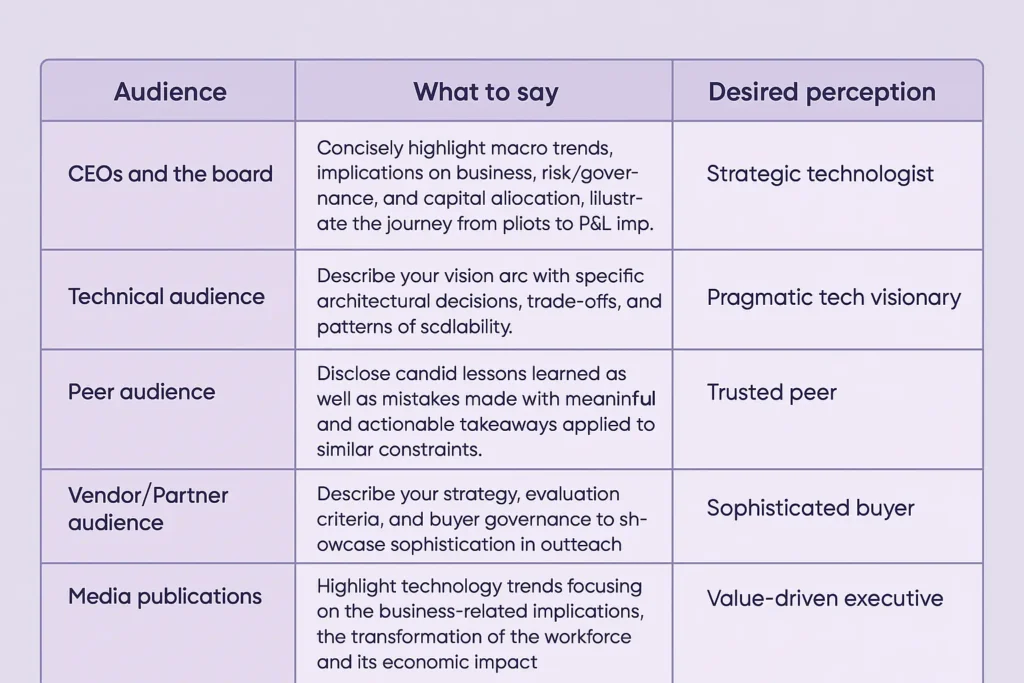
How to Refine the Same Topic for Different Audiences
Consider how a CIO would position an article about AI implementation across different media outlets:
- For a Business Publication (E.g., Wall Street Journal, Financial Times): “The AI Payoff: Questions CIOs Need to Ask” – Focused on tech trends, business metrics, and competitive advantage.
- For a Technology Publication (E.g., MIT Technology Review, IEEE Spectrum): “From Proof of Concept to Production – The Architecture Decisions That Make AI Scale” – Focused on deep technical insights, infrastructure decisions, and frameworks for implementation.
- For a Business Magazine (E.g., Harvard Business Review, McKinsey Quarterly): “The AI-First Operating Model – How CIOs Are Transforming Enterprise Strategy” – A deep dive on strategic transformation, organizational change, and leadership implications.
Pillar 3: Build Consistency Over Virality
Virality captures attention. But consistency builds reputation.
A powerful personal brand is not built on a single viral post. A powerful personal brand is built on repeated signals of reliability. With every blog post, the positioning gets reinforced. With every keynote, the message is amplified.
Over time, this steady, repeated reinforcement makes your brand voice credible, which will be valued by your investors, employees, and clients alike. Setting a practical publishing schedule, whether it is weekly or monthly, and sticking to it, creates consistency.
Another strategy is to batch-create content, allowing you to schedule the posts in advance. The aim is to maintain a steady flow of content, irrespective of how busy your personal calendar is.
Inspiring CIO Thought Leaders
Here are two examples of CIOs who are taking a distinct, practical approach to building a strong personal brand:
Gary Sorrentino, Global CIO at Zoom, has built his personal brand around the human side of technology. His primary focus is on hybrid work and collaboration. He takes the opportunity and platform to discuss how technology can amplify the human-to-human connection. His multiple podcast appearances and keynotes are on the future of work and how technology can empower people, subtly positioning Zoom’s capabilities.
Cynthia Stoddard, CIO at Adobe, is a technology leader who has fully adopted and scaled AI within her organization. She talks about her frameworks through long-form interviews and podcasts. She also shares her own experiences of being “customer zero” of Adobe’s own products.
She has in the past described how her team identified usability issues early in the deployment process, feedback that shaped product development. By sharing real-world challenges and problem-solving mechanics, she has built her credibility and trust with peers.
The Four-week CIO Personal Branding Starter Plan
If you are ready to embark on your personal branding journey, here’s a four-week plan to help you get started.
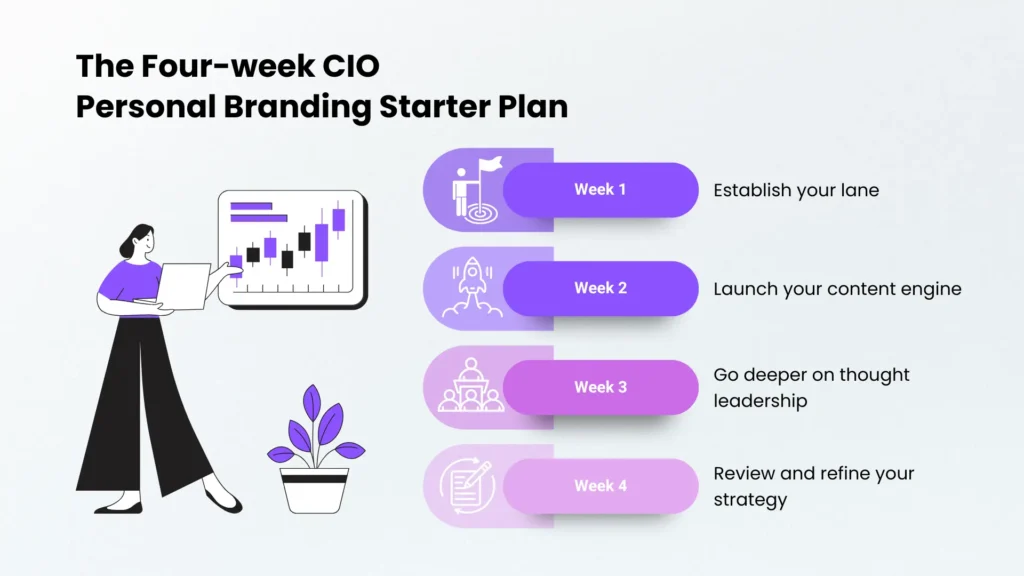
Week 1: Establish Your Lane
Begin with an analysis of your LinkedIn profile, company biography, and speaker profile. Revise your headline to include a value proposition that describes how you uniquely lead.
Headline example: “CIO helping drive AI-first change at [Company] | Zero-trust advocate | 15+ years of scaling enterprise technology”
Next, add 3-5 targeted keywords around your technology focus, industry practice area, and leadership philosophy that your ideal audience would use to search for thought leaders in your field. Write an engaging 200-character statement that you can use for all your online content and speaking engagements.
POV example: “The future of enterprise IT is not choosing between security and innovation. It is about using zero-trust as the enabling force of innovation.”
Pull together three engaging stories from your current role that support your POV:
- Story 1: A technology decision you made and its measurable impact on the business.
- Story 2: A complex problem you addressed that will have lessons for your peers.
- Story 3: An industry/technology forecast you made that turned out to be true.
Week 2: Launch Your Content Engine
Once your point of view has been established, start producing content that aligns with it. The best place to start is with formats you already know work with executive audiences.
Article 1: “3 Lessons from [Specific Project]” (300-400 words)
Example: “3 Lessons from Moving 10,000 Employees to Zero-Trust: What We Got Right and Wrong”
Article 2: “Why [Industry Trend] Matters to [Audience]” (400-500 words)
Example: “Why Explainable AI Matters to Banking CIOs”
Architecture note: Consider one technical decision you made recently and use the following structure to document your decision:
- What was the problem you were trying to solve?
- What was your approach?
- What did you trade off?
- What did you achieve?
- What lessons have you learned; what would you change?
While you publish content, don’t forget about engagement. Comment intentionally on 10 posts from peer CIOs every week, while also sharing one useful industry article each week with your personal perspective. Join and actively engage in 2-3 relevant LinkedIn groups.
Week 3: Go Deeper on Thought Leadership
Compose a 600-800-word article that aligns technology trends with corporate strategy. This will highlight you as a strategic thinker rather than just a technical resource.
Potential topic: “From Pilot to Production: The Internal Controls that Make AI Reliable”
Here is a suggested direction for the article:
- Outline the key market forces driving change or common challenges faced
- Elaborate on your approach
- Discuss the measurable results
- Add takeaways in the form of best practices and next steps
Research content ideas for keynotes and panel discussions. Before proposing topics to an event organizer, determine the average delegate profile. If you are addressing a conference of CTOs, choose a technical topic that will position you as an expert while offering them immense value.
As you build your social capital through event participation and media coverage, build social proof along the way. Ask for testimonials from two or more key stakeholders, such as your CEO, the leader of another business unit, or a strategic partner. Testimonials lend credence to your impact and approach.
The most critical aspect of week 3 is content repurposing. Take your executive brief and turn it into a series of 3-4 POV posts on LinkedIn. Submit an op-ed pitch for a business publication. Find a podcast or webinar and share what you have learned.
Continue to explore innovative ways to repurpose existing content, reinforcing the messaging while saving time. It will not only help you accelerate content production but also maximize the ROI of your content.
Week 4: Review and Refine
Monitor engagement signals such as comments, shares, and connection requests from professional peers. Track quality signals, including requests to speak and represent, peer, and media outreach. Document business opportunities ranging from meeting requests and partnership discussions to improved vendor relationships.
Plan your cadence
Lock your Q1 content calendar into a sustainable cadence:
- Weekly: One LinkedIn post on “tech-in-business” insights
- Bi-weekly: An architecture note or in-depth case work
- Monthly: A thought leadership piece
Your Voice is Your Biggest Unfair Advantage
When it comes to B2B technology, purchases can go into millions of dollars. And complex, high-stakes transactions are not made on impulse. Moreover, B2B buyers are, after all, people making decisions on behalf of their organizations. They are most comfortable going with leaders they trust, not just a product that holds a promise. They are placing their budget and trust in another leader’s judgment, experience, and ability to minimize uncertainty.
In these decisions, a CIO’s capability as a leader and strategic thinker becomes a differentiator. Hence, personal branding for CIOs is now a critical lever, helping decision-makers feel adequately reassured that you will minimize uncertainty, reduce risk, and drive meaningful business value.
At Purple Iris Communications, we help technology executives build authentic thought leadership that makes “yes” easier in the rooms that matter. We work with IT leaders and executives to amplify their voice, develop thought leadership, and deliver strategic executive communications. Our proven methodology has helped executives in enterprise technology, SaaS, fintech, and healthtech build credible and influential personal brands.
Start with a point of view, cadence, and proof asset each quarter. Let Purple Iris partner with you to get your editorial engine up and running and elevate your executive presence for sustained impact.