
Employees receive leadership announcements, policy updates, newsletters, and regular business communications. Yet they may still struggle to explain what the organization is trying to achieve, why certain decisions have been made, or how their work contributes to business priorities.
The gap is visible in recent research. Gallup’s August 2026 workplace indicator found that only 16% of US employees strongly agreed that their organization’s leadership communicated effectively. Axios HQ’s 2025 State of Internal Communication report found that while 27% of leaders believed their employees were entirely aligned with organizational goals, only 9% of employees agreed.
These findings point to an important consideration for leadership and communications teams: distributing information does not automatically create employee understanding.
An employee communications strategy provides a framework for deciding what employees need to know, how information should reach different groups, who is responsible for communicating it, and how its effectiveness will be assessed.
This article explains how to develop an employee communications strategy, audit existing practices, plan communication across employee groups, and measure whether messages are achieving their intended purpose.
What Is an Employee Communications Strategy?
Employee communications refers to the planned exchange of information, messages, and feedback between an organization and its workforce. It covers how an organization communicates its priorities, decisions, policies, culture, and expectations to employees across different roles, departments, and locations.
It includes leadership announcements, employee newsletters, policy updates, town halls, manager briefings, internal campaigns, and everyday workplace communication.
The term is often used interchangeably with internal communications. Internal communications generally describes the broader function responsible for managing information and dialogue across an organization, while employee communications emphasizes the messages and communication experiences directed at its workforce. The distinction is not standardized across the industry. The Local Government Association’s overview of internal communications discusses the different ways the discipline is defined and its role in informing employees and enabling them to have a voice.
An employee communications strategy establishes the direction for this work. An employee communications plan translates that direction into specific activities, messages, channels, owners, and timelines. An editorial calendar coordinates those activities.
The three serve different purposes:
| Component | The question it answers | Primary output |
| Employee communications strategy | What should employees know, and why? | Communication priorities, audience requirements, messaging, and success measures |
| Employee communications plan | What needs to happen to execute the strategy? | Messages, channels, owners, responsibilities, and timelines |
| Editorial calendar | How will communication activities be coordinated? | Publication dates, campaign schedules, and review deadlines |
A calendar can organize communication without ensuring that employees receive relevant information. A plan can list announcements without explaining why they matter. The strategy provides the direction needed to make both effective.
How to Develop an Employee Communications Strategy: A Six-Step Framework
Step 1. Audit Existing Employee Communications Before Adding More Channels
An employee communications audit establishes what your organization currently communicates, how employees access that information, and where communication gaps exist.
Without this assessment, teams risk adding more newsletters, announcements, and digital channels without addressing the underlying problems.
Begin by creating an inventory of existing communications. This may include leadership updates, employee newsletters, policy announcements, onboarding materials, internal campaigns, town halls, and operational updates.
Evaluate them against a consistent set of criteria.
A practical employee communications audit framework
| Criterion | Questions to ask |
| Business alignment | Do communications reflect current organizational priorities? |
| Audience relevance | Does the information address the needs of the intended employees? |
| Accuracy and clarity | Are messages accurate, understandable, and consistent? |
| Channel accessibility | Can employees access important information through available channels? |
| Governance | Are communication responsibilities and approval processes clear? |
| Feedback | Can employees ask questions and see how their feedback is addressed? |
| Effectiveness | Does the organization assess understanding and action, rather than just distribution? |
Use the findings to decide which communication activities to retain, improve, consolidate, or discontinue.
For example, a company may discover that its corporate newsletter receives strong readership among office employees but has limited reach among production teams. The issue may be channel accessibility rather than content quality. Shift briefings, supervisor communication, or mobile-friendly updates may be more appropriate for those employees.
Distinguish an audit from a communication gap analysis.
An audit evaluates existing communication practices. A gap analysis identifies what employees are missing.
A company may have regular leadership announcements but no structured way for managers to explain business decisions to their teams. Another may have detailed policies but no accessible summary explaining how those policies affect employees.
These gaps require different solutions.
Combine the audit with employee interviews, manager discussions, channel analytics, and short surveys. The resulting improvement priorities should reflect what employees actually experience.
Step 2. Connect Business Objectives With Employee Information Needs
An employee communications strategy should reflect what the organization needs to achieve and what employees need to understand to support those objectives.
Start by identifying the business priorities that require employee awareness, participation, or action.
These may include introducing a new operating model, implementing technology, integrating an acquisition, entering a new market, improving customer experience, or strengthening organizational culture.
Next, identify the information employees need to respond to these priorities.
Build a business objective-to-communication map
| Business objective | Employee questions | Communication requirement |
| Introduce a new technology platform | Why is it being introduced? How will my work change? | Leadership announcement, training communication, FAQs |
| Integrate an acquisition | What does the integration mean for our teams? What happens next? | Leadership updates, manager briefings, targeted employee messages |
| Improve customer experience | What changes in our daily responsibilities? | Team communication, process updates, internal campaigns |
| Strengthen organizational culture | What behaviors and values should employees understand? | Leadership messaging, employee stories, culture campaigns |
| Introduce a new policy | What has changed? Who is affected? | Policy announcement, accessible reference documents, manager guidance |
This exercise helps communications teams distinguish between information that employees simply need to know and information that requires them to take action.
An announcement about quarterly business performance may primarily require awareness. A new compliance process may require employees to understand revised responsibilities and follow specific instructions.
The communication objective should reflect this difference.
Avoid broad objectives such as increasing employee communication or sending more frequent updates. Instead, define what employees should understand, know how to find, or be prepared to do.
Step 3. Segment Employee Audiences and Develop a Message Architecture
A company-wide announcement can establish a common message, but employees often need different levels of information.
Audience segmentation helps organizations account for differences in job responsibilities, work environments, location, access to technology, and exposure to business decisions.
For example, a new operating model may require executives to understand its strategic rationale, managers to understand departmental implications, and frontline employees to receive specific instructions about their work.
Create an employee audience map
| Employee group | Information priorities |
| Senior leadership | Strategic direction, business performance, and organizational decisions |
| Middle management | Departmental implications, implementation requirements, and employee questions |
| Frontline employees | Operational instructions, responsibilities, and immediate changes |
| Remote and hybrid employees | Organizational updates, access to resources, and opportunities to participate |
| New employees | Company policies, culture, expectations, and role-related information |
| Employees affected by change | Personal implications, timelines, available support, and next steps |
The segmentation model should reflect the organization’s actual workforce. Some employees may belong to several groups and require information from different communication streams.
Organizations should also consider language preferences, accessibility requirements, working hours, and access to workplace technology.
Establish a consistent message framework.
A message architecture establishes the information employees should understand and helps maintain consistency across leadership messages, departmental updates, and internal campaigns.
| Message element | Question it should answer |
| Core announcement | What is happening? |
| Business rationale | Why is this happening? |
| Strategic context | How does this support organizational priorities? |
| Employee implications | What does this mean for different teams? |
| Required action | What should employees do next? |
| Support | Where can they find information or raise questions? |
Consider an organization introducing a new enterprise resource planning system.
A basic announcement may explain the launch date and provide a training link. A more useful communication explains why the system is being introduced, which workflows will change, how departments will be affected, and what employees need to do before implementation.
The central message remains consistent, but the detail should be adapted to the audience.
Storytelling can help employees understand the reasoning behind organizational decisions. The Role of Storytelling in Internal Alignment explores how leadership narratives connect strategic priorities with everyday work. Similarly, How Storytelling Can Strengthen Employee Engagement examines how organizations can use real employee experiences to make internal messages more meaningful.
Step 4. Turn Communication Priorities Into a Plan and Select the Right Channels
Once objectives, audiences, and messages have been established, translate them into a communication plan.
The plan should identify what needs to be communicated, who is responsible, which channels will be used, and when employees should receive the information.
Employee communications planning framework
| Planning field | What to document |
| Objective | What the communication needs to achieve |
| Audience | Which employees need the information |
| Key message | What employees should understand |
| Sender | Who should communicate the message |
| Channel and format | How the information will be delivered |
| Owner | Who develops, reviews, and distributes it |
| Timeline | When the communication will happen |
| Employee response | What employees need to know or do |
| Measurement | How effectiveness will be evaluated |
Choose channels according to employee requirements.
Organizations have several options for delivering information, including email, intranet platforms, newsletters, town halls, video messages, mobile applications, team meetings, and workplace displays.
The choice should depend on the communication objective and the audience’s working environment.
| Communication need | Suitable channels |
| Strategic announcements | CEO messages, town halls, leadership presentations |
| Routine updates | Employee newsletters, intranet updates |
| Urgent operational information | Direct alerts, supervisor briefings, mobile channels |
| Complex or sensitive information | Manager discussions, targeted meetings, FAQs |
| Policies and reference material | Employee handbooks, intranet knowledge hubs |
| Employee participation | Surveys, focus groups, Q&A sessions |
| Frontline communication | Shift meetings, visual explainers, digital displays |
Consider accessibility before selecting a channel. An intranet may work well for office-based employees but may not be practical for workers in production facilities, warehouses, or field operations.
Similarly, a lengthy email may not be the most effective way to communicate an urgent operational instruction.
Organizations should also avoid duplicating the same information across multiple channels without a clear reason. Each channel should serve a defined purpose, and employees should know where to find the authoritative version of important information.
Build a communication calendar.
An editorial calendar coordinates announcements, campaigns, leadership updates, policy changes, and employee initiatives.
It helps communication teams identify overlapping messages and coordinate with HR, finance, technology, and business functions.
A calendar should remain flexible enough to accommodate unexpected business developments. Its purpose is to support communication planning, not create a rigid publishing schedule.
Purple Iris’s employee engagement communications case study illustrates how different formats can support communication across employee groups. The engagement involved a global BPM organization operating in close to 20 countries. Work included executive messages, emails, text messages, campaign banners, and video scripts for employee referral, equity, diversity, and inclusion, and CSR initiatives.
Step 5. Prepare Leaders and Managers to Communicate Organizational Change
Leadership and managers influence how employees understand organizational priorities and decisions.
Senior leaders provide strategic context. Managers explain what decisions mean for their teams and address questions about day-to-day responsibilities.
Both roles should be built into the communication strategy.
The IoIC’s 2026 IC Index, based on an online survey of 5,000 UK workers aged 18–75 in organizations with at least 500 employees, conducted in January 2026, found that 64% of employees agreed their employer had been clear about its strategy and business priorities.
The same report found that 76% of surveyed managers felt equipped to lead conversations with their teams about what was happening across the business. The manager finding was based on 2,130 respondents with management responsibilities.
These figures highlight two communication requirements: employees need clarity from leadership, and managers need sufficient information to explain what is happening at the team level.
Prepare leaders and managers before important announcements.
Provide them with:
- The business rationale and key messages.
- Information about the implications for different employee groups.
- Manager briefing documents and FAQs.
- Talking points for team discussions.
- Guidance on handling sensitive questions.
- A process for escalating concerns they cannot answer.
Managers should also have a way to share employee feedback with leadership and HR.
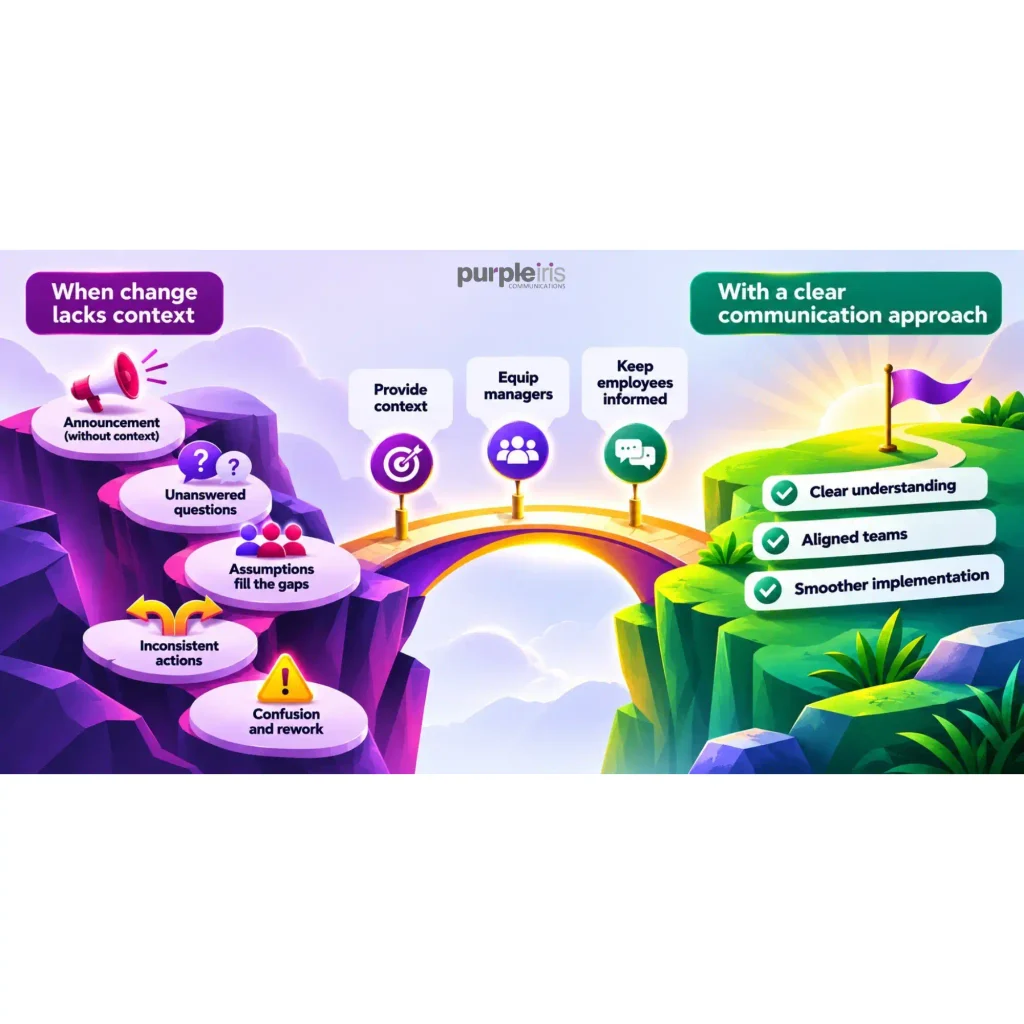
Plan communication throughout organizational change.
The communication requirements become more demanding during acquisitions, restructurings, technology implementations, and operating-model changes.
Employees need to understand what is changing, why it is happening, how it affects their responsibilities, and where they can find support.
A change communications plan should address four stages:
Before the announcement: Prepare leaders, identify affected groups, align key messages, and establish what information can be shared.
At the announcement: Explain the business rationale, the scope of the change, and its known implications.
During implementation: Provide progress updates, clarify responsibilities, and communicate training and support arrangements.
After implementation: Address outstanding questions, gather feedback, and explain the next steps.
The IoIC’s 2026 research found that only 42% of surveyed employees agreed their organization was good at helping employees adapt to change. This finding was based on 4,795 responses.
This makes clear communication particularly important when some decisions remain uncertain. Leaders should distinguish between confirmed information and matters still under consideration, and explain when further updates will be available.
For example, during an acquisition, employees may need information about changes to reporting structures, team responsibilities, workplace arrangements, and the integration timeline. A general announcement about the acquisition will not answer all these questions.
Purple Iris’s 360° Communications Support case study provides an example of coordinating messages across employees, leadership, and external partners through different stages of an organizational initiative.
Step 6. Establish Governance and Measure Communication Effectiveness
Employee communications often involve several departments. HR, leadership, finance, operations, and technology teams may all communicate with employees independently.
Without clear responsibilities, messages can overlap, information can become inconsistent, and employees may struggle to identify authoritative updates.
A governance framework should establish who develops, reviews, approves, and distributes communications.
| Stakeholder | Primary responsibility |
| Executive leadership | Communicate organizational priorities and major decisions |
| Internal communications | Coordinate strategy, messaging, channels, and editorial planning |
| HR | Communicate policies, employee programs, and people-related changes |
| Functional leaders | Translate business priorities into departmental messages |
| Managers | Explain team-level implications and share employee feedback |
| Subject matter experts | Validate technical and operational information |
| Channel owners | Maintain publishing standards and information access |
Approval processes should reflect the nature of the communication. A routine departmental update may require functional approval, while a restructuring announcement may need coordination among executive leadership, HR, legal, and communications.
Measure what employees understand and do.
Employee communications measurement should go beyond publication volume, email open rates, and town hall attendance.
The AMEC Integrated Evaluation Framework provides a useful basis for examining communication outputs, audience responses, outcomes, and organizational impact.
For employee communications, consider the following measures:
| Measurement area | Possible indicators |
| Delivery | Messages published, newsletters distributed, campaigns completed |
| Reach | Delivery rates, readership, town hall attendance, employee coverage |
| Understanding | Message recall, survey responses, comprehension checks |
| Action | Training completion, process adoption, policy awareness, participation |
The right measures depend on the communication objective.
For a new policy, the organization may assess whether employees understand the revised requirements. For a technology implementation, it may track training completion and adoption milestones. For a leadership communication program, it may assess whether employees understand the organization’s strategic priorities.
Establish a baseline before introducing changes to the communication program. Review results across different employee groups to identify gaps that organization-wide averages may conceal.
Measurement should also distinguish communication outcomes from broader business outcomes. Retention, productivity, and employee engagement are influenced by several organizational factors, and should not automatically be attributed to communication alone.
The purpose is to help communications teams decide what is working, where employees need additional information, and which changes deserve attention.
Organizational messaging should also remain consistent with the employee experience. Internal branding strategy explores how an organization’s values need to be reflected across leadership communication, workplace messaging, and employee interactions. Purple Iris’s workplace branding case study illustrates how contextual messages across office spaces can reinforce organizational values and culture.
Where AI Fits Into Employee Communications
AI can support employee communications through drafting assistance, summarization, translation, content adaptation, and the development of communication materials for different audiences.
It can also help teams organize large volumes of employee feedback and identify recurring questions.
However, employees need clarity about how AI is being introduced into their work.
The IoIC’s 2026 IC Index found that only 32% of surveyed UK employees agreed their employer had clearly communicated how they were expected to use AI in their jobs. The question had 4,593 respondents.
Organizations introducing AI should explain its intended uses, changes to responsibilities, training requirements, and safeguards.
AI tools can support communication workflows, but human review remains necessary to check accuracy, context, confidentiality, and the implications of sensitive messages.
Build an Employee Communications Capability That Supports the Business
An effective employee communications strategy connects organizational priorities with the information employees need to understand and act on them.
The process begins with an audit of existing communication practices. Business objectives and employee information needs establish the priorities. Audience segmentation and message architecture provide direction, while communication plans, channels, leadership involvement, and governance translate the strategy into everyday work.
For organizations with limited internal communications capacity, developing and maintaining this structure can require additional strategic and editorial expertise. The choice between strengthening an internal team and engaging an external partner also deserves consideration. Employee Communications Agency vs. In-House Team: How to Make the Right Choice explores the strengths of both models and the questions leaders should consider before making that decision.
Purple Iris Communications supports organizations through its Employee Communications practice, covering leadership and strategic communication, day-to-day employee updates, engagement and culture-building content, and employer brand and talent positioning.
Explore Purple Iris’s Employee Communications Services to understand how specialized communication support can help address these requirements.
A well-planned employee communications strategy gives people a clearer understanding of organizational decisions, their responsibilities, and the priorities that connect their work to the wider business.
Ready to create communication moments that truly matter? Click here.
Frequently Asked Questions About Employee Communications
What should an employee communications strategy include?
An employee communications strategy should include business objectives, employee audience requirements, key messages, communication channels, leadership responsibilities, feedback mechanisms, governance, and success measures.
How often should an organization communicate with employees?
The frequency depends on the nature of the information and employee requirements. Routine updates can follow a predictable schedule, while urgent decisions and organizational changes may require more frequent communication. Relevance and timing are more important than sending messages simply to maintain volume.
What is the difference between an employee communications strategy and a communication plan?
The strategy establishes what employees need to understand and why. The communication plan translates those priorities into messages, audiences, channels, owners, and timelines.
How can organizations measure employee communications effectiveness?
Organizations can measure delivery, reach, understanding, and employee action. Suitable indicators include message recall, policy awareness, training completion, employee feedback, and adoption of revised processes. Metrics should reflect the original communication objective.
How can organizations improve employee communications during change?
They should explain the business rationale, identify affected employee groups, communicate known implications, prepare managers, provide regular updates, and create channels for employee questions. When decisions remain uncertain, leaders should explain what is known and when further information will be available.
References:
https://www.gallup.com/workplace/716321/leadership-communication-at-work.aspx
https://axioshq.com/insights/internal-communications-statistics
https://www.ioic.org.uk/resource-report/ic-index-2026-the-reality-check.html