Every content asset demands an investment of time, expertise, and resources. When content decisions are disconnected from business priorities and buyer needs, teams can end up maintaining a busy publishing operation without giving buyers the information they need or strengthening the organization’s market position.
The challenge, then, is to establish a clear basis for deciding which content deserves investment and what it needs to accomplish.
A B2B content strategy establishes what an organization should communicate, whom it needs to reach, why its perspective matters, and how its content should support business objectives. It connects individual assets to a wider plan and gives teams a basis for deciding what to create, improve, reuse, or discontinue.
Marketers recognize the value of a content strategy. In the Content Marketing Institute’s B2B Content and Marketing Trends: Insights for 2026, based on a survey of over 1,000 B2B marketers, 97% said their organizations had a content strategy. Among those with a strategy, 61% reported that its effectiveness had improved. Of the marketers reporting improvement, 74% cited strategy refinement as a contributing factor.
The findings suggest that having a strategy is only the starting point. Teams also need to review and improve the decisions that shape it.
This article explains how to create a content strategy that connects business goals, audience needs, topic priorities, messaging, planning, and measurement. It includes practical frameworks to help B2B marketing teams assess their existing content and decide where to invest next.
What is a B2B Content Strategy?
A B2B content strategy is a framework for planning and managing content around defined business objectives and audience needs. It establishes the priorities, themes, messages, formats, distribution approaches, responsibilities, and success measures that guide content decisions.
A content marketing strategy is closely related to it. It describes how an organization will use content to attract, educate, engage, and retain its intended audiences. The terms are often used interchangeably, although content strategy can have a broader remit that includes messaging, governance, and the management of content across business functions.
A content marketing plan translates that direction into actionable work. It specifies which assets need to be created or improved, when they are required, who will contribute, and how they will reach their intended audiences.
An editorial calendar coordinates the execution of that plan through publication dates, deadlines, owners, and review stages.
| Component | The question it answers | Primary output |
| Content strategy | What should we communicate, to whom, and why? | Strategic priorities, audience needs, positioning, and measures of success |
| Content marketing plan | What work needs to happen to execute the strategy? | Prioritized assets, formats, channels, owners, and timelines |
| Editorial calendar | How will the planned work be coordinated? | Deadlines, contributors, review stages, and publication dates |
A calendar can keep a team organized without ensuring that its content is strategically relevant. A plan can list dozens of assets without explaining why those assets deserve resources. A content strategy provides the direction needed to make both useful.
How to Create a B2B Content Strategy: A Seven-Step Framework
Step 1. Audit Existing Content Before Commissioning More
A content audit establishes what your organization already has, how well those assets serve their intended purposes, and where improvement could make a meaningful difference.
Without this assessment, teams risk duplicating existing material or overlooking assets that could become more useful with relatively modest changes.
Begin by creating an inventory of the content within scope. This may include website pages, blog posts, case studies, reports, downloadable resources, and sales enablement material.
For each asset, record its URL, format, publication date, intended audience, strategic theme, and available performance data. You can then evaluate each against a consistent set of criteria.
A practical content audit framework
| Criterion | Questions to ask |
| Business relevance | Does the asset support a current business priority or offering? |
| Audience relevance | Does it address a meaningful buyer question or business problem? |
| Accuracy and freshness | Are the information, examples, and references still current? |
| Quality and depth | Does it give readers enough information to understand the subject or take action? |
| Differentiation | Does it express the organization’s expertise or a distinctive point of view? |
| Messaging consistency | Does it reflect the current positioning and value proposition? |
| Performance | Does it attract a relevant audience or support an intended business outcome? |
| Duplication | Does another asset cover the same ground without adding meaningful value? |
Use the findings to assign one of six actions to each asset: retain, update, consolidate, repurpose, retire, or create.
For example, an article that attracts relevant visitors but contains outdated information may need an update. Two articles that answer almost identical questions may be candidates for consolidation. A technical guide that receives limited traffic may still be valuable if it helps qualified buyers understand a complex implementation decision.
Assess each content asset by its purpose, not simply by the traffic it has attracted or its publication date.
Distinguish an audit from a content gap analysis.
An audit evaluates what exists. A content gap analysis identifies what is missing. A gap may involve an unanswered buyer question, limited coverage of a particular solution, or a lack of content that helps prospects compare approaches and evaluate implementation requirements.
For example, a software company may have several introductory articles about automation but no credible guide to assessing integration requirements, implementation risks, or the operational changes involved. The missing decision support is a more useful content opportunity than another introductory article on automation.
Use the audit and gap analysis together to establish a clear starting point for your content strategy.
Planning a website refresh? Our Content Scoping Template Every Website Refresh Needs provides a structured way to assess existing website content, identify gaps, decide which pages to retain or rewrite, and clarify stakeholder responsibilities before production begins.
Step 2. Align Content with Business Goals and Stakeholder Needs
A content strategy should reflect what the business aspires for and the information its intended audiences need to make decisions.
Start by identifying the business objectives content must support. These may include entering a new market, building awareness for a specific offering, strengthening category positioning, supporting a product launch, or helping sales teams address recurring objections.
Then identify the audiences whose decisions influence those objectives.
In complex B2B markets, a single buying decision may involve executives, functional leaders, technical specialists, procurement teams, and end users. Each group can approach the same offering with different priorities.
An executive may need to understand the business case. An operations leader may want to evaluate implementation requirements. A technical stakeholder may need evidence of integration compatibility, security, and scalability.
Content should reflect these differences without fragmenting the organization’s central message.
Build a buyer-question map
| Buyer context | Questions to investigate | Potential content |
| Problem recognition | Why does this problem matter? What happens if it remains unresolved? | Explainers, industry analysis, research-led articles |
| Exploring approaches | What options exist, and which approaches suit different situations? | Frameworks, comparison guides, educational articles |
| Evaluating solutions | How does a particular approach work? What evidence supports its value? | Case studies, technical explainers, implementation guides |
| Building internal agreement | What are the costs, risks, and organizational implications? | Business cases, FAQs, ROI analyses, stakeholder-specific resources |
| Preparing for implementation | What needs to change, and what should the organization plan for? | Checklists, planning guides, onboarding resources |
Treat this as a working model, not a universal buyer journey. Actual decision processes vary by industry, deal size, purchasing structure, and the complexity of the offering.
Gather information from sales calls, customer interviews, support interactions, search data, website enquiries, win-loss analysis, and subject-matter experts. Look for recurring questions and disagreements about what buyers need to understand.
Next, compare those questions with your content audit. The result should identify where content already helps, where it needs improvement, and where a genuine gap remains.
For teams marketing to named accounts or complex buying committees, ABM Content Strategy: What Works in Modern B2B Marketing provides a more specific perspective on aligning content with account intelligence, stakeholder needs, and buying decisions.
Step 3. Define Content Pillars and a Distinctive Point of View
Content pillars are the broad subject areas around which an organization develops its expertise and communications. They provide continuity across individual assets while allowing each article, report, or case study to address a different question.
The strongest pillars connect four considerations:
- Business relevance: The subject supports a current objective or strategic offering.
- Audience value: It addresses a recurring problem, question, or decision.
- Differentiation: The organization can contribute a perspective beyond familiar industry explanations.
- Evidence: The organization has the expertise, research, experience, or customer evidence to support its perspective.
Consider a B2B technology company serving manufacturers. A broad theme such as digital transformation may be too general to guide a distinctive content program. More focused pillars could address production planning, operational visibility, integration challenges, and investment decisions.
Each pillar can support several types of content. A topic on operational visibility might include an introductory explainer, an implementation guide, an expert perspective on common pitfalls, a diagnostic checklist, and a customer case study.
Those assets contribute to the same area of expertise but serve different purposes.
This is the foundation of a connected content library. Instead of publishing isolated articles, the organization develops related resources that help readers explore a subject in greater depth.
A useful content strategy framework also establishes boundaries. Not every popular topic deserves a place in the content plan. If the subject has little connection to the organization’s expertise or the needs of its intended audience, search demand alone is not a strong enough reason to pursue it.
The objective is to establish a recognizable body of knowledge around subjects the organization has a credible reason to own.
Developing a distinctive point of view takes more than identifying popular industry topics. Teams need to identify where their experience challenges conventional thinking and build a credible argument around that perspective. The How to Develop a Distinctive POV That Gets You Found in AI Search handbook offers a practical framework for developing and communicating that perspective.
Step 4. Prioritize Content Opportunities Using Business Value and Effort
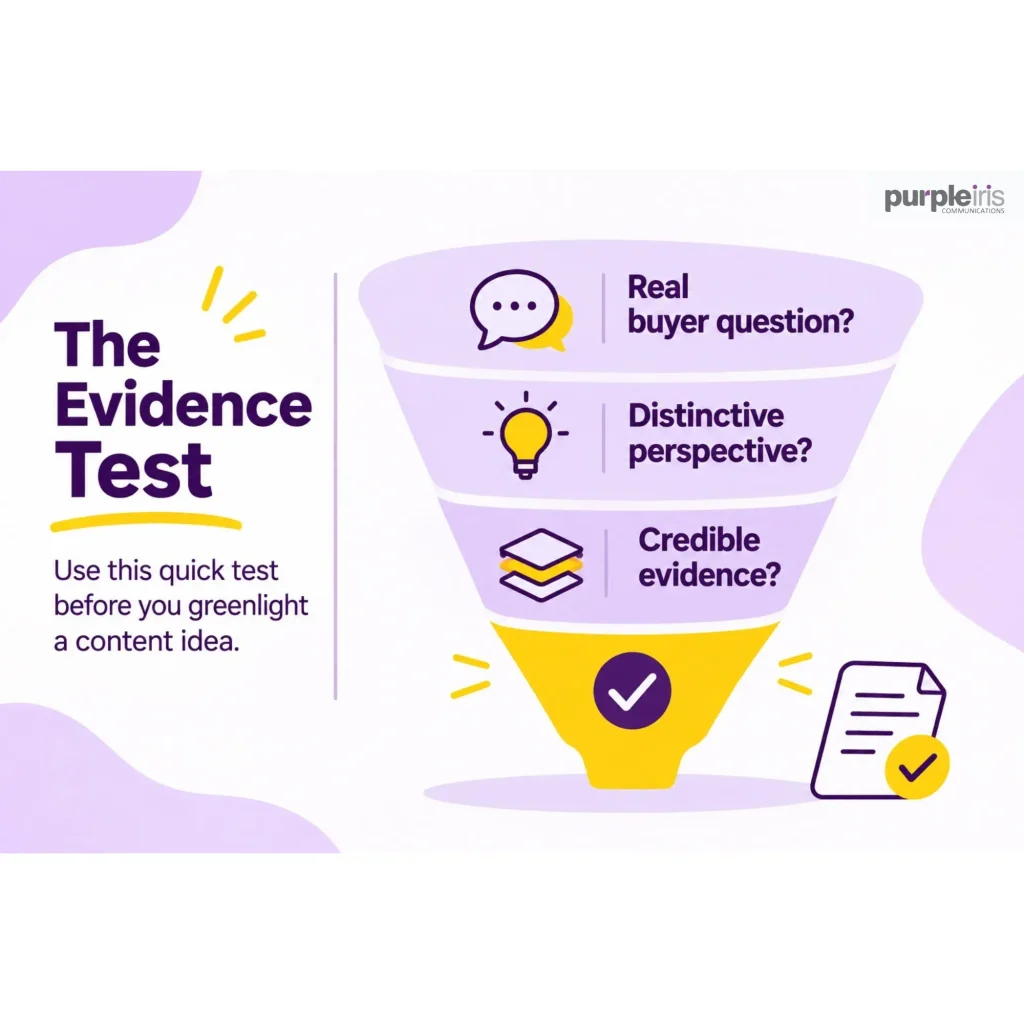
Research, search data, internal expertise, and AI-assisted ideation can produce more potential topics than a team can realistically execute. Prioritization turns that collection of ideas into a set of deliberate investment decisions.
Evaluate new ideas alongside existing assets that need improvement. A high-value opportunity may involve refreshing an established article, consolidating overlapping pages, or producing a new resource to address an important buyer question.
Use the following framework to compare potential work.
Content prioritization scorecard
| Criterion | Assessment question |
| Business impact | How directly does the opportunity support a business objective? |
| Audience importance | How important is the question to the intended reader? |
| Coverage gap | Is the information missing, outdated, or inadequate? |
| Differentiation | Can the organization offer a credible, distinctive perspective? |
| Evidence readiness | Are the necessary research, expertise, and supporting proof available? |
| Effort | What time, specialist input, approvals, and production resources are required? |
Teams can rate each criterion on a consistent scale, such as 1 to 5, and assign weights to reflect their priorities. However, a numerical score should inform the decision rather than make it automatically.
Consider two hypothetical opportunities. The first is a broad industry article with substantial search interest but limited connection to the company’s expertise. The second is a focused implementation guide that addresses a recurring objection raised during sales conversations.
The first may offer greater reach. The second may provide more direct support for a commercially important decision. The right choice depends on the objective, audience, available evidence, and resources.
Use a scorecard to determine whether each opportunity should be:
- Prioritized: It addresses an important need and merits investment.
- Improved: An existing asset can be strengthened more efficiently than a new one can be created.
- Deferred: The opportunity may be worthwhile, but other priorities or dependencies come first.
- Rejected: The topic lacks a clear purpose, sufficient evidence, or a credible connection to business goals.
This approach prevents the content marketing plan from becoming a list of everything the team could publish.
It also helps explain decisions to stakeholders. If a team defers a topic with high search demand, it should be able to explain why another opportunity offers greater strategic value.
For a related examination of content investment and buyer intent, see Why Most B2B Content Fails Before the Decision.
Step 5. Turn Priorities Into a Content Marketing Plan
Once priorities are established, translate them into a roadmap that identifies what needs to happen, in what order, and why.
The roadmap connects strategic decisions to execution. The editorial calendar then coordinates that work through owners, deadlines, dependencies, review stages, and publication dates.
For every planned asset, document the following:
| Planning field | What to record |
| Objective | The business or audience need the asset supports |
| Intended reader | The role, audience, or buyer context |
| Core question | What the asset must help the reader understand or decide |
| Strategic pillar | The theme the asset reinforces |
| Format and distribution | The appropriate format and how it will reach the audience |
| Inputs | Required research, SME interviews, source material, or customer evidence |
| Internal links | Relevant articles, resources, and commercial pages |
| Ownership and timing | Responsibilities, deadlines, and dependencies |
| Measurement | The indicators that will be reviewed after publication |
A content marketing plan should also account for work that does not involve creating something new. Existing articles may need updating, strong insights may be suitable for another format, and redundant pages may need consolidation.
The roadmap should remain responsive to new evidence. A calendar provides coordination, but it should not force a team to publish an asset simply because it was scheduled months earlier.
If an upcoming launch changes the company’s priorities or sales teams identify a critical new buyer concern, the team should be able to adjust the sequence of work.
For practical guidance on coordinating deadlines and publication, read 5 Things to Remember When Creating a Content Calendar and Business Blogging: Putting the Right Strategy and Plan in Place.
Step 6. Align Brand Messaging and Establish Editorial Standards
A content strategy determines what an organization should communicate. A messaging framework establishes the central narrative and the evidence that supports it. Editorial guidelines help contributors express that narrative consistently across different assets and channels.
These components work together.
A website might describe the company in terms of efficiency, an executive’s thought leadership might emphasize innovation, and a sales presentation might lead with risk reduction. Each message may be valid, but the organization’s value can become difficult to recognize if the relationship between those messages is unclear.
A practical messaging framework should establish four foundations:
| Element | Key question |
| Audience | Whom does the organization serve, and what matters to them? |
| Value proposition | What does the organization help customers achieve? |
| Differentiation | What makes its approach or expertise distinct? |
| Supporting evidence | What research, customer outcomes, capabilities, or examples substantiate the claims? |
The framework should provide consistency without forcing every asset to use identical language. A technical guide, executive article, case study, and service page will need different levels of detail, even when they express the same central positioning.
It should also make evidence requirements explicit. Contributors need to know which claims are approved, where supporting proof can be found, and when a statement requires additional validation.
To put these principles into practice, use the Messaging House Framework: Ready-to-use Template for Brand Messaging. This downloadable workbook helps teams organize their core messages, supporting evidence, and channel-specific communication, with practical exercises for reviewing messaging consistency.
For more on identifying when your existing narrative needs attention, read 7 Signs You Need a Brand Messaging Refresh and The Psychology Behind B2B Messaging.
Editorial guidelines translate those strategic decisions into working standards. They should define voice, terminology, formatting, sourcing, factual accuracy, evidence, review requirements, and publication readiness.
As more internal specialists, external writers, editors, and AI tools contribute to a content program, shared standards reduce inconsistent messaging and subjective review.
Governance should clarify who owns each decision, who supplies expert input, which approvals are necessary, and who is accountable for the published asset. The process should reflect the organization’s scale without adding unnecessary administrative work.
Step 7. Plan Distribution and Measure the Results
A content strategy should account for how each asset will reach its intended audience and what the organization expects it to accomplish after publication.
A useful guide might be distributed through organic search, email, LinkedIn, executive communications, or sales outreach. A report might support a webinar, a series of specialist articles, and conversations with prospective customers.
The right channels depend on the audience, the purpose of the content, and how readers prefer to access information.
Repurposing can extend the usefulness of an existing asset. A research report might become an executive summary, a practitioner-focused article, and a presentation for a customer event. Each adaptation should provide value in its new context instead of merely reproducing the original material.
Distribution and repurposing should therefore be planning decisions, not tasks added after production. Our article on Repurposing Content: Tips on How to Maximize Value explores this further.
Measure performance against the original objective.
| Objective | Useful indicators |
| Improve organic visibility | Relevant impressions, clicks, rankings, and visibility across priority topics |
| Improve engagement | Use of priority resources, meaningful interactions, and return visits |
| Generate qualified enquiries | Relevant enquiries, conversion rates, and enquiry qualification |
| Support sales conversations | Sales team usage, buyer feedback, and evidence that content addresses recurring questions |
| Strengthen positioning | Feedback from customers and sales teams, and consistency across important assets |
No single metric establishes whether an entire content strategy is working. A page can attract substantial traffic but have limited relevance to qualified buyers. A specialist guide may attract a smaller audience yet help prospects evaluate an important implementation decision.
Establish a baseline before launching a new initiative. Agree on the measures of success, review performance at a suitable interval, and use the findings to decide what to improve.
If an article attracts the intended readers but they do not engage with its supporting resources, examine the relevance of its internal links and next steps. If a page attracts the wrong audience, revisit its positioning and search intent rather than assuming that more promotion will solve the problem.
Measurement should inform the next decision. Reporting publication volume or traffic without learning from the results limits its value.
Where AI Fits Into a B2B Content Strategy
AI can support research, topic exploration, outlining, summarization, content adaptation, and routine editorial checks. It can also help teams organize large content inventories and identify assets that may need further review.
Its usefulness depends on the decisions and standards that govern the work.
The Content Marketing Institute’s 2026 B2B research found that 89% of B2B marketers use content creation tools for generating or optimizing written content. Among marketers using AI for content creation, 61% did not report improved content performance. Productivity and operational efficiency were more commonly reported benefits.
The distinction matters for planning. Faster production does not automatically mean that the right topics are being selected, the organization’s perspective is distinctive, or the finished assets help buyers make decisions.
A content strategy should establish where AI can support the workflow, which claims require verification, what information must come from subject-matter experts, and who approves the final work.
Google’s guidance on creating helpful, reliable, people-first content similarly emphasizes original value, accuracy, expertise, and satisfying the reader’s needs. It explicitly advises against writing to an arbitrary word count simply because it is believed to influence rankings.
For a broader perspective on how distinctive expertise contributes to brand visibility and authority in AI-driven search, explore From Visibility to Authority: Building B2B Influence in the Age of AI Search. The guide shows how organizations can build stronger associations with the subjects they want to be known for and identify signals of growing authority.
AI should fit within a well-defined content operation, with clear accountability for accuracy, relevance, evidence, and editorial quality.
Build a Content Operation That Makes Better Decisions
A strong B2B content strategy gives teams a clear basis for deciding what to communicate, which audiences to serve, and where to invest their effort. It connects existing assets, buyer needs, strategic priorities, messaging, execution, and measurement in one practical framework.
The process starts with an honest assessment of what exists. Business objectives and buyer questions reveal the gaps. Prioritization determines what deserves attention, and a clear roadmap translates those decisions into work. Consistent messaging, editorial standards, relevant distribution, and meaningful measurement help the organization improve over time.
For teams that need to establish this foundation, Purple Iris’s content consulting services cover content audits and diagnostics, strategy and prioritization, messaging and narrative development, and editorial guidelines.
The right starting point is not another list of topics. It is a clear understanding of what your content needs to accomplish, where the current approach falls short, and which decisions will make the greatest difference.
CTA: Ready to bring order to your content ecosystem? Click here.
Frequently Asked Questions About B2B Content Strategy
What should a B2B content strategy include?
A B2B content strategy should connect business objectives, audience needs, positioning, content pillars, prioritization, formats, distribution, ownership, and success measures. Depending on the organization’s requirements, it may also include a content audit, messaging framework, editorial guidelines, and a content roadmap.
How do you create a content strategy when a team has limited resources?
Start by auditing existing assets and identifying the buyer questions most closely connected to business priorities. Prioritize opportunities based on audience value, business impact, evidence, and effort. Improving or repurposing existing content may be more useful than commissioning additional assets.
How often should a content strategy be reviewed?
Review the strategy at regular intervals, such as quarterly, and when material business changes warrant it. A new product launch, market expansion, repositioning, or shift in buyer priorities may require changes before the next scheduled review.
How can a content strategy improve SEO?
A content strategy helps align content with relevant audience questions, identify coverage gaps, reduce unnecessary overlap, and connect related pages. It can improve the usefulness and coherence of the content library, but search performance also depends on technical SEO, competition, authority, and other factors.
Does a company need a content strategy if it already has a content marketing plan?
A plan coordinates activities, assets, and timelines. A content strategy establishes why those activities matter and how priorities should be chosen. If the plan lacks a clear connection to business goals and audience needs, strategic direction can help the team make better use of its resources.
References:
https://contentmarketinginstitute.com/b2b-research/b2b-content-marketing-trends-research
https://developers.google.com/search/docs/fundamentals/creating-helpful-content