The struggle to keep employees engaged continues. Gallup’s latest global data shows that just 20% of employees worldwide were engaged at work in 2025, down from 23% in 2022 and 2023.
Engagement is shaped by more than one factor. Leading research links it to workplace conditions such as clear expectations, the resources to do the job well, recognition, opportunities for development, having a voice at work, and a clear connection between an employee’s work and the organization’s purpose.
Communication plays a key role, though it alone cannot compensate for poor leadership, weak management, or unfair policies. Communication does influence how employees understand workplace experiences, including what is expected of them, how their work connects to a larger purpose, and what the organization is trying to achieve.
That makes how organizations communicate more consequential than it might seem. When communication needs to turn abstract values, strategy, and change into something employees can understand and relate to, storytelling becomes a useful device.
The evidence in favor of storytelling is still emerging, though it cannot be taken as a universal engagement fix. Recent research suggests that organizational narratives can help people make sense of their experiences and actions within organizations.
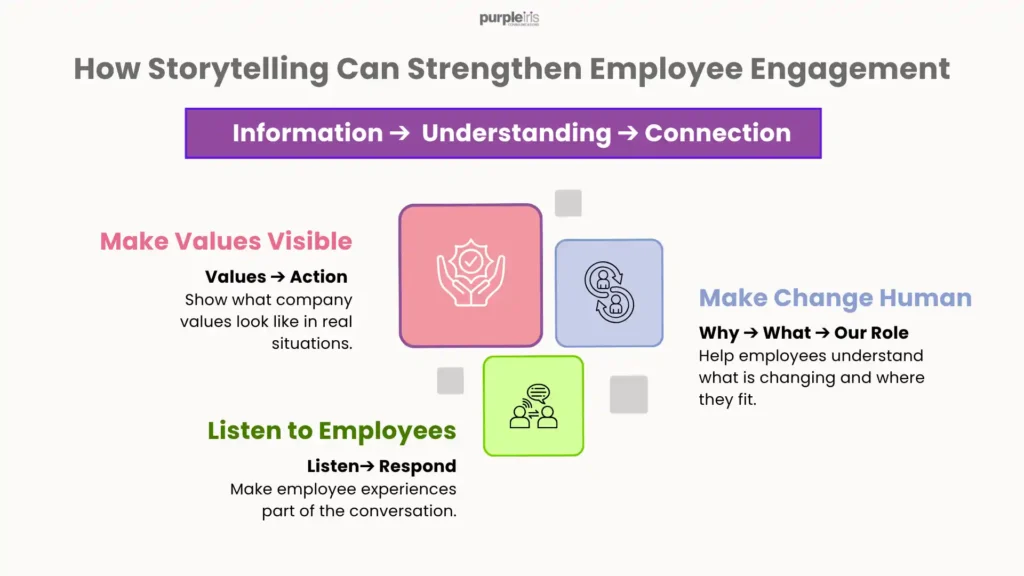
Make values visible
Consider the difference between a company saying, “We put customers first,” and telling the story of an employee who stayed with a difficult customer problem though it fell outside the team’s standard process.
The first is a principle. The second is an action on the ground.
That distinction matters because meaning at work is not created by slogans alone. Everyday actions bring it alive.
A 2024 study in Switzerland found that perceptions of an organization’s public value were positively associated with employee engagement. In this case, the researchers argue that an organization’s public value can provide employees with a source of meaning.
Stories can give that meaning a human context.
Together, the research findings suggest a useful role for storytelling in values communication and connecting abstract principles to situations employees can recognize.
Give change a human context
An employee rarely experiences transformation as a neat sequence of announcements. They experience uncertainty, new expectations, competing priorities, and decisions that make sense only after the fact.
A recent study on organizational narrative building shows how storytelling can be used. In this 2025 California Management Review study, researchers examined five corporate executives whose organizations had undergone major change.
In two of the five cases, executives described using a version of the hero’s journey to engage employees during the transformation. The authors also make an important caveat: research connecting the hero’s journey specifically to corporate change remains limited.
The distinction matters because storytelling does not remove the reasons employees may resist change. It can, however, give the change a structure: here is the problem we faced, here is what we tried, here is what changed, and here is the role employees have in what comes next.
Instead of asking employees to follow the organization’s transformation story from the sidelines, the narrative gives them a place inside it.
The strongest stories show, don’t tell
The easiest way to tell an internal story is to provide the conclusion before the audience has experienced the situation: “Our team demonstrated incredible resilience,” “This was a powerful example of collaboration,” or “We are thrilled by how everyone embraced the change.”
A more credible approach is to take employees through the situation and let them decide what they feel about it. They are more likely to recognize themselves in a story when communication describes a real situation rather than offering a conclusion with an intended emotion or lesson.
A 2024 Safety Science study based on interviews with leaders and employees identified nine attributes associated with effective storytelling, including relatability, realism, structure, and descriptiveness. Effective leader storytelling was associated with outcomes including trustworthiness, approachability, safety knowledge, motivation, and behavior.
For employee communications, the practical implication is straightforward: make the experience concrete.
Describe what happened. What did the person see? What decision did they have to make? What happened next?
Think of it as the “what’s happening camera.” Show what a camera could capture. Leave room for the audience to make the connection themselves.
That is very different from manufacturing an emotion and attaching it to the story.
Limitations of a broadcast-only strategy
If organizations only tell employees stories but rarely listen to the stories employees are already living, they may simply be creating a more polished form of one-way communication.
A 2025 systematic review synthesized 256 longitudinal studies of employee voice, involvement, participation, and silence, arguing that employee voice needs to be understood as something that develops over time within organizational contexts and processes.
Another study found that employees who felt their supervisors listened to them were more likely to engage in voluntary behaviors that helped their colleagues and the organization, with motivation and job satisfaction partly explaining the relationship.
This changes what a storytelling strategy should look like.
Instead of beginning with, “What story should we tell employees?” begin with, “What are employees experiencing that we haven’t heard yet?”
Ask for stories about difficult decisions, moments when a value was tested, customer problems, unexpected successes, and the friction created by change.
The point is not to only collect feel-good anecdotes, but also make the employee experience visible.
Build a story culture, not a story campaign
A story culture treats employee stories as an ongoing part of how an organization listens, communicates, and responds, instead of content created for one-off campaigns.
- Stories are gathered continuously. They emerge from everyday work, not just from moments selected for an internal campaign.
- Stories travel upward as well as downward. Leaders share the organization’s perspective, but employees also have ways to tell leaders what they are experiencing on the ground.
- Not every story is inspirational. Friction, mistakes, uncertainty, and disagreement are part of organizational reality. Making room for those stories can lend more credence to internal communication than a steady stream of success stories.
- What changed. When employees share a problem or experience, they should be able to see what happened next, whether a process changed, a concern was addressed, or a decision was reconsidered.
The outcomes that such a culture enables are the most important. Without that, organizations risk creating a “storytelling theater” that just collects employee stories and moves on without acting on what those stories reveal. The result can look like listening without giving employees evidence that they were heard.
Measure the outcome, not the attention
A video with a high completion rate or high click-through rate tells you employees engaged with the asset. Neither tells you whether they understood a strategic change more clearly or felt more connected to the organization.
So measure storytelling against the job you gave it.
If the story was meant to explain a change, test whether employees now understand the change better. If it was meant to reinforce a value, look for evidence that the value shows up in decisions and behavior over time. If it was meant to build connection, use an established engagement or organizational measure rather than treating views and likes as proof of impact.
The goal then becomes telling stories that help employees understand what the organization stands for, what it is becoming, and where they fit.
At Purple Iris Communications, we help organizations turn internal communication into something employees can connect with, not just consume. From cultural storytelling and leadership communication to employee engagement campaigns, we create communication that reflects the realities of your workplace, strengthens trust, and gives employees a reason to pay attention. Let’s make your internal communication feel human again.
References:
Gallup, State of the Global Workplace 2026
Narratives in Organizations: A Review and Future Directions
Connecting value creation for society with work engagement
Quest for Success: The Hero’s Journey Narrative in Corporate Change Management
Time to voice? A review and agenda for longitudinal employee voice research