AI can help B2B marketing teams research, write, and adapt campaign content faster. The harder task is deciding what is worth saying, what evidence will make the message credible, and what each asset should help a buyer do next.
A campaign can generate engagement and still leave buyers unsure how to evaluate a solution. A blog may attract the right audience but offer no distinct perspective. A brochure may explain features without establishing business value. A case study may describe a successful project without answering the questions a prospect would ask before choosing a vendor.
The Content Marketing Institute’s 2027 B2B Content and Marketing Trends research found that 88% of B2B marketers use AI-powered content creation tools. While 78% said speed was AI’s biggest contribution, only 17% cited improved quality. This makes the decisions around positioning, evidence, and editorial quality more important, not less.
This blog explores how to plan campaign content around buyer needs, maintain a consistent message across assets, and assess whether communications is helping buyers make decisions.
What is B2B marketing communications, and how does it differ from demand generation?
B2B marketing communications covers the messages and assets a business uses to explain its value to customers and prospects. It includes brand positioning, product messaging, campaign content, social media, sales material, and other communication across the buyer journey.
Demand generation is the program that activates those messages through audience targeting, campaigns, channels, and conversion paths. Marketing communications establishes what the business needs to communicate and gives demand generation the assets to do it.
The two functions work together, but they have different responsibilities.
| Marketing communications | Demand generation |
| Establishes what the business wants its audience to understand | Determines which audiences and accounts to reach |
| Develops positioning, messages, and campaign narratives | Plans campaigns, channels, and audience engagement |
| Creates content, campaign assets, and sales collateral | Uses those assets to attract, engage, and convert prospects |
| Maintains consistency across customer touchpoints | Measures campaign engagement and demand outcomes |
A weak set of assets can undermine a well-funded demand generation program. Strong content without a clear distribution plan may never reach the people who need it. Marketing communications should therefore inform campaign planning from the beginning, rather than enter only when the team needs something written.
What does each stage of the buying journey need from campaign content?
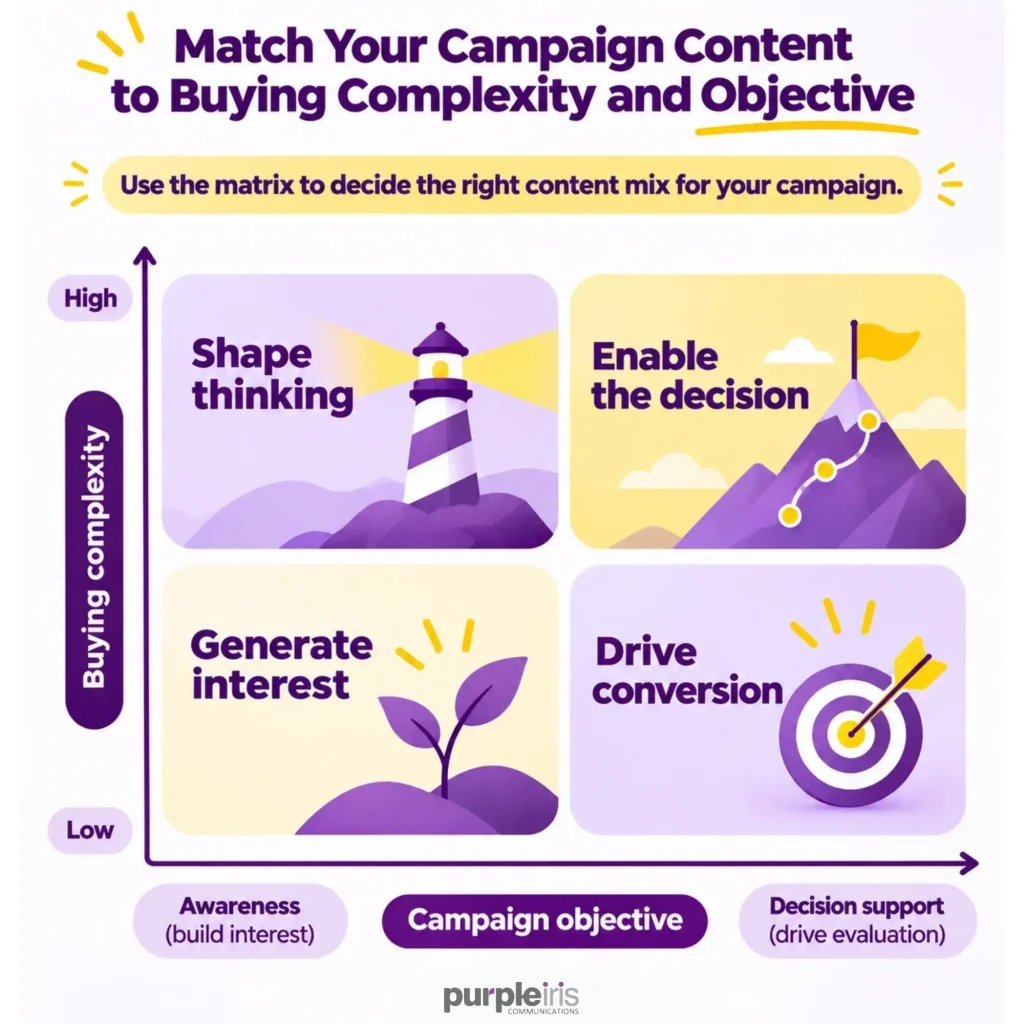
B2B buying groups need content that helps them understand a problem, compare options, assess a vendor, and build internal agreement. These are four jobs campaign content should perform: Attract, Educate, Prove, and Equip.
They are not necessarily consecutive stages. Different stakeholders may be evaluating technical feasibility, business value, and implementation risk at the same time. The test for each asset is whether it answers a relevant question and helps someone take a useful next step.
| Function | Buyer’s question | What the content needs to provide | Where content tends to stall |
| Attract | Is this problem worth solving now? | A distinct point of view, industry evidence, and business implications | It earns attention but gives no reason to act |
| Educate | What are our options? | Comparisons, decision criteria, use cases, and practical guidance | It describes the category without helping buyers evaluate trade-offs |
| Prove | Can this vendor deliver for a company like ours? | Customer evidence, implementation detail, and verified outcomes | Claims are easy to make, but evidence is missing or hard to check |
| Equip | How do I get this approved internally? | Business cases, executive briefs, ROI narratives, and objection-handling material | The buyer is interested but cannot build internal support |
Attract
A draft assembled from top-ranking pages can restate a category without giving readers a reason to think differently. Useful attract-stage content brings a clear perspective to a problem buyers already recognize and explains why it matters to their business.
For example, an article on supply chain costs could connect demand volatility and inventory imbalances to working capital and service levels, rather than simply list common supply chain challenges. Our article on content that generates leads explains why attracting attention and creating buying intent are different jobs.
Educate
Buyers need help comparing approaches against their own constraints. A guide to automation, for instance, should explain where rule-based automation, RPA, and AI-driven automation are suitable, what each requires, and where the trade-offs lie. That level of specificity depends on product knowledge, customer insight, and access to subject matter experts.
Prove
Claims about efficiency, cost savings, or business transformation need evidence. A useful case study explains the original problem, the work undertaken, and the measurable result. It should also give enough context for a prospective customer to judge whether the experience is relevant to their own situation.
Different case study formats serve different purposes. Read our guide to five types of B2B case studies and when to use each, and the article on case study mistakes that weaken buying decisions.
Equip
An interested buyer may still need approval from finance, IT, procurement, legal, or senior management. The internal champion needs material that explains business value, addresses objections, and helps colleagues assess the investment.
Gartner’s 2026 survey of 645 B2B buyers found that 67% prefer a sales-rep-free experience, while 69% prefer to validate AI-generated insights with sales representatives. Buyers therefore need information they can access independently, alongside credible material and expert support when they need reassurance.
Executive briefs, sales decks, one-pagers, ROI narratives, and implementation summaries can help champions make the case internally. The pricing, product, and implementation details these assets require should be checked with the teams that own them. Purple Iris’s marketing collateral service covers decks, one-pagers, and related materials.
How can ABM content stand out from generic demand content?
Account-based marketing (ABM) content is developed for the buying group within selected accounts. The account tier determines how much research and tailoring each asset needs: 1 content serves a broader group with shared needs, 1 content is adapted for a smaller group of similar accounts, and 1:1 content is built around an individual strategic account.
The central value proposition and supporting facts should stay consistent. Personalization should make the message more relevant, not create different promises for different stakeholders.
Start by identifying what each stakeholder needs to understand. An economic buyer may need the business case and financial implications. A technical evaluator may need integration, security, and implementation details. An operational leader may want to understand workflow changes and day-to-day impact. An internal champion needs concise material to explain the case to colleagues.
Use account research and sales conversations to establish these priorities. Industry examples, relevant use cases, and customer evidence can make content more specific, but account-level claims must be grounded in reliable information. Adding a company name to generic copy is not meaningful personalization.
Our articles on content formats for ABM campaigns and B2B ABM content strategy explain how to match assets to account and stakeholder needs.
How do you get more from each campaign without diluting it?
Plan the assets that will come from a campaign’s core piece in the brief, before anyone starts writing. Emails, social posts, landing pages, and sales one-pagers should carry the same central argument while giving each audience or format something useful of its own.
Repurposing is not a volume target. A case study, for example, could become an executive summary focused on business outcomes, a technical brief about implementation, or a social post built around one practical lesson. Each version should serve a different reader or question rather than repeat the original in a shorter format.
Refresh an asset when its central argument remains useful but its examples or evidence have dated. Adapt it when the audience or format changes. Retire it when the underlying claim, product information, or proof no longer holds. Do not repurpose content written for a different buyer role without changing the emphasis and evidence.
Our content repurposing tips cover ways to refresh and localize older material.
How do you know campaign content is working?
Agree on what each asset should achieve before production, then assess it against the job it is meant to do. Early indicators show whether it reached the right people. Sales and account indicators can help establish whether it supported evaluation or addressed a buying concern.
| Function | Early signal | Downstream indicator | Question to agree before production |
| Attract | Repeat visits from target accounts | Share of target accounts engaged | Which audience should engage, and what should they read next? |
| Educate | Engagement with evaluation content by buying role | Progression to more specific solution material | Which decision should this help someone evaluate? |
| Prove | Case study views within open opportunities | Use by sales in active evaluations | Which buyer doubt should this answer? |
| Equip | Sales use of decks and one-pagers | Sales-confirmed progress on an approval question | Which objection or approval step should this support? |
Use consistent campaign tagging, CRM records, and sales feedback to connect engagement with account activity. Record when an asset is used in an active opportunity and what question it helped answer. Distinguish content-sourced opportunities from content-influenced opportunities where the data allows.
No single asset explains the progress of an entire deal. Distribution, product fit, pricing, and sales execution also influence results. Review the scorecard as a set and use it to improve the campaign, not to claim that content alone created the pipeline.
Where do marketing teams using AI get stuck?
AI can speed up research, drafting, and adaptation. It cannot decide which customer insight matters, whether a claim is defensible, or how the brand should differentiate itself. As production becomes faster, the bottleneck often shifts to the decisions and checks around each draft.
Senior judgment becomes the bottleneck
Senior marketers and subject experts are asked to review more drafts, verify claims, and correct positioning. When every asset depends on the same few people, review queues grow or quality checks become thinner. Clear briefs and review criteria help focus their time on decisions that need their expertise.
Weak inputs create avoidable rework
Important evidence often sits in customer conversations, proposals, product documents, and the knowledge of busy experts. Thin briefs and outdated source material lead to generic drafts and repeated corrections. Consolidate approved messaging, product facts, customer evidence, and terminology so writers have reliable inputs.
Assets drift from campaign goals
An asset can be accurate and on brand while answering the wrong buyer question. Give every writer the campaign objective, central narrative, intended audience, and next action. Editorial review should assess whether the asset advances the campaign, not just whether the writing is polished.
The brand speaks in several voices
Different contributors may use different prompts, reference material, and writing styles. A shared messaging source, editorial guidelines, and examples of approved copy help keep the website, sales deck, and campaign emails aligned. A messaging house framework can give teams a common reference for the core promise, supporting messages, and proof.
Use AI for research synthesis, gap analysis, structuring, proofreading, and consistency checks. Keep people responsible for the central argument, original perspective, customer context, evidence, and final editorial decisions. Our article on persuasive writing explores how to make a case without pushing the reader.
If the underlying messaging is unsettled, Content Consulting is a better starting point than simply increasing content production.
Where does outside help fit at each level of AI use?
AI readiness and content maturity are different things. A team can automate production and still have unclear messaging, weak proof, or limited access to subject expertise. The right support depends on where the process is breaking down.
| What the team is facing | What external support can provide |
| Capacity constraints | Production support for recurring and campaign-specific assets |
| Complex products or limited expert access | Research, interviews, and writing that translate technical information into clear buyer communication |
| Inconsistent messaging or review bottlenecks | Messaging frameworks, editorial standards, and quality control across assets |
Forrester’s 2026 B2B Brand and Communications Survey found that 93% of respondents used agencies in some capacity. However, the share expecting to increase agency spend on content creation and development fell from 41% in 2025 to 26% in 2026. This points to more selective agency investment, with teams looking for specialist expertise and execution support that complements their in-house capabilities.
Purple Iris works alongside in-house marketing teams and fits into their existing tools and review processes. The scope can range from taking on a specific set of assets to supporting a campaign’s research, messaging, and production.
What changes when a campaign is planned this way?
A well-planned campaign gives each audience a clearer reason to engage and gives sales material that can support real conversations. The benefits should be visible across the buying group and the marketing operation.
| Who notices | What should change |
| Buyers | Clearer answers at each stage, credible evidence, and material they can use to explain the decision to colleagues |
| Sales | Assets that address common objections and reinforce one story across the website, decks, and campaign emails |
| Marketing team | Fewer avoidable review rounds, better use of subject experts, and more time for strategic decisions |
Start with the brief. Agree on the buyer question, central argument, evidence, and intended next step before anyone opens a prompt. Interview experts early, appoint one owner for the message, and use the first finished asset to test the direction before scaling production.
That is the work Purple Iris does across Brand Awareness and Positioning, Demand Generation Assets, and Marketing Collateral. In one engagement, we delivered more than 30 communication assets in 10 business days for a digital transformation company’s global CSR milestone, bringing leadership, volunteers, NGO partners, and employees together around one narrative.
For campaigns that also need internal alignment, our Employee Communications team supports the internal side. PR and marketing agencies can also work with us through Agency Partnerships.
Frequently asked questions
Can you work with our existing AI tools and content workflow?
Yes. We work within the tools and review processes your team already uses, taking on the research, writing, or editorial stages where additional expertise or capacity is needed.
How much time will our team and subject experts need to give?
That depends on the campaign and the complexity of the subject. Typically, the team provides a briefing, access to relevant experts and source material, consolidated feedback on the first asset, and approval of product claims.
Can you support a campaign when our in-house team is short on capacity?
Yes. Teams can bring us in for a defined campaign, a specific group of assets, or recurring support during periods of high demand.
Will campaign content written this way hold up in AI search?
Content that answers buyer questions clearly, demonstrates expertise, and supports claims with reliable evidence is better positioned to be useful to both readers and AI-driven search experiences. Our B2B guide to winning visibility in AI search engines explains how to structure content for this environment.
References:
https://contentmarketinginstitute.com/b2b-research/b2b-content-marketing-trends-research