Start With the Communications Need
From broadcasting messages to inform and educate to elevating the employee experience and creating influence, expectations from employee communications have evolved significantly. In Gallagher’s 2026 Employee Communications Report, as many as 73% of the 1,300 communications and HR professionals surveyed said they wanted their function to operate as a strategic consultancy. Yet only 18% said that reflected their current reality.
The role of communications teams now extends beyond producing and distributing internal messages. They contribute to broader business priorities while helping leaders create clarity and workforces navigate change.
For leaders assessing how to strengthen their employee communications function, the agency-versus-in-house decision has therefore become more nuanced than choosing between two staffing models.
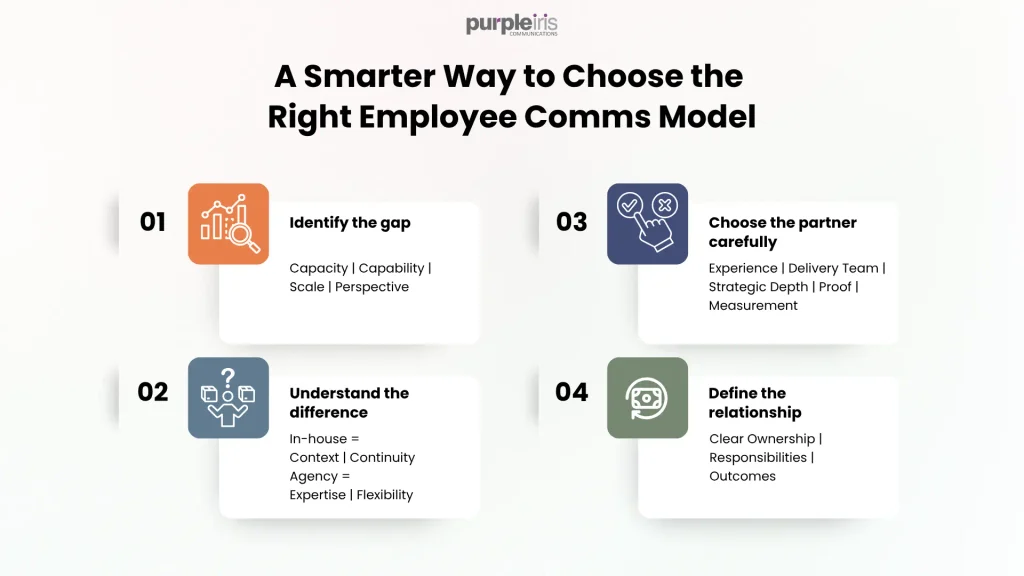
A good starting point is to identify what the internal team needs to own, and what capability it needs to add.
What an in-house team does best
An in-house employee communications team brings something an external partner cannot replicate: organizational context.
Internal communicators work close to leaders who set priorities, employees who receive messages, and stakeholders who shape how those messages are understood. They know the organization’s history, culture, sensitivities, and informal ways of working better than an external partner.
Over time, they also build relationships that make it easier to anticipate concerns, navigate approvals, and recognize when the same message needs to land differently with different audiences.
Their proximity matters most when communication involves complex decisions or significant organizational change. For instance, an internal team can connect a message to what employees already know, what leaders are trying to achieve, and the outcomes of similar exercises in the organization before.
What an employee communications agency does best
An employee communications agency’s value lies in being able to assemble different areas of expertise around a defined communications need. A single engagement may require strategic counsel, executive messaging, campaign development, creative content, and high-volume execution at different stages. An agency can bring those capabilities together without requiring the organization to build each one as a permanent internal function.
An external partner can also bring pattern recognition that is difficult to develop from within an organization. Experience across different communications challenges can help identify blind spots, question established assumptions, and introduce approaches that the internal team may not have considered.
But this model has a trade-off: context takes time to build. An agency must learn the organization’s business, culture, stakeholders, and communication history before it can operate with the same confidence as an internal team. The quality of the engagement therefore depends partly on how quickly the agency closes that context gap through onboarding, access, and collaboration.
The company plays an equally important role in closing this gap. The faster it gives the agency access to the right stakeholders, business context, existing communications, and relevant employee insights, the faster the agency can begin contributing with the necessary context.
Identifying capability gaps in both models
With communication demands growing, capability gaps can appear in either model. The issue is not always a shortage of people or expertise. Sometimes the problem lies in how that capability is structured and sustained.
- Internal teams can face a codification gap. Expertise may exist within the team but remain concentrated in individuals rather than documented in shared frameworks, processes, or tools. Gallagher’s 2026 Employee Communications Report found that more than half of teams lacked an agreed, codified standard for five of the seven strategic assets it examined (such as employee value propositions, strategic narratives, or manager toolkits), making those capabilities harder to share, scale, or measure.
- External partners can face a transfer gap. An agency may bring strong expertise to an engagement, but that expertise does not automatically become an enduring organizational capability. The value of the relationship can be limited if the internal team remains dependent on the agency to repeat the same processes or deliver the same work.
Leaders need to take a broader view while assessing the two models–where the organization can go beyond the capability that exists today and assess how well that capability can be shared, scaled, and sustained.
Employee Communications Agency vs. In-House Team: What Each Model Offers
| Area | In-house team | Employee communications agency |
| Organizational context | Deep and immediate | Developed through the engagement |
| Stakeholder relationships | Embedded within the organization | Built around the engagement |
| Specialist expertise | Based on existing team capabilities | Flexible access to specialist skills |
| Resource flexibility | Tied to internal capacity | Can scale with demand |
| External perspective | Less inherent | Built into the relationship |
| Short-term surge capacity | Requires internal reprioritization or hiring | Can be added around a defined need |
The comparison becomes more useful when organizations assess these differences against the capability they need to add instead of treating the choice as a competition between two models. The practical question is therefore: which of these capabilities does the internal team need to retain, strengthen, or add temporarily?
Define the Engagement Before You Bring in an Agency
Once the gap is clear, the next step is to define what an external partner needs to solve. A broad brief such as “improve employee communications” leaves too much open to interpretation.
Start by defining the business objective, audiences, scope, timeline, and expected role of the external partner. Is the agency being brought in to support a specific change initiative, provide specialist expertise, increase delivery capacity, or help strengthen an existing communications approach?
It is also worth defining what success will look like before the work begins. Gartner’s 2025 Internal Communications Primer emphasizes the importance of aligning employee communications strategy with business outcomes.
A well-defined brief gives both sides a clearer basis for scoping the work, setting expectations, and evaluating the engagement.
How to Choose the Right Employee Communications Agency
Responses to these five questions can help separate a capable partner from a good sales presentation.
1. Have they solved a similar communications problem?
Look for evidence involving comparable audiences, organizational change, leadership communication, employee engagement, or similar levels of complexity. Relevant experience matters more than the number of logos on an agency website.
2. Who will actually deliver the work?
The team presenting the pitch may not be the team managing the account. Ask who will provide strategic counsel, who will lead day-to-day delivery, and how much senior involvement the engagement will receive.
3. Can they work beyond the brief and become a thinking partner?
A production partner can execute what it is given. A stronger employee communications partner should be able to help shape the communication approach itself, from audience and message definition to leadership communications, storytelling, campaigns, and channel selection. Gartner’s research on internal channel mix recommends selecting channels based on communication goals rather than treating channel choice as a standalone decision.
4. Can they show how they work alongside internal teams?
Case studies should show the problem, the agency’s role, what it delivered, and what changed for the client. Client references can add another layer of validation by showing what the working relationship was like in practice, including responsiveness, collaboration, and consistency of delivery.
Purple Iris’ work with a global business process management company provides an example of the hybrid model in practice. The client retained its in-house communications function while Purple Iris worked as an extension of the team, supporting campaign conceptualization, executive communications, creative content, and employee campaigns. The engagement helped the client bring greater creativity and variety to its internal campaigns, improve the speed of content delivery, and free in-house resources to take on other responsibilities.
5. How will they measure success?
Ask what they will measure before the work begins. Content volume, email opens, and page views can indicate activity, but the agency should be able to connect communications to outcomes that matter for the brief, such as understanding, participation, adoption, or change readiness.
Decide What Stays In-House and What the Agency Supports
Once an agency is selected, the next decision is how responsibilities will be divided. The internal team should retain the areas where organizational context and stakeholder relationships are essential, including strategic priorities, leadership relationships, governance, and final decisions.
The exact division will vary by organization and scope, but the principle is consistent: assign each responsibility to the team best positioned to execute it and establish decision rights before work begins.
A clear allocation of responsibilities keeps an external partner from becoming another layer of coordination and allows each team to focus on the work it is best positioned to perform.
Choose the Capability Model, Not the Org Chart
Choosing an agency is only the beginning. The more meaningful test is what the partnership enables the organization to do after the work is underway. Does it make space for the internal team to establish clearer ways of working, stronger communication practices, or more capacity to focus on strategic priorities?
Such a rigorous test matters because the value of an external partner should extend beyond the immediate deliverables. The partnership should make the function more effective over time, whether by creating room for strategic work, strengthening execution, or bringing capabilities the organization does not need to build permanently.
Purple Iris Communications works alongside internal communications and HR teams that want to extend the function without building another layer of permanent capacity. By combining strategic communication with creative execution, we help teams strengthen leadership messaging, build employee engagement campaigns, and keep day-to-day communications moving, while the internal team stays focused on its broader organizational priorities.