

Winning more business can change the economics of delivery. According to a 2025 Agency Industry Report, 59% of agencies grew revenue, but only 31% improved their margins. The gap highlights an important consideration for growing agencies – onboarding more accounts and delivering them profitably do not always happen at the same pace.
Content delivery is where that tension often becomes visible. Every new account adds briefs, revisions, subject-matter requirements, and deadlines. As the account base grows, agencies also need to balance fixed team capacity, senior expertise, specialist talent, emerging AI-enabled workflows, and changing production volumes.
This doesn’t make growth a problem, but makes the way an agency structures its delivery model increasingly important.
A content operation that works effectively at one stage of growth may need greater flexibility at another. Therefore, producing more content is only a fraction of the solution. The key is to build a delivery model that can keep pace with business growth without adding the same level of cost and complexity.
When the Delivery Model Hits Its Limits
Agencies will have to take on more accounts at some point, and the content operation has to accommodate greater variation in workload and expertise. Four considerations become particularly important.
- Capacity and cost need to remain aligned: Content demand can fluctuate significantly across accounts and quarters, but payroll does not. During slower periods, agencies carry underutilized capacity; during heavy delivery cycles, they may end up paying more through freelancers or pulling senior people into execution.
- Senior talent needs room to focus on higher-value work: Senior strategists can find themselves spending hours sourcing freelancers, managing availability, reviewing drafts, and rewriting content that doesn’t meet the expected standard. Their time gets absorbed by keeping production moving instead of focusing on strategy and clients.
- AI is changing the production equation: Producing a draft is easier than ever, but getting that draft to a client-ready standard still requires domain understanding, depth, voice accuracy, and editorial judgment. The bottleneck simply shifts from creating content to reviewing and refining it.
- New business can expose the limits of a delivery model: Every time a new account enters the pipeline, the same cycle repeats. The agency is forced to either stretch its existing team, compromise on delivery quality, or turn away work it cannot absorb.
These friction points all stem from the same root cause: the content operation is not designed to flex with the agency’s growth.
Building Capacity Beyond Headcount
The instinctive response to rising demand is often to add more people. But for agencies, adding permanent capacity every time the pipeline grows can simply move the problem from delivery pressure to cost pressure.
A more flexible model separates core strategic capability from the variable layer of content production. The agency retains ownership of strategy, client relationships, and creative direction, while the delivery layer can flex around the requirements of each account. This allows capacity and expertise to be matched to the work at hand rather than forcing the internal team to absorb every increase in demand.
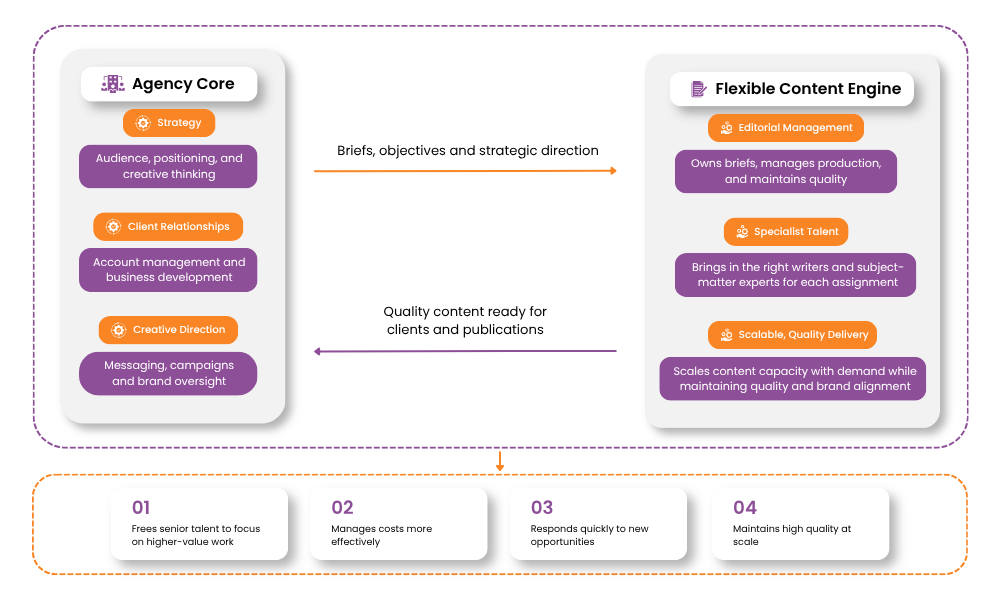
This is where an integrated backend content engine from an external partner becomes useful. Instead of requiring the agency build and manage every layer of delivery internally, it provides the operational capacity to extend the team where it is needed most.
For an agency, it is no longer another source of writers or production support. The partner becomes an extension of the delivery operation, taking on the coordination and quality-control work while working within the agency’s existing strategic and client-facing structure.
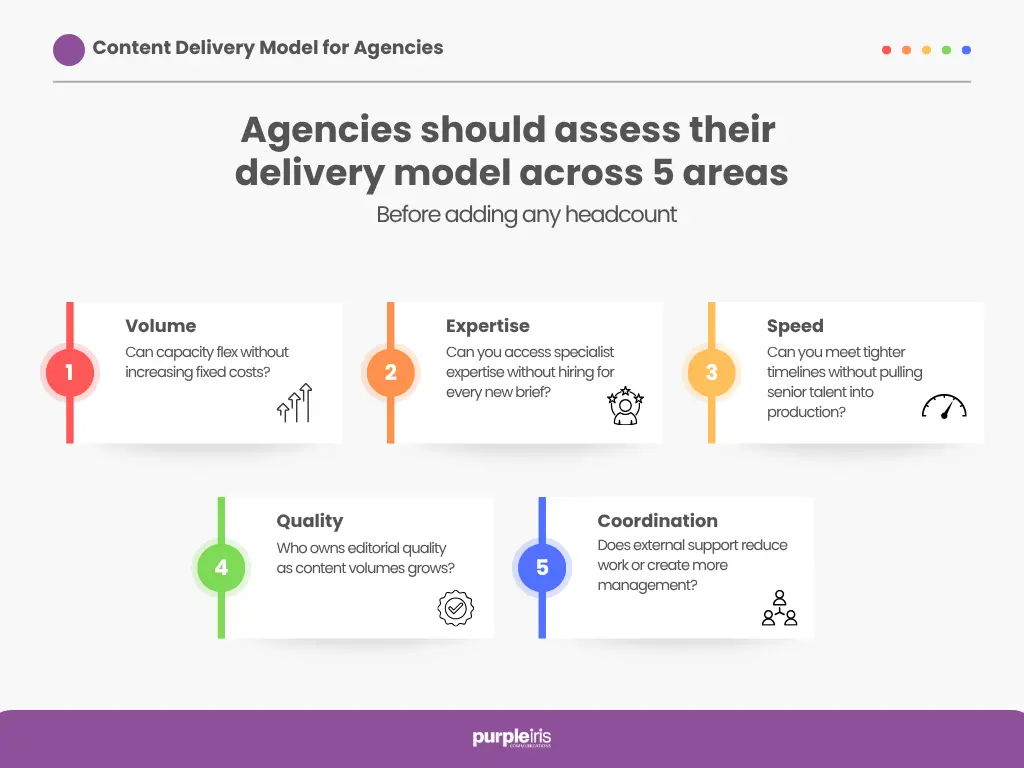
Case Study: Scaling a Startup PR Practice Without Adding Headcount
A Singapore-based integrated communications agency faced a similar challenge while expanding its startup practice. Thought leadership was central to its offering, but its founder clients often needed help turning their expertise into perspectives suitable for leading business and mainstream publications.
Purple Iris Communications worked behind the scenes as the agency’s editorial partner, handling founder interviews, identifying editorial opportunities, developing publication-specific storylines, ghost writing in the founder’s voice, and refining articles before submission. The work spanned fintech, AI, digital transformation, and workplace design, requiring sector-specific expertise across different assignments.
Within three months, nine thought leadership articles were published across six leading publications in Asia, including The Straits Times, The Business Times, Gulf News, BusinessWorld, YourStory, and Deccan Herald.
The engagement gave the agency an editorial layer it could draw on without having to build and manage the entire capability internally.
Building a More Strategic Delivery Model
As an agency grows, its content operation should not become another source of friction. The right support should make it easier to absorb new work, access the expertise a brief requires, and keeps delivery moving, without creating more coordination for the internal team.
At Purple Iris Communications, this is the operational shift we help agency leaders navigate. We work behind the scenes as an integrated editorial partner, taking on the work involved in producing expert-led, publication-ready content.
If you are balancing an ambitious growth pipeline with a delivery model that feels stretched, let’s talk. We can look at how your content operation works today and explore where a flexible editorial backend could extend your capacity without requiring you to build every capability in-house.
Frequently Asked Questions
What is the difference between a freelance writer pool and an integrated backend editorial partner?
A freelance pool provides execution capacity, but managing it requires your senior team to handle briefing, project tracking, quality control, and draft rewrites. An integrated backend editorial partner operates as an extension of your agency and takes full ownership of coordination, subject matter extraction, and publication-ready quality control while working invisibly within your existing workflow.
Why does winning new accounts often reduce an agency’s profit margins instead of increasing them?
Revenue grows with new accounts, but delivery costs can rise exponentially when relying solely on internal teams or fragmented freelancers. Adding permanent staff creates unbilled overhead during slower periods, while unexpected demand spikes force agencies to pay premium freelance rates or pull expensive senior strategists into day-to-day production work.
How does AI change the way agencies should structure their content teams?
AI has commoditized basic draft generation, which has raised client expectations for speed and depth while lowering their tolerance for generic content. Agencies can no longer rely on generalist writers to pull information off the web. The need of the hour are niche teams with high-level editorial judgment and domain expertise to synthesize complex topics into original, publication-ready perspectives.
Will using an external content partner affect our client relationships or agency identity?
No. Strategic direction, client communication, and overall account ownership remain entirely with your internal team. The partner works behind the scenes, adapting to your agency’s processes, brand voice guidelines, and editorial standards.
When is the right time to move from an in-house production model to a flexible backend model?
The shift makes sense when workload volatility forces senior strategists to spend significant hours on production churn, or when winning new accounts regularly creates immediate capacity gaps that strain your existing team.