

There was a time when writing well was enough to stand out.
AI has changed that equation. Today, almost anyone can generate a polished LinkedIn post or a white paper in no time.
When everyone has access to the same tools, the process you apply to the writing, and not the output itself, becomes your competitive advantage.
What separates content people trust and act on comes down to a set of human capabilities that AI can imitate on the surface, but has no real access to what lies underneath.
These are not newly discovered attributes. But AI has made them far more valuable today.
In this article, we clear the air around some of these concepts that have become buzzwords in the market, whether you are working to shape new thinking, drive demand, grow authority, or rally employees behind your brand.
1. Storytelling
Until recently, ‘business storytelling’ might not have had many takers. Now, it’s a great time to be a storyteller in the corporate world. The Wall Street Journal finds that LinkedIn job postings in the US with the term ‘storyteller’ doubled last year.1
Business storytelling uses a narrative style that turns facts, decisions, and experiences into what people can easily understand, remember, and act on.
It has found its place in different forms of communication. For instance, building a brand with the customer as the protagonist, and not the product, or turning dry subjects such as compliance into something easy to consume for employees through relatable scenarios, instead of listing down the rules.
Imagine two companies announcing a product.
The first writes:
After 18 months of development, we are excited to launch our AI platform.
The second writes:
Six months into development, customer interviews forced us to admit we were solving the wrong problem. We scrapped half our roadmap, rebuilt the product around explainability, and eventually reduced implementation time by almost 50 percent.
Both companies reached the same milestone. Only one revealed how it reached there: a situation, a turning point, a decision, and an outcome. That makes it human and memorable.
To add storytelling to your content, try this:
- Start with the change or turning point, rather than the beginning of the journey.
- Identify the tension, challenge, or uncertainty that made the outcome meaningful.
- Look for the decision, realization, or action that changed the direction of the story.
- Use specific details, observations, and experiences that could only come from being close to the work.
2. Authenticity
Authenticity has become one of those words brands use so often that it can mean almost anything. Yet audiences clearly care about it.
A 2025 Clutch study found that 97% of consumers say authenticity influences their brand decisions, while 85% have purchased from a brand because it felt authentic.2 The research also found that transparency, consistency, a distinct brand voice, and visible human involvement are among the strongest signals of authenticity.
Authenticity is when what a brand says, how it behaves, and what people experience from it all tell the same story.
That goes beyond sounding conversational or giving a founder a more personal voice. It shows up when the values in your content are visible in your decisions, customer interactions, and employee experiences.
Imagine an HR technology company that regularly talks about transparency and putting people first. Its LinkedIn posts celebrate open communication, and its leadership team frequently speaks about listening to employees.
Then the company goes through a restructuring.
Employees hear about it through rumors before leadership communicates anything officially. Questions go unanswered for days. Managers have little context to share with their teams.
The external brand still sounds authentic, but the internal experience tells a different story. That gap is where authenticity breaks.
Now consider a company that communicates the difficult decision directly, acknowledges what it knows and what it does not, gives managers enough context to answer employee questions, and keeps the same principles visible in its external communication.
That consistency makes the brand believable.
And it is worth noting what the Clutch research says about the opposite: 56 percent of consumers identify a mismatch between a brand’s values and its actions as a fast way to damage authenticity, while 87% say they would stop supporting a brand if its actions violated its stated values.
To build authenticity into your communication, try this:
- Define the beliefs and principles your brand practices, rather than starting with tone of voice.
- Look across your website, social content, sales material, leadership communication, and employee comms. Do they reflect the same thinking?
- Share real experiences and lessons, including things that did not work, where they add genuine value.
- Before publishing a claim about your culture or values, ask: “Would an employee or customer recognize this from their actual experience?”
3. Systems Thinking
A business problem rarely exists in isolation. The visible event is usually a part of a larger issue. Understanding it requires ‘systems thinking’, which is an important component even in communications.
The Iceberg Model of systems thinking breaks this down into four levels: events, patterns, underlying structures, and mental models. The idea is simple: instead of reacting to what just happened, look at what has been happening over time, what structures are producing that pattern, and what beliefs or assumptions are keeping those structures in place.
Systems thinking is the practice of looking beneath an event to understand the patterns, structures, and assumptions shaping it.
How does it apply to communications? Suppose a cybersecurity company notices that demo requests have fallen by 30%.
At the event level, the content team sees a drop in leads and starts planning more lead-generation content.
A systems thinker goes deeper. Is this part of a longer pattern? Have buyers been spending less time on the website? Are they arriving after researching vendors through AI tools? Has the company’s messaging kept pace with how buyers now evaluate cybersecurity products? Are sales teams hearing objections that marketing has not yet addressed?
The writer is no longer simply creating content around the problem. They are investigating the system behind the problem.
That could lead to a very different piece of content: perhaps an article about how cybersecurity buyers are changing their evaluation process, a case study that answers the implementation questions prospects now ask, or a thought leadership piece challenging the company’s old assumptions about how buyers discover vendors.
To bring systems thinking into your content, try this:
- Start with the event, then ask what pattern sits behind it.
- Look for the relationships between different parts of the business, rather than analyzing one metric in isolation.
- Talk to sales, customer success, product, and employees who experience the problem firsthand.
- Examine the assumptions your audience, industry, or organization may be taking for granted.
- Build content around the underlying problem you uncover.
4. Judgment
As AI takes on more of the execution, the human role is moving further upstream: deciding what should be done, what should be trusted, and what needs another look.
Microsoft’s 2026 Work Trend Index, based on research with 20,000 AI users across 10 countries, found that 46% ranked critical thinking, defined as analyzing information objectively and making a reasoned judgment, among the human skills becoming more important as AI takes on more work. Quality control of AI output topped the list at 50%.3
That matters particularly in communication, where the technically correct answer is not always the right message.
Judgment is the ability to bring knowledge, experience, context, and values together to make a sound decision when there is no obvious right answer.
Consider a company facing a major product outage. The communications team has all the facts, and an AI tool can turn those facts into a polished statement within seconds.
But what should come first? The technical explanation? An apology? The impact on customers? What must customers do next? What the company still does not know? There is no universal formula.
An experienced communicator considers the severity of the incident, what customers already know, what remains uncertain, the business implications, and what the audience needs most at that moment.
The resulting message may be shorter, more transparent, or less defensive than the first draft.
The facts provide the material. Judgment determines what to do with it.
To bring judgment into your communications, try this:
- Look beyond accuracy and ask whether the message is appropriate for the audience, context, and objective.
- Make deliberate choices about what to include, what to leave out, and what deserves emphasis.
- Challenge claims that sound convincing but lack enough evidence, context, or nuance.
- Consider how a message could be interpreted differently by different audiences.
5. Specificity
There is an old writing principle that has survived every change in publishing, from print to social media to AI-generated content: show, don’t tell.
Anton Chekhov, the Russian playwright and short-story writer, captured it beautifully:
“Don’t tell me the moon is shining; show me the glint of light on broken glass.”
The idea is simple: details bring an idea alive and make it meaningful in a way a broad statement cannot.
In business communication, this principle finds its power in specificity. This is particularly important at a time when the lack of specificity, in the form of abstract claims and sweeping statements, has become a characteristic of AI-generated content.
Specificity turns claims into evidence. It proves you have been close enough to the problem to notice what everyone else missed.
Consider two customer success stories.
The first says:
Our client improved operational efficiency after implementing our solution.
The second says:
During implementation, warehouse managers were manually approving every inventory adjustment before it reached finance. Removing that single approval step reduced month-end reconciliation from three days to six hours.
The second gives the reader something to picture. More importantly, it reveals how the problem worked inside the business.
That is where the writer adds value.
They look for what sits underneath an outcome: the customer objection that kept surfacing, the unexpected result, or the small process change that unlocked a much bigger outcome. Those details make expertise visible.
To bring specificity into your content, try this:
- Replace broad claims with specific observations, examples, or outcomes.
- Use real-world examples, customer stories, or hypothetical scenarios to illustrate abstract ideas.
- Point out small details or step changes that lead to a larger outcome.
- Use exact numbers, timeframes, terminology, or customer language when they add meaning.
6. Point of View
There is plenty of information out there. What is harder to find is a perspective worth remembering.
The 2025 Edelman-LinkedIn B2B Thought Leadership Impact Report found that 86% of hidden decision-makers want thought leadership that challenges their thinking, rather than simply confirming what they already believe. The same research found that 53% of B2B decision-makers say strong thought leadership can make brand recognition matter less.4
This is where point of view becomes important.
A point of view is a well-reasoned perspective that helps people look at a familiar problem differently.
It does not require an entirely new idea. Sometimes, the strongest perspectives come from connecting familiar observations in a way people have not considered before.
Consider a CFO who is building his personal brand around business growth. He could reshare news on interest rates, AI adoption, cost optimization, and other topics that are already filling the LinkedIn feeds of executives.
Instead, he picks a couple of themes in which he has deep expertise: financial discipline and startup financing that founders of high-growth startups will be interested in.
He backs observation with examples from the companies he has worked with, explains the trade-offs, and recommends next steps.
That is what gives personal branding substance, as the audience starts recognizing how you think.
To build a stronger point of view into your content, try this:
- Start with an observation or tension you have seen firsthand.
- Ask what your experience has taught you that conventional wisdom misses.
- Support your perspective with evidence that gives it weight.
- Be willing to make a clear argument, rather than covering every side equally.
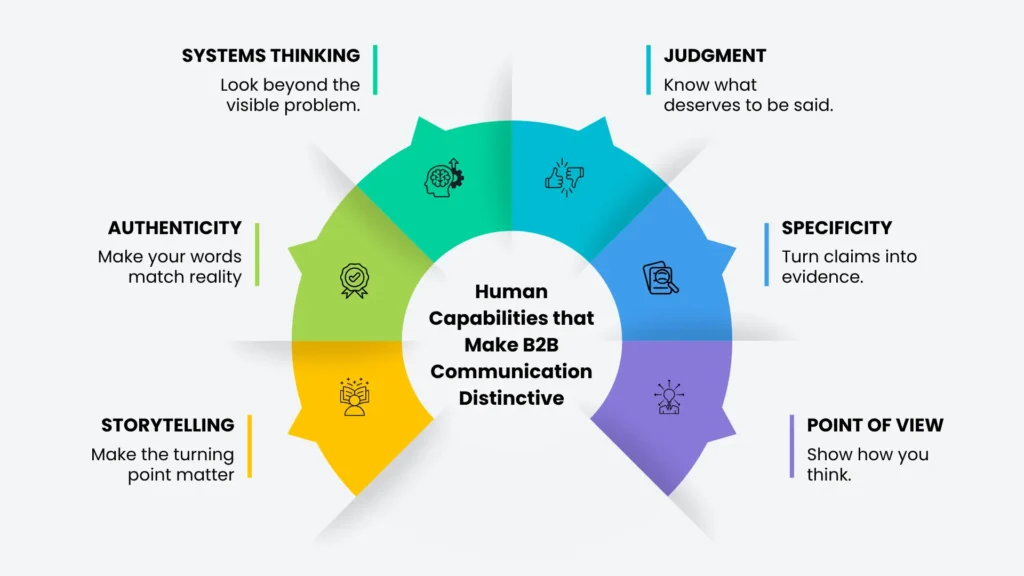
The Real Differentiator is What You Bring to the Page
A B2B buyer does not experience your storytelling, judgment, or point of view as separate skills. They experience the result as one thing:
Does this brand have something useful and credible to say?
That is why these concepts work best together.
- A story without specificity becomes a familiar narrative.
- A point of view without judgment becomes an opinion.
- Authenticity without consistency becomes a claim.
- Systems thinking without context can miss the real problem.
The strongest communication brings these capabilities into the same piece of work. It gives the audience a reason to pay attention, trust the message, and remember the brand behind it.
For B2B brands, that has implications far beyond a single article or LinkedIn post. It shapes how founders communicate their expertise, how brands build authority, how marketing teams explain complex ideas, and how organizations communicate with their people.
At Purple Iris Communications, we help businesses bring that thinking into their communication, from thought leadership content and personal branding to marketing communications and employee communications.
If your expertise is strong but your content still feels interchangeable, the next step would be to look more closely at the thinking you want your content to carry.
FAQs
1. Why are human communication skills becoming more important in the age of AI?
As AI makes content production faster and more accessible, the value of capabilities such as storytelling, authenticity, systems thinking, judgment, specificity, and point of view becomes more visible. These qualities determine whether content has something distinctive and credible to say.
2. How should B2B brands use AI without making their content generic?
Use AI for tasks such as research assistance, outlining, summarisation, and first drafts, while keeping strategic decisions with people who understand the business. The strongest workflow uses AI to accelerate production and human expertise to add experience, judgment, evidence, and a distinctive perspective.
3. What should a human review before publishing AI-assisted B2B content?
A human should review the facts, sources, assumptions, examples, tone, audience relevance, and overall argument. The most important check is whether the content reflects genuine business experience and adds something beyond information that an AI tool could easily assemble from existing sources.
4. How can B2B brands make AI-assisted content more distinctive?
Start with proprietary inputs. Customer conversations, internal data, executive experience, original research, implementation lessons, unusual observations, and strong opinions give content material that generic prompts cannot provide. Google similarly recommends creating unique, non-commodity content with a genuine point of view for its AI search experiences.
5. How can founders find ideas for thought leadership content?
Look at the decisions, patterns, problems, and disagreements they encounter repeatedly in their work. A strong topic can emerge from a customer misconception, an industry assumption they disagree with, a lesson from a failed initiative, or a pattern they have noticed across multiple businesses.
6. How can subject-matter experts contribute to B2B content without becoming full-time writers?
They can contribute through short interviews, voice notes, recorded conversations, internal documents, customer examples, or responses to focused questions. A writer can then turn that raw expertise into a structured article, case study, whitepaper, or thought leadership piece while preserving the expert’s perspective.
References:
- https://www.wsj.com/articles/companies-are-desperately-seeking-storytellers-7b79f54e?gaa_at=eafs&gaa_n=AWEtsqd5g2ip8ZWaNvDf-iwZeV50K8OAd2Q_y_bf3uAuYEmvW_plCix9LxhJNEVE6FU%3D&gaa_ts=6969abbc&gaa_sig=BRjvlo-8FMv4NfvE04PYbbZlVIFUVWx5QSo14QBhSdAUNN-lnSlKCtgVujgNOCOKMNBx9IaAJ-Yy4HocynT7aQ%3D%3D
- https://www.businesswire.com/news/home/20251202533732/en/Clutch-Report-Brands-Are-Losing-Consumer-Trust-Fast-as-97-Demand-Authenticity
- https://www.microsoft.com/en-us/worklab/work-trend-index/agents-human-agency-and-the-opportunity-for-every-organization?utm_source=chatgpt.com
- https://www.edelman.com/expertise/Business-Marketing/2025-b2b-thought-leadership-report