The visibility game on search engines has fundamentally changed. Today, instead of scrolling through 10 blue links, your potential buyers are getting answers from Google AI overviews.
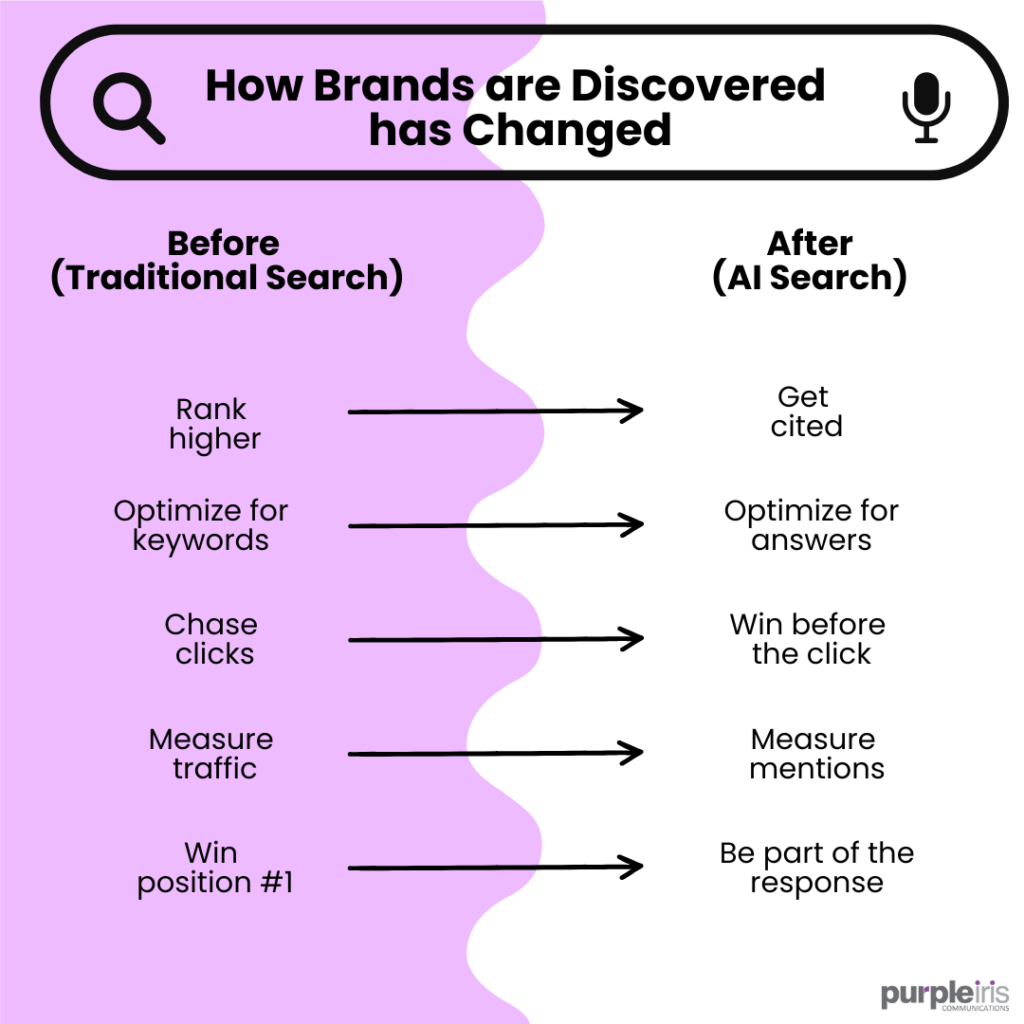
Traditional SEO taught us to rank, but now AI search demands something else entirely: being cited. There is no position one anymore. This shift is why AEO (Answer Engine Optimization) and GEO (Generative Engine Optimization) are becoming critical for B2B brands navigating AI search.
Take a company that sells demand forecasting software for supply chain teams.
In traditional search, its focus would be on ranking for keywords like “demand forecasting tools” or “supply chain software.”
In AI search, the goal changes. The same brand now needs to appear when Google AI overviews or ChatGPT answer questions like:
“How do manufacturers forecast demand accurately?” Or something broader: “How can companies reduce supply chain disruptions?”
Brand discovery is now happening before a buyer even visits a website.
That leaves B2B brands with an uncomfortable question: How do you get AI tools to mention your brand?
Already, nearly 50% of Google searches surface AI-generated summaries, a number expected to cross 75% by 2028. AI search has already become the second-largest driver of qualified leads for B2B brands.
This article outlines key content strategies that B2B brands need to embrace to adapt to this new reality.
Shift From Ranking to Being Cited
Unlike traditional search that ranks pages in a list, AI picks 1-2 online sources to formulate a concise, yet comprehensive answer to a user’s query. The distinction matters more than you think.
On AI, buyers don’t search with keywords. They ask specific questions in natural language, shaped by their unique context.
For example, a buyer might ask:
“What tools help mid-sized manufacturing companies reduce supply chain disruptions?”
Your brand now has just one opportunity to appear in front of the potential buyer–not as a link, but as part of the answer delivered by a Google AI overview or ChatGPT.
This changes everything about content strategy. Instead of competing for click-through rates, you are now competing for inclusion in a synthesized answer.
What must you do:
- Answer category-level questions directly in the first 100 words
- Structure content as: clear question, immediate answer, supporting detail, and real example
- Lead with the answer, no preamble about company history
Citation-ready content looks like this:
“To reduce supply chain disruptions, implement three controls: predictive demand forecasting, supplier diversification across regions, and real-time inventory monitoring.”
It answers the question, provides structure, and stays specific. AI can extract it, understand it, and cite it. The first paragraph must be extractable. The rest can build depth.
Own Your Category Narrative
AI systems learn patterns from the web. The brands that define categories get cited more often because they become the reference point for how AI understands that space.
Look at HubSpot with inbound marketing. Salesforce with CRM. Gong with revenue intelligence. These brands do not just operate in categories. They define them. AI learns about these spaces from these brands.
How to own your narrative:
- Publish original frameworks and methodologies
- Create new mental models, not regurgitated thinking
- Distribute your framework beyond your blog: third-party websites, press coverage, partner sites, analyst reports
- Get discussed on Reddit in relevant threads
- Have your senior executives or leadership team reference it on podcasts
When you publish “The 5-Stage Revenue Acceleration Model,” you are teaching AI how to categorize solutions in your space. Every time that framework is referenced elsewhere, AI reinforces the idea that your brand owns that narrative.
Optimize for Entity Recognition
AI systems do not understand brands the way humans do. They rely on entities: structured information about brands, products, people, and concepts. If your brand is not clearly defined as an entity in the web ecosystem, AI cannot confidently cite you.
Most B2B brands leave a massive opportunity on the table here. They have messy ‘about’ pages, product descriptions that lack specificity, inconsistent brand names across platforms, and zero structured data.
Here’s what you need to fix:
- Your ‘about’ page needs to simply and clearly state what you do, who you serve, and what problems you solve. For example, “Acme provides cloud-based inventory management software for e-commerce retailers with over $10M in annual revenue.” That is an entity definition AI can parse.
- Describe what your product does, not that it is “innovative”. For example, “Real-time inventory sync across Shopify, Amazon, and Walmart with automated reorder alerts.” It is specific, clear, extractable.
- Implement schema markup. Use organization schema to define your company. Use product schema for each offering. Use FAQ schema for common questions. It is how you define your content, without leaving room for inference.
What is schema markup?
Schema markup (also known as structured data) is code added to your website to help search engines understand your content and display it clearly in search results. - Ensure brand name consistency across platforms. If your brand name is “Acme Inc.” on your website, “Acme” on LinkedIn, and “Acme Software” on G2, you create entity confusion. AI systems struggle to connect these references as the same entity.
Audit every platform where your brand appears. Ensure your company name, description, and key details are identical. This consistency allows AI to build a unified understanding of your brand across the web.
Publish Content AI Can Easily Extract
AI favors content that is clear, modular, and authoritative. The structure of your content determines whether it gets cited.
What works:
- Lists: “Top 10 tools for sales enablement”
- Comparison tables
- Step-by-step guides
- FAQs written in natural language
- Short, definitive answers near the top of pages
What does not work:
- Long narrative content that buries the answer
- Complex prose requiring interpretation
- Ambiguous statements
- Content without a clear structure
Let’s understand it better through a real scenario: a buyer asks ChatGPT: “What should a mid-sized B2B SaaS company look for when choosing marketing automation software?” You have a 3,000-word guide on this topic. But if the guide does not have a clear, extractable answer upfront, followed by structured sections with clear headings, AI will skip that content.
Here’s how you can restructure your content to be AI-friendly:
- Start every piece with a direct answer
- Use H2s and H3s that are questions
- Break information into bullet points and numbered lists
- Add comparison tables wherever relevant
- Implement FAQ schema for direct question-answer pairs
Do not manufacture this structure artificially. Cover real questions your buyers ask and provide real answers that add value. AI systems are trained to identify helpful content. Keyword-stuffed FAQs that exist only for SEO get ignored.
Be Present Where AI Models Learn
Large language models are trained on public, trusted, high-signal sources. If your brand is not present in those sources, AI cannot learn about you.
You cannot control AI training data the way you control your SEO strategy. You can only increase the probability of being present where AI models learns.
Prioritize these channels:
- User-generated content on Reddit (genuinely participate, do not spam)
- Earned media mentions in industry publications
- Analyst reports from Gartner, Forrester, IDC
- High-quality guest posts on authoritative sites
- Podcasts and webinars with full transcripts published
Reddit matters more than most B2B marketers realize. Buyers are asking questions in subreddits about your category. They are discussing pain points, comparing solutions, and sharing experiences. If your brand is not part of those conversations, you will be absent in a buyer’s research phase and miss the opportunity to be included in AI model training data.
The answer is not in spamming Reddit with promotional content. But in genuinely participating in communities where your buyers are and answering questions, sharing insights, and providing value. When your team gives thoughtful, unbiased responses that mention your product experience, you build presence.
The same principle applies to earned media. Here’s how:
- Get quoted in TechCrunch, Forbes, and vertical-specific publications
- Contribute expert commentary
- Share data from your research
Analyst reports carry disproportionate weight. If you cannot be included in a Gartner Magic Quadrant yet, focus on getting mentioned in analyst content or cited in research.
Podcasts and webinars with transcripts are particularly valuable because they create long-form, authoritative content that AI can extract. A podcast about your approach to solving a specific problem becomes a rich source of extractable insights. Make sure transcripts are published and indexed.
Invest in Reviews and Third-Party Validation
AI search prioritizes consensus and credibility. When multiple trusted sources say your product is effective for a specific use case, AI reinforces that signal.
Reviews on G2, Capterra, and TrustRadius are training data for AI models. Review sites rank among the most cited sources in AI search for B2B SaaS.
Here’s how to build review presence:
- Make it easy for happy customers to share experiences
- Send review requests after successful implementations
- Respond to every review, positive or negative
Reviews alone are not enough. You need use cases: detailed, specific stories about how customers solved real problems.
Here’s how to create extractable evidence:
- Publish case studies on your site and distribute them through industry publications
- Get customers to speak at events
- Document “Company X used Solution Y to achieve Result Z” stories
Third-party validation extends beyond reviews. Industry awards, certifications, partnerships, customer logos, media mentions, and analyst recognition contribute to the consensus signal AI looks for. When Perplexity encounters 15 different sources mentioning your brand as a leader in your category, it gets the confidence to cite your brand.
Create Comparison-Ready Content
AI frequently answers by comparison. When someone asks “what is the best project management tool,” AI does not recommend one solution. It compares options.
Your brand needs comparison-ready content that positions you clearly against alternatives. Most B2B brands are terrified of this. They do not want to mention competitors. They think it sends traffic elsewhere. Buyers are making those comparisons whether you participate or not. When AI is making the comparison for them, you want your perspective included.
Publish this content:
- “Brand X vs Competitor Y” pages
- “Alternatives to Competitor Z” content
- “Best tools for specific niche” resources
Be honest. If your competitor has a feature you lack, acknowledge it and explain your alternative approach. If you are better for a specific use case, be explicit. AI rewards specificity over marketing spin.
The format matters too. Use comparison tables, where you clearly define criteria like price, features, ideal customer profile, integration capabilities, and support options. Make it scannable, fair, and useful.
Category-level comparisons matter just as much. “Best CRM for small nonprofits” positions you in a specific conversation. AI can cite you when someone asks about that exact scenario.
Make Your Experts Visible
AI attributes authority to people, not just brands. When your executives and subject matter experts create thought leadership under their names, it strengthens your brand’s authority signal. Every time your technical executive is quoted in TechCrunch discussing cloud architecture trends, it builds personal and brand authority.
This is about entity recognition again, but for people. AI needs to understand who your experts are, what they know, and why they are credible. That understanding comes from consistent presence across multiple platforms.
Here’s how to build expert visibility:
- Have experts write regularly on LinkedIn about industry trends, technical challenges, and strategic thinking
- Find speaking opportunities for them at owned and third-party events
- Maintain consistent author bios everywhere with the same photo, description, LinkedIn URL, and company connection
- Attribute blog content to named authors, not your brand
- Use an author schema to explicitly define who wrote each piece
Track Visibility in AI Answers
Traditional SEO tools measure rankings. AI search requires different metrics. You need to track whether your brand appears in AI-generated responses and how you are positioned relative to competitors.
Start tracking manually:
- Test prompts in ChatGPT, Perplexity, Google AI overviews
- Build a list of high-value queries: “Best marketing automation for B2B SaaS,” “How to implement account-based marketing”
- Test weekly and document which platforms mention you, in what context, and which competitors appear
This reveals patterns and gaps. Maybe you appear in ChatGPT but not in Perplexity.
Start now while most competitors are not tracking yet. The insights from seeing how AI responds to queries about your category must shape your content strategy.
The Reality of AI Search
You cannot force your way into AI citations, but you can make yourself impossible to ignore. Winning in AI search is about being present where AI learns, creating extractable content, building authority through third-party validation, making expertise visible through named individuals, and tracking progress.
At Purple Iris Communications, we work with B2B brands navigating exactly this shift. The brands making progress are not waiting for perfect strategies. They are starting with the fundamentals: cleaning up entity definitions, implementing schema markup, building relationships that create earned media, and participating in communities where their buyers are.
The shift from ranking to being cited is happening right now, in every search your potential buyers are making. You’re either part of the answer or part of the noise.