For a long time, B2B content teams have followed a familiar rhythm. Research keywords, publish fresh content, and climb search rankings. If the website ranked well, it attracted traffic and fed the funnel.
That system worked because search behavior was straightforward. Buyers would type queries, search engines would return links, and content competed for clicks.
But that predictability is now fading.
B2B buyers are not just searching for relevant websites. They are using AI tools for summarized, highly contextual answers. They may use ChatGPT to compare solutions, Perplexity to validate approaches, and Gemini to check whether a platform fits their specific business context. AI search tools are compressing what used to be multiple touchpoints into a single interaction. Instead of reading five blog posts, buyers get one synthesized answer for their query.
Visibility is no longer defined only by rankings.
Influence is no longer driven only by traffic.
Authority is no longer built just by publishing more.
When a buyer asks a question, and your brand does not shape that answer, you are absent from the decision.
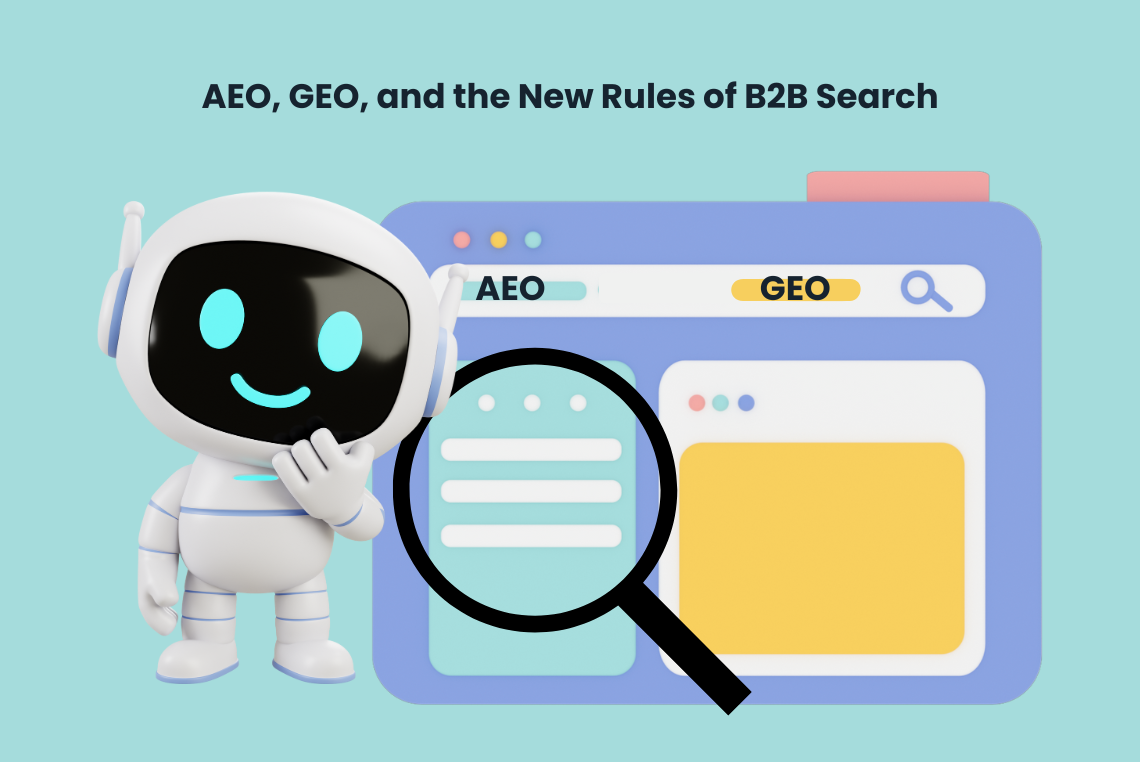
Answer Engine Optimization (AEO) and Generative Engine Optimization (GEO) have hence become integral parts of an organization’s content marketing strategy.
Understanding AEO and GEO
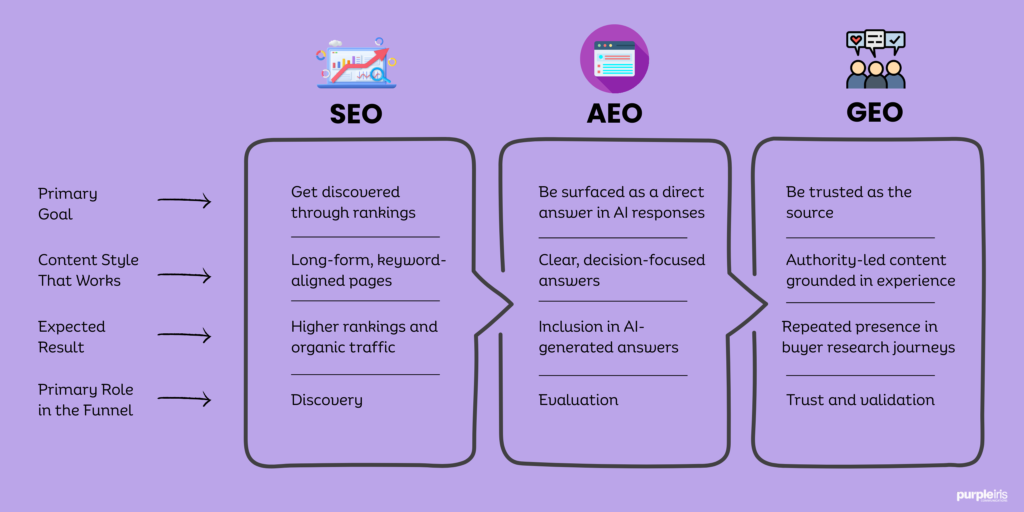
AEO is about structuring your content so AI tools extract, summarize, and cite your insights when answering a user’s question.
GEO makes your content so contextually rich and decision-relevant that generative AI models prioritize it when creating original responses.
AEO focuses on answering foundational buyer questions. At this stage, buyers are trying to understand definitions, distinctions, and basic concepts. AEO-optimized content explains these concepts in a structured, unambiguous way. At this stage, the role of content is to provide clarity, not persuasion.
GEO comes into play when buyers move past basics and start seeking judgment. Their questions become more contextual, comparative, and situation-specific. AI tools are no longer extracting isolated facts, but synthesizing viewpoints. Content that explains real trade-offs, implementation challenges, and contextual limitations is treated not just as information, but as perspective. Here, your content helps shape how the answer is framed.
Both are necessary. AEO gets you into the answer, whereas GEO determines how much weight your viewpoint carries within it.
This shift is not about gaming algorithms. It is about answering real buyer questions with the kind of clarity and depth that makes AI systems see your content as the best source to pull from.
How B2B Buyers Are Using AI
AI tools are now part of the buying committee’s research from early on. In fact, a Forrester study found that in less than two years, 89% of B2B buyers have adopted generative AI, ranking it among the top sources of self-guided information across every phase of the buying process. 1
In the initial research phase, buyers ask foundational questions such as “What is product analytics?” or “How does session replay work in a SaaS product?” They are not evaluating vendors yet. They are trying to understand the problem space. Content that explains these concepts clearly and in a way AI tools can parse becomes part of that early learning loop.
As buyers move into comparison, their questions become more evaluative. Queries like “Segment vs Amplitude for product analytics” signal that they are narrowing options. AI tools summarize trade-offs, highlight differences, and introduce context. If your content does not clearly state where you stand and why, it loses influence at the moment when preferences start forming.
During validation, questions shift toward risk and reliability. Buyers ask things like “Is this approach reliable?” or “What challenges do teams face after implementing a headless CMS?” At this stage, they are looking for confidence rather than explanation. AI-generated answers that include practical examples, known limitations, and real-world context help reinforce decisions.
B2B buyers already spend only a small part of their decision-making process engaging directly with suppliers. With AI tools now synthesizing and presenting highly contextual responses, buyers can form opinions based on your content without ever visiting your website.
From Ranking Pages to Shaping Answers
The old content model competed with other pages for keywords and rankings. The goal was simple. Rank higher, earn the click, and pull buyers to your site.
Now, content competes with other insights for inclusion inside AI-generated answers. AI tools no longer surface links first. They assemble responses by pulling from sources they trust.
In this shift, winning is not about being the best page. It is about being the most useful source for answering a specific question.
Answer-worthy content does not try to inform broadly. It clarifies decisions, takes a clear position, and reduces uncertainty at the moment buyers feel it. You are no longer optimizing only to get clicked, but to be referenced.
What makes content answer-ready in a B2B context?
| Clear positioning AI models prioritize content that takes a stance. If you are writing about whether to build or buy a data pipeline solution, do not just list pros and cons generically. Explain when building makes sense, when it does not, and why. Specificity signals expertise. This level of clarity is also what separates generic content from true thought leadership content that AI systems and buyers alike trust. |
| Depth where buyers feel uncertainty When a buyer is trying to understand “how to structure a content ops team,” they are not looking for a definition. They are looking for role breakdowns, reporting structures, common pitfalls, and what works at the maturity stage. That level of detail is what makes AI tools pull from your content instead of someone else’s. |
| Structure that mirrors how questions are asked Buyers ask questions in natural language. “What is the difference between AEO and GEO?” or “How do I optimize content for AI search?” If your content is structured around these actual questions and answers them directly, AI systems have an easier time extracting and using your insights. This is not about keyword stuffing. It is about organizing information the way people seek it naturally. |
| Credible signals AI models weigh experience, examples, and specificity heavily. If you are explaining how to build a demand gen engine, referencing a real campaign structure, tangible metrics, and specific challenges you have experienced makes your content more credible than generic advice. Generative engines prioritize content that demonstrates lived expertise, not recycled frameworks. |
Rethinking B2B Content Strategy for AI Search
Earlier content strategy mainly included covering topics around the buyers’ journey and hitting keywords. Now it is more about mapping to decision friction.
Buyers do not move through awareness, consideration, and decision in neat stages anymore. They jump around. They research deeply on one aspect, ignore another, then circle back weeks later with a completely different question. Your content needs to match that reality.
Write less for keywords and more for the questions buyers are asking at moments of uncertainty.
Instead of organizing content by funnel stages, organize it by the type of clarity buyers need. While some content exists to explain concepts, some exists to compare options, and some to validate decisions. When you map content to decision friction instead of stages, you create the kind of resource library that AI tools pull from consistently.
Treat content as a system, instead of isolated posts. One piece explains what account-based marketing is. The second breaks down how to structure an ABM team. Another walks through campaign execution and addresses common mistakes. Together, they create a knowledge base that AI systems recognize as comprehensive and authoritative.
B2B marketing is increasingly focused on building trust and credibility rather than chasing leads. That approach maps directly to AEO and GEO, where AI systems favor content they consider reliable and authoritative.
This is where strategy shifts from content creation to content intent. Every published piece answers specific questions, reduces friction points, or builds confidence at the time of decision-making.
Measuring Success When Clicks Matter Less
You cannot measure influence the same way you measured traffic.
Visibility used to mean impressions and clicks. Now it means presence in AI-generated answers. But how do you track that?
Start by monitoring if your content gets cited in AI responses. Manually test queries related to your space in ChatGPT, Perplexity, and Gemini. This may not be a scalable approach, but it is directional. Tools are emerging to track brand mentions in AI outputs, but start with manual testing for now.
Buyer questions during sales calls are another strong signal. If they are asking deeper, more informed questions, your content is working. If they are coming in with clarity about what they need and how your solution fits, something in their research process shaped that understanding. In many cases, that influence comes from AI-generated answers pulled from your content. These questions should not stop at observation. They should feed directly into the content creation process, helping teams refine existing assets and create new content that addresses the next layer of buyer uncertainty.
This does not mean businesses can abandon traditional metrics. Traffic and rankings still matter, but they are lagging indicators now. Leading indicators are found in how informed your prospects are before they approach you.
Prioritizing AEO and GEO
SEO is not dead, as distribution still plays a crucial role. But an organization’s strategy must now start with how buyers seek clarity.
The question is not about abandoning what is working. It is rather about layering in new thinking that accounts for how information flows now. Your keyword strategy must inform your content, but it must be written to answer buyers’ questions, not just rank for terms. Your blog must continue to drive traffic, but it must also be structured so AI systems can extract insights from your content.
The companies winning in this shift are not choosing between SEO and AEO. They are doing both, but with AEO and GEO as the strategic lens that shapes how they approach content.
Think of it this way: SEO gets you found when someone is looking for you. AEO and GEO get you included when someone is not looking for you specifically but is asking a question you can answer better than anyone else.
That is the opportunity.
Responding to the Shift Decisively
AI is changing how and what buyers search for. Search is no longer just about discovery. It’s also about interpretation. Buyers want fewer pages and better answers. They want context, perspective, and confidence in the decisions they are making.
AEO and GEO respond to that shift. They encourage content that explains better, takes a point of view, and helps buyers think through trade-offs instead of simply listing options.
For B2B teams, the opportunity is straightforward. Create content that reflects how real decisions are made, focus on the questions that surface uncertainty, share insight from experience, and structure ideas so they can be understood, reused, and trusted.
This way of thinking shapes how we approach content strategy and creation at Purple Iris Communications, prioritizing clarity, depth, and decision-relevance over volume.