
In the world of B2B messaging, where stakeholders are many and buying cycles can be long and complex, your messaging must do more than just inform. It must build trust, influence perception, and inspire action.
However, all too often, there is a gap between the marketer’s intent and the actual takeaway by the reader. In a high-stakes, competitive environment, that gap can cost revenue, new deals, and growth.
So, what differentiates messaging that sparks engagement from one that fades quickly? The answer lies in the psychology of messaging.
When marketers understand the power each word wields over the eventual outcome of the message, the needle actually moves. Every word a brand chooses shapes how audiences perceive, feel, and act.
In this article, we explore how science meets storytelling to elevate messaging beyond just noise to a heavyweight lever for growth.
This is the psychology of messaging– where every word counts.
The Science Behind B2B Messaging
Language triggers subconscious reactions that shape perceptions and initiate decisions. In this section, we examine the science behind effective messaging, delving into the cognitive biases, emotional triggers, and the neurolinguistic patterns that can be leveraged to drive conversions.
Cognitive Biases at Play
Although usually data-reliant, B2B leaders don’t always make decisions rationally. At the end of the day, an executive reading your message is human and will likely share the same biases as an end consumer. McKinsey research confirms that B2B customers are shifting toward consumer-like purchasing behaviors1.
Smart marketers acknowledge this and ensure that marketing communication aligns with these cognitive biases:
- Framing Effect
“Accelerating turnaround time” is more compelling than “Reducing the number of delays.”
The first frames it as a positive outcome; the second focuses on a negative. - Social Proof
“Trusted by 8 of the top 10 global banks” carries far more weight than “Industry-leading solution.”
There is safety in “tried and tested.” - Anchoring
“Save $2 Million Annually” catches more attention than “Boost Cost Savings.”
Starting with a strong metric sets the benchmark for perceived value.
B2B marketers can leverage cognitive biases by using the right framing to generate a positive response, anchoring value with strong metrics, and reinforcing credibility with real-world proof.
Emotion in a Rational World
Emotion drives action more than logic. A message that triggers an emotional response in the reader–trust, empathy, humor, curiosity, belonging, or urgency– is more likely to register. Gallup research finds that 70% of decisions are based on emotion, including brand preference2.
In B2B, emotional triggers also include:
- Confidence: “Proven award-winning solutions.”
- Safety: “Zero disruption implementation.”
- Fear (of being left behind): “Global leaders are already seeing 2x ROI.”
By consciously embedding emotional triggers into narratives, marketers can ensure their messages resonate subconsciously with the reader.
Neurolinguistic Patterns that Drive Action
The human brain tends to prefer simplicity, rhythm, and clarity. These neurolinguistic patterns explain why concise, direct phrases outperform long-winded explanations. In B2B, this translates to:
- Fewer, but impactful words
- Specific outcomes over generic promises
- A clear, crisp flow over dense, jargon-filled paragraphs
Following these simple guidelines can help craft messaging that is easy to read and quick to grasp. That is the language the brain naturally prefers.
The Messaging Trifecta that Works: Clarity, Relevance, Momentum
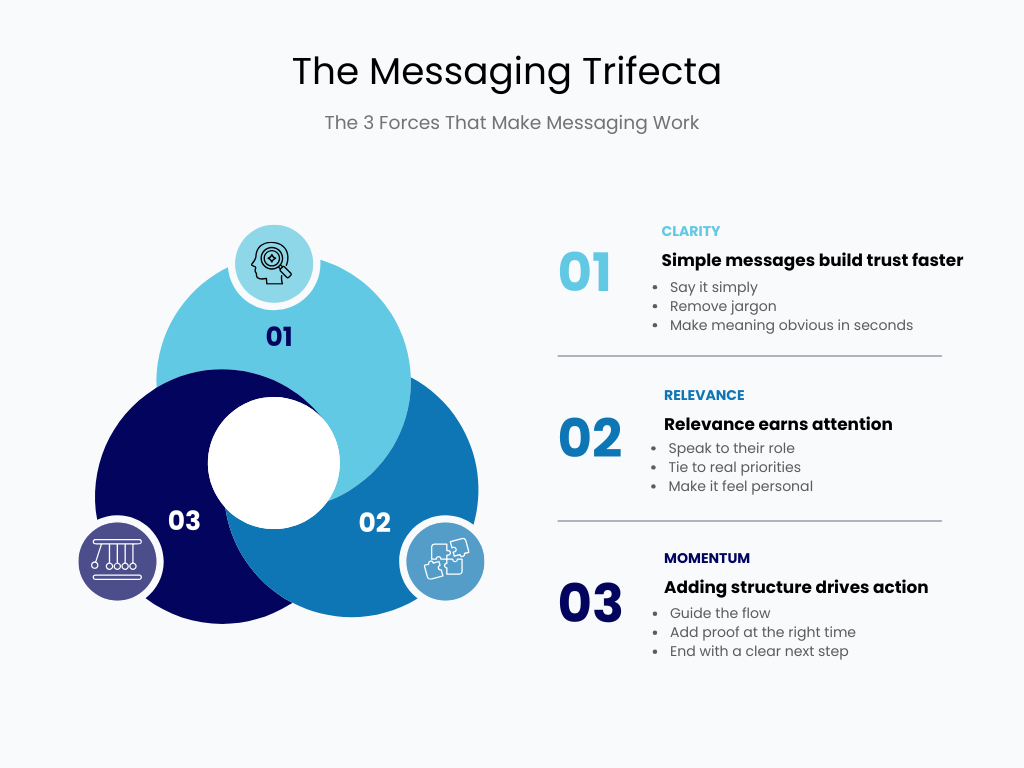
In B2B, where time is money and competition is high, your message must cut through the clutter and make an impression. Marketers who pay attention to the clarity, relevance, and momentum of their messaging are the ones who see desired results.
Clarity: Keep it simple
Decision-makers don’t have time or inclination to decode complexity. Research has shown time and again that simplicity directly correlates with trust and engagement.
Real-world Example

Weak: “We embed autonomous agents into workflows to optimize strategic and operational performance.”

Strong: “We use AI agents to make processes faster and smarter.”
Relevance: If it’s not a priority, it won’t land
From the industry to the domain to the actual challenge, your reader will pay attention only when it is relevant to them. A study found that personalized subject lines increase email open rates by 26%3. In the B2B context, personalization is more than just names, it’s about immediate priorities.
Real-world Example:

Weak: “Unlock AI potential across your enterprise.”

Strong (for a CFO): “Reduce operating costs with AI-driven process automation.”

Strong (for a COO): “Scale operations without adding headcount using AI.”
Momentum: Rhythm, structure, and CTA
Your message can build momentum and guide readers toward action through a logical flow, strategic placement of proof points, and clear CTAs at the right points.
Real World Example:

A well-placed “Download Now” after building urgency.

Creating a smooth transition from problem to insight to solution to proof and action.
Messaging Mistakes to Avoid
- Jargon overload
If it sounds impressive but the message is lost, it won’t convert.
- Too text-heavy
Your key message, including your brand promise, must appear early in the message, or you will lose attention
- Over-reliance on features
Buyers care more about outcomes, not just capabilities.
- Ignoring where your buyer is
Early-stage buyers need insight; late-stage buyers need proof.
- Lack of differentiation
If your messaging is generic and could belong to any competitor, or is for any reader, it’s ineffective.
Building a Messaging Framework That Converts
By paying attention to the cognitive biases, emotional triggers, and neurolinguistic insights of their target audience, marketers can layer science into their communication. Here is a practical roadmap that takes theory into action, helping you build a messaging strategy that resonates, stands out, and ultimately drives action.
- Start with the reader
- Who is the buyer? (CIO, CFO, Operations Head?)
- What are their typical pain points?
- What does success look like for them?
Knowing the reader and their context lets you align with the right cognitive biases.
- Identify the primary priority, such as:
- Cost reduction
- Risk mitigation
- Transformation
- Growth acceleration
- Competitive advantage
Priorities trigger emotion, making the message resonate beyond logic.
- Frame the value clearly, using:
- Numbers: “Reduce costs by 25%”
- Timeframes: “In under 90 days”
- Comparisons: “2x faster than legacy systems”
Clear framing taps into subconscious preference for simplicity and anchors perception of value.
- Structure the message
- Headline: outcome-driven
- Subhead: context with differentiation
- Body: proof and clarity
- CTA: clear next step
Structured flow builds momentum, guiding the brain’s natural rhythm toward action.
- Provide proof and credibility
- Case studies
- Client logos
- Data-backed outcomes
Social proof reassures the subconscious; buyers trust what others have already validated.
- Test, learn, and refine
- A/B test subject lines and headlines
- Track engagement drop-offs
- Optimize based on behavior, not assumptions
Iteration ensures your words align with how audiences actually feel and react, not just what you intend.
Messaging as a Strategic Growth Lever
Words don’t just communicate; they drive business outcomes. They shape perception, drive engagement, and ultimately, influence revenue. When used right in B2B, messaging is not merely a creative exercise or an informational tool; it becomes a powerful strategic lever.
The right message that triggers emotions, resonates, and is structured optimally drives the desired action. For marketing and business leaders, understanding the psychological effect of their message is a critical consideration to standing out in today’s competitive marketplace.
Because ultimately, it doesn’t matter what you say; what matters is what your reader infers from what you say.
Want messaging that drives real business outcomes?
At Purple Iris Communications, we combine behavioral insight with strategic storytelling to craft messaging that resonates, differentiates, and converts. Let’s start the conversation.
- https://www.mckinsey.com/capabilities/growth-marketing-and-sales/our-insights/five-fundamental-truths-how-b2b-winners-keep-growing ↩︎
- https://www.gallup.com/workplace/398954/customer-brand-preference-decisions-gallup-principle.aspx ↩︎
- https://www.ama.org/marketing-news/email-personalization-strategies/ ↩︎