
Most B2B content teams are staffed and budgeted for one job–making an organization’s content discoverable. But getting found now takes three jobs. Content strategy decides what you say, while SEO strategy decides whether classic search finds it. Then comes AI visibility, which decides whether AI answer engines find, trust, and cite your business. The start of the buying journey will steadily move to LLMs as AI search gains dominance.
Gartner predicted that in 2026 traditional search volume would drop 25 percent as AI overviews and chatbots took share.1 It raises the stakes on the content layer underneath as both SEO strategy and AI visibility need a content strategy that offers something worth ranking or citing.
If you get it wrong, you end up with a blog that ranks for a hundred keywords, sounds like every other blog in the category, and does not earn a mention in an AI-generated answer. The content gets ignored because it is not distinct enough to cite.
What is Content Strategy?
Content strategy is the set of decisions that determine what a brand says, to whom, in what order, and why. It covers positioning, messaging, editorial pillars, tone of voice, and the roadmap that turns all of it into content people consume.
Without a documented content strategy, teams produce content on instinct. Output goes up while the impact stays flat because nobody has decided what value the content would deliver or who it will convince.
What is an SEO Strategy?
SEO strategy is the set of decisions that determine how content gets discovered through classic search using keyword research, on-page optimization, technical site health, internal linking, and backlinks.
Without an SEO strategy, even the sharpest narrative sits on page four or five of search results, invisible to the buyer who is actively looking for it.
What is AI Visibility?
AI visibility is whether AI-driven answer engines and chatbots surface your content directly in a generated response, ahead of the list of blue links on a search page. It runs on a different mechanism than classic search.
Google indexes a page and ranks it for a single query. An AI engine takes that query and generates a handful of related sub-questions behind the scenes by a process called query fan-out. It then pulls together the sources that answer each sub-question best.
Ahrefs tracked the overlap between what ranks in Google’s organic top 10 and what gets cited in AI Overviews for the same searches. In mid-2025, the overlap was around 76 percent. A year later, it dropped to 38 percent. Evidently, ranking well and getting cited is not the same job anymore.
AI visibility rewards what a documented content strategy is built to produce, and exposes what SEO-only content tends to miss. What’s more, authority signals predict AI mentions better than anything else. Webflow’s 2026 analysis of 2,000 company sites found bylines, sourced data, credentials, and third-party recognition correlate more strongly with brand mentions than content depth, technical readiness, or measurement.
How AI visibility has Changed Content strategy and SEO strategy
Before AI-driven answer engines entered B2B search, content strategy and SEO strategy ran on independent tracks.
Content strategy built the narrative while SEO strategy got that narrative ranked. AI visibility collapsed the separation, since the same page that ranks well on a search engine can be invisible to an AI engine.
The stakes around brand voice have risen as well. A reader who notices a brand sounding different across channels loses trust in it, and an AI engine picks up on that same inconsistency when deciding whether to cite a piece of content.
For SEO strategy, this means ranking is no longer the finish line. As for content strategy, pillars and pages now need to be built to be cited, on top of ranking and reading well.
Most B2B organizations today place the responsibility for AI visibility on their content strategist. Citation quality depends on narrative consistency, and that is the job best suited for someone with deep expertise in content strategy. The SEO specialist takes care of the technical and distribution side, but a single owner keeps the practice from falling through the gap between teams.
When that consistency starts slipping, content strategists look for content consulting partners who bring an outside, objective view, the kind that spots exactly where a narrative needs sharpening.
A Head-to-Head Comparison
| Dimension | Content strategy | SEO strategy | AI visibility |
| Core question it answers | What should we say, and why should anyone care? | Can the right person find it when they search? | Will an AI engine trust it enough to cite it and mention my business? |
| Starting point | Business goals, audience research, buyer journey | Keyword data, search intent, competitor rankings | Buyer questions, consistent brand facts, where the brand is already mentioned |
| Primary output | Positioning, messaging, editorial pillars, content roadmap | Keyword maps, on-page fixes, technical audits, link building | Focused, citable pages and consistent mentions across the web |
| Time horizon | Long-term. Narrative compounds over the years. | Medium-term. Rankings shift within weeks or months. | Fast-moving. Citation patterns can shift with a single model update. |
| Success metric | Share of voice, sales enablement lift, brand recall, engagement depth | Organic traffic, keyword rankings, click-through rate | Citation frequency, brand mentions, and appearance rate in AI answers |
| Typical owner | Content or brand strategist | SEO specialist or growth marketer | In-house strategists working with content and SEO partners to monitor and adapt as AI engines evolve |
| Common tools | Editorial calendars, positioning documents, style guides | Ahrefs, Google Search Console, Clearscope, Surfer | Ahrefs Brand Radar, manual prompt testing, mention tracking |
| What breaks without it | Content that ranks but does not convince anyone | Content that resonates but nobody finds it | Content that ranks and resonates, but never gets mentioned by AI |
Why the Sequence Matters More Than the Split
Most B2B teams hire for SEO first because rankings are measurable and messaging is not, and they treat AI visibility as an afterthought, if they think about it at all. Then they wonder why traffic goes up while deals do not close any faster, and why their brand does not show up when a buyer asks an AI agent for a shortlist.
Content Marketing Institute’s 2026 research backs this up. Ninety-seven percent of B2B marketers already have a documented strategy, and among those who saw real improvement this year, 74 percent credited refining that strategy.2
Every one of those self-directed research moments is a moment your content strategy either earns trust or does not, before SEO strategy or AI visibility gets a chance.
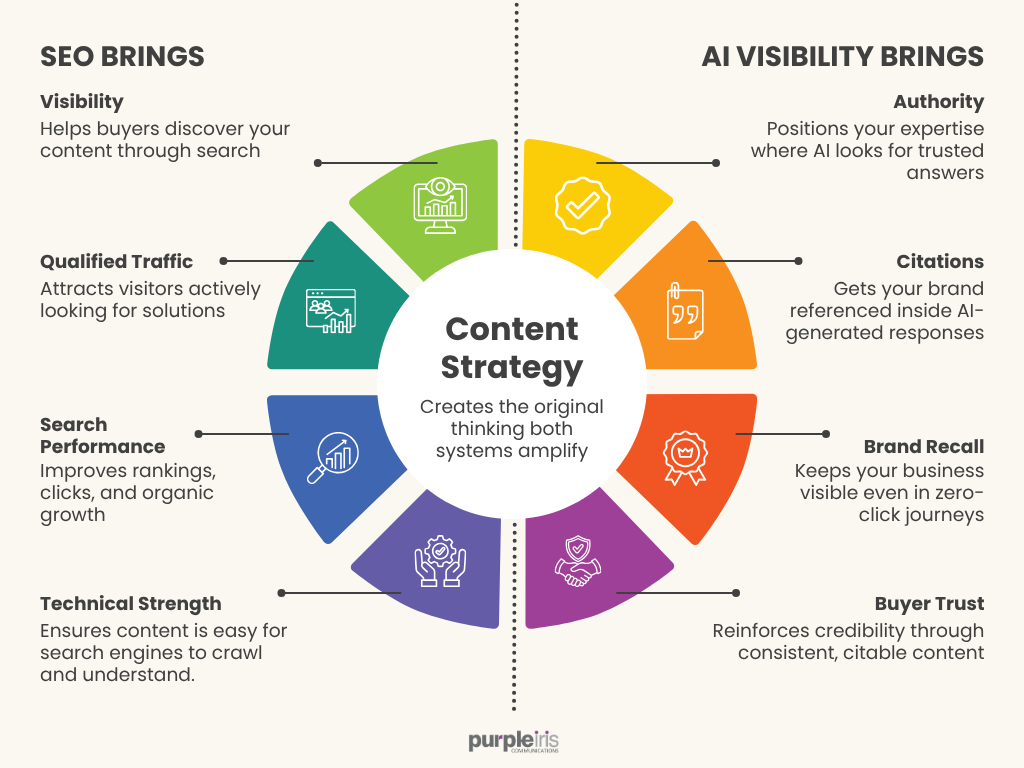
Content strategy has to answer the “why us” question before SEO strategy and AI visibility can answer “how do they find us.” Once the narrative exists, SEO strategy makes it findable at scale through classic search, and AI visibility makes it citable inside AI-driven answers.
Three Scenarios That Show What This Looks Like
Here are some patterns that match what shows up consistently across B2B content and SEO engagements when your content strategy aligns with SEO and AI strategies.
Startups Building Narrative and Foundation Together
Picture a SaaS platform in its early stage, where every marketing channel speaks in a different voice, and there is no content library or SEO history to speak of. The priority is a documented content strategy, so the team builds its first tone-of-voice framework and working brand guidelines. Then they can start publishing the founder’s point of view on where the category is headed.
That thought leadership becomes the anchor for the rest of the company’s content. Prospects start recognizing the founder’s name before a sales call ever happens, and every team, from support to sales, speaks the same language. Even at this stage, the handful of pieces that do get published are built with clear structure and sourced claims from day one, so the SEO and AI visibility work that comes next has something solid to build on.
Growing Companies Scaling SEO on a Narrative That Already Works
Now picture the same company two years later. It now has a working narrative but barely any organic visits and no content library at scale. The job shifts to building an SEO program from the ground up, mapping the industry’s full buying journey into topic clusters and expanding the keyword footprint from a handful of terms to thousands.
Traffic climbs to a steady, meaningful stream of monthly visits, and qualified pipeline grows with it. It works because the content filling those clusters is written around a narrative that already exists, not built from keywords alone.
Enterprises Earning AI Citations After Already Winning the Rankings Game
At the far end, take an enterprise that already ranks on page one for its core keywords and has a deep content library, but almost never comes up when a buyer asks an AI assistant the same questions.
The team restructures its highest-intent pages around direct, question-based headings and tightens each page to answer one buyer question clearly. Then, they work to get the brand PR mentions, industry forums, comparison sites, and review platforms, beyond the usual link-building targets.
AI-generated answers start naming the company, and it shows up in AI-assisted research, even on zero-click search queries.
Putting the Sequence Into Practice at Your Company
Turn any of those three scenarios into a repeatable process and this is what it looks like.
- Draft a content strategy with audience, positioning, and 3-5 editorial pillars before opening your keyword tool.
- Run keyword and competitor research against those pillars and let your strategy decide which keywords matter.
- Build the content calendar so every piece maps to a pillar and answers one buyer question tightly. Cut anything that does not map to the pillar, no matter how searchable the keyword looks.
- Bring in an SEO specialist for technical and on-page fixes once the narrative and content calendar are ready.
- Structure the highest-intent pages for AI visibility using question-based headings, one clear answer per page, and consistent mentions of the brand across the web, beyond backlinks.
- Review rankings, AI citation appearance, and the original pillars together every quarter. When any of the three pull apart, revisit the strategy first.
Why the Sequence Holds Even When Budgets are Tight
Getting cited on AI is not the end game. A Columbia Journalism Review study of eight AI search tools found they answered more than 60 percent of citation-related queries incorrectly, misattributing sources, fabricating links, or naming the wrong publisher outright.3 The same risk applies to how AI engines describe a brand. Track how often you get cited, but spot-check what they actually say about you when they do.
In the case of companies under a tight quarterly target, freezing SEO strategy and AI visibility work while the narrative gets built may not be the smart way to go about it. Narrow, tactical fixes on a handful of high-intent pages can run in parallel, as long as they stay a placeholder and not the whole plan. A citation earned without building the narrative can result in subpar results.
At Purple Iris Communications, we help businesses build the fundamentals for a content strategy–content audit, positioning, content pillars, and an editorial calendar. That sets the stage for an SEO and AI visibility plan.
For startups building both functions from the ground up, our startup content strategy solution sequences narrative and discoverability early on. When you get the story right first, rankings become a pipeline instead of just traffic.
Frequently Asked Questions
What is the difference between content strategy, SEO strategy, and AI visibility?
Content strategy decides what a brand says and to whom, covering positioning, messaging, and editorial planning. SEO strategy decides how that content gets discovered in classic search, covering keywords, on-page optimization, and technical site health.
AI visibility decides whether AI-driven answer engines find, trust, and cite that same content. One builds the narrative while the other two build two different kinds of discoverability.
What is AI visibility, and how is it different from SEO?
AI visibility is whether AI-driven answer engines and chatbots surface and cite your content when someone asks a question, irrespective of whether you rank on a traditional Search Engine Results Page (SERP). SEO strategy still matters for classic search, but ranking well in the SERP and getting cited by an AI engine are increasingly distinct outcomes, driven by different signals.
Should a B2B company build a content strategy, an SEO strategy, or AI visibility first?
Content strategy comes first in almost every case. Without a documented narrative and clear editorial pillars, SEO work and AI visibility work optimize content that has nothing distinct to say. An organization may drive traffic or citations but see little to no conversions. The exception is a company that already has a working narrative and only needs to catch up on distribution. There, SEO and AI visibility fixes can start immediately, provided the team revisits the narrative the moment gaps show up in the data.
Can you have a content strategy without SEO or AI visibility?
Yes. Brand narrative work, sales enablement content, and internal communications all run on content strategy without keyword targeting or AI visibility work involved.
Who should own content strategy, SEO strategy, and AI visibility on a marketing team?
A content or brand strategist usually owns the narrative, an SEO specialist or growth marketer owns classic discoverability, and the content strategist typically leads AI visibility too, working closely with external content and SEO partners to monitor and adapt as AI engines evolve. However, all three strategies should bank on the same content calendar so they stay aligned.
How often should a B2B team review its content strategy against SEO and AI visibility performance?
Quarterly is a reasonable cadence. Pull organic rankings and AI citation appearance together, and check both against the original editorial pillars. If either one is climbing for topics that do not map to the strategy, revisit the plan itself before touching the keywords or the pages.
- https://www.gartner.com/en/newsroom/press-releases/2024-02-19-gartner-predicts-search-engine-volume-will-drop-25-percent-by-2026-due-to-ai-chatbots-and-other-virtual-agents ↩︎
- https://contentmarketinginstitute.com/b2b-research/b2b-content-marketing-trends-research ↩︎
- https://www.cjr.org/tow_center/we-compared-eight-ai-search-engines-theyre-all-bad-at-citing-news.php ↩︎