
In many Account-Based Marketing (ABM) campaigns, the content sparks initial interest but rarely travels across the buying group. More often than not, the problem is that the format does not match how B2B decisions are evaluated internally. Analysis from N.Rich of 2026 ABM programs found that 71% of B2B practitioners now run some form of ABM. Yet only 26% call their program truly successful, and around 80% fail to meet expectations.1
The real gap is alignment. Marketing content gets created, but it does not always fit the stage, the stakeholder, or the context inside the account. That is where momentum starts to break.
In this article, we break down what formats hit the target and why.
Why Format Matters in ABM
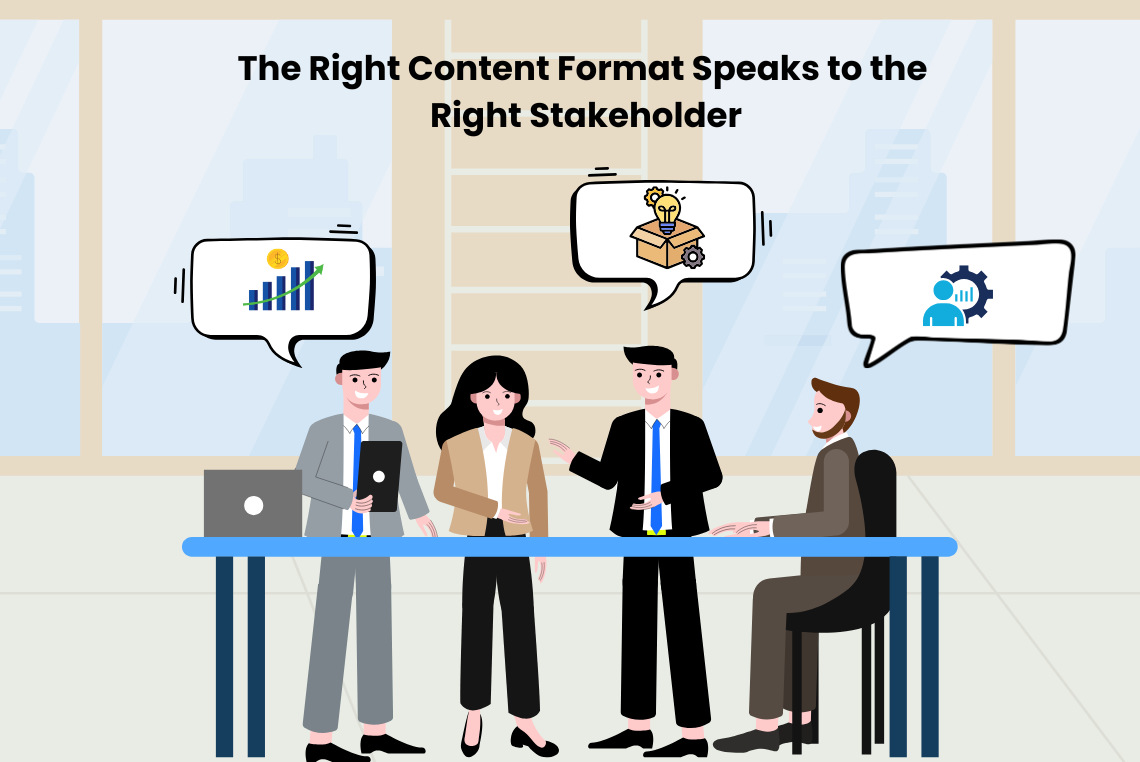
ABM compresses the buying journey. You are likely not nurturing cold leads over time. You are influencing a set of pre-qualified, high-value leads who may have had some exposure to your business. The target list includes different stakeholders—a CFO, product leader, or operations head—with different priorities who do not consume content in the same way.
That means your content formats must do two things well:
- Travel across stakeholders
- Build trust without direct interaction
The right format makes content easier to share internally, discuss across teams, and use during evaluation.
1. Thought Leadership: Frame the Problem Before Anyone Else Does
Opinions form long before a sales conversation starts. Thought leadership is where that happens, and in ABM, its job is more than creating awareness. It is to shape how a problem gets understood, so that by the time your sales team shows up, the account is already thinking in your direction.
But generic thought leadership does not land in ABM campaigns. What works is sharper:
- Industry-specific angles that reflect real dynamics in the client’s market, not broad commentary that applies to everyone
- Role-aware framing, because what a CFO is worried about is different from what a VP of Operations is wrestling with
- Timely hooks that connect to something the account is navigating right now
The Content Marketing Institute’s B2B Benchmarks report found that 53% of marketers are increasing thought leadership investment, with clearer visibility into its early-stage impact.2
2. Case Studies and Custom Research: Give Buyers Something to Circulate
Every ABM deal reaches a point where the question shifts from “is this interesting?” to “will this work for us?” Case studies answer that, but only when they mirror the client’s reality.
However, case study selection is critical for an ABM campaign. A story about a retail brand will not create the right influence among healthcare stakeholders evaluating the same product. The most effective case studies mirror the target account’s situation, industry, scale, and comparable challenges.
That level of relevance matters because personalization in ABM is not limited to messaging alone. It also shapes the kind of proof buyers trust and are willing to circulate internally. G2’s ABM research found that 42% of marketers use content personalization specifically to drive account engagement and long-term relationships.3
Custom research plays a similar role. Original industry data, benchmark reports, or account-relevant insights help position your brand as a source of market understanding. It gives stakeholders something valuable to reference during internal discussions and evaluations.
When you publish proofpoints or custom data that fills a knowledge gap in your target accounts, it creates leverage for your brand.
- Internal champions gain something credible to share
- Your brand builds authority without self-promotion
- Outreach becomes value-led instead of sales-led
This is one of the most underused formats in ABM.
3. Executive Briefs and One-Pagers: Enable Internal Selling
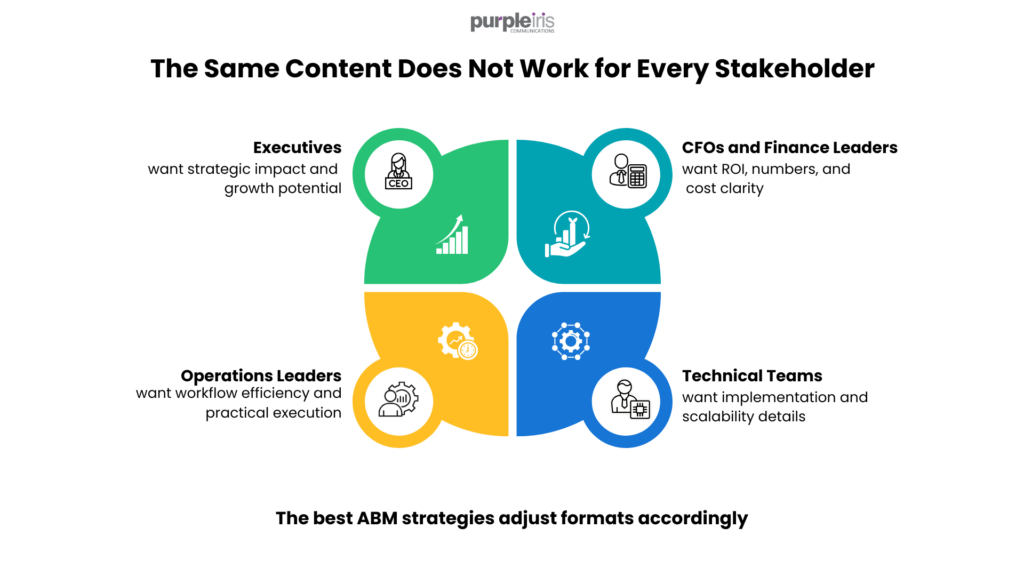
Not every stakeholder in the buying group consumes information the same way. An IT head or CIO may want to understand the mechanics behind your solution, implementation details, or how you solved similar challenges for other companies. But executives such as CEOs and CFOs are often looking for the highlights: business impact, risk reduction, operational efficiency, or revenue outcomes.
This is where short, precise formats such as executive briefs and one-pagers win:
- One-pagers anchored in business outcomes like cost reduction, revenue growth, or risk reduction, not product features
- ROI frameworks that translate what you do into numbers a CFO recognizes and trusts
- Tailored briefs that speak directly to the account’s stated priorities, not a generic product overview
These formats make it easier for senior decision-makers to quickly understand the value, align internally, and move conversations forward without needing to dig through long-form content.
4. Webinars and Roundtables: Engage the Buying Group with Intent
In traditional demand generation, webinars are built for volume. In ABM, they signal intent. When multiple stakeholders from the same target account attend a focus group webinar or closed-door roundtable on their industry or a challenge they are actively working through, you are in a conversation with a group already inside the problem, asking sharper questions and moving closer to a decision.
What works instead is focus and structure:
- Industry-specific sessions designed for a vertical where you are targeting multiple accounts. Build these around one clear problem, use examples that reflect that industry, and keep the group small enough for interaction.
- Closed-door roundtables for high-priority prospects, where the conversation can go deeper and stay grounded in their context. Tailor the agenda to their priorities, involve both sales and subject matter experts, and leave space for discussion rather than running it like a presentation.
Create documents with key highlights from the sessions and share them with the participants. That becomes yet another touchpoint for your team.
5. LinkedIn Content: Staying Visible While Accounts Decide
ABM is not about quick motion. Target accounts often take months to reach a buying decision. During that window, a consistent LinkedIn presence through executive posts, targeted sponsored content, and industry commentary keeps your brand visible to stakeholders who are not yet ready to engage directly.
Buyers now complete a large part of their research independently, often consulting peer reviews, third-party content, and increasingly, AI tools before engaging a vendor’s sales team. Platforms like LinkedIn play a significant role in that process, shaping how buyers evaluate and compare options long before direct conversations begin.
This format works best when it feels human:
- Posts from senior leaders with clear opinions
- Commentary tied to industry developments
- Occasional long-form insights without promotion
Rather than polished corporate content, use different messaging styles. Think of combining bold POVs, storytelling with a human touch, and utilitarian content to educate your audience.
6. Email and Orchestration: Connect Everything
Most teams create strong assets but treat them as standalone pieces. In ABM campaigns, content needs to function as a sequence, and email is what holds that sequence together. This is often where ABM programs either build momentum or lose it.
That requires a more intentional approach:
- Trigger communication based on account behavior rather than fixed timelines
- Match content to what each stakeholder actually cares about, whether that is technical feasibility, operational impact, or business outcomes
- Align closely with sales so content reinforces ongoing conversations
By doing this, teams are not just using emails as a distribution channel, but as a way to control timing, context, and progression across the account, ensuring the right stakeholder sees the right content at the right moment and understands why it matters.
How Purple Iris Approaches ABM Content
At Purple Iris, we look at content through one lens: does it help an account move forward?
That changes how content gets created. We tailor messaging and content formats based on account context, engagement patterns, and marketing signals across ABM campaigns. We look at what topics are driving interaction, what formats are getting shared internally, where conversations are slowing down, and which stakeholders are engaging at different stages of the buying journey.
From there, formats become more deliberate.
- Thought leadership is used to shape how a problem is understood
- Case studies and research are built to support internal discussions
- Executive content is designed to help champions make a clear business case
Successful ABM campaigns rely on multiple factors working together, from targeting and timing to sales alignment, personalization, distribution, and follow-through. Content is one part of that larger system, but it plays a powerful role in helping accounts understand value, build internal alignment, and move conversations forward.
Is your ABM content driving engagement but not movement?
Purple Iris Communications combines behavioral insight with strategic storytelling to craft messaging that resonates, differentiates, and converts. Let’s start the conversation.
FAQs
What type of content do different stakeholders prefer in ABM?
Different stakeholders prioritize different information:
- Executives focus on business growth and strategic value
- Finance leaders look for ROI and cost clarity
- Technical teams evaluate implementation and scalability
- Operations leaders care about efficiency and execution
This is why ABM campaigns require multiple content formats.
How is ABM content different from traditional B2B content?
Traditional B2B content is usually created for broader audiences and lead generation at scale. ABM content is more targeted, personalized, and designed for specific accounts, stakeholders, and business contexts.
What role does thought leadership play in ABM campaigns?
Thought leadership helps shape how target accounts understand a problem before sales conversations begin. Strong thought leadership content builds credibility, creates differentiation, and positions your brand as a strategic partner rather than just another vendor.
How can businesses improve content performance in ABM campaigns?
Businesses can improve ABM content performance by aligning formats with stakeholder needs, using account-specific insights, coordinating closely with sales teams, and creating content that supports internal evaluation and decision-making.