
Personal branding today often looks like momentum from the outside but feels like maintenance on the inside.
You are still showing up on social media and hitting the posting cadence you set for yourself. But the ideas feel thinner than they used to. The posts take longer to write. Maintaining the momentum every week carries a weight it did not have 18 months ago.
That is personal brand burnout. And in the world of B2B personal branding, it is far more common than anyone talks about publicly, partly because admitting it feels like admitting you have run out of things to say.
| What is personal branding burnout? |
| Personal branding burnout happens when the effort to consistently create and share content starts to drain your energy, usually because your output is not supported by meaningful thinking or real work. |
The data backs this up. A 2025 study surveying 1,000 American professionals found that 38% of professionals say maintaining a personal brand has caused them stress or burnout, and 40% have already taken a break from visibility because of it. 1
YouTube creator Jacksepticeye publicly spoke about stepping back from content creation after experiencing burnout, which led to a deliberate reduction in his posting frequency. 2
Here are five specific ways burnout takes hold, and what to do about each one.
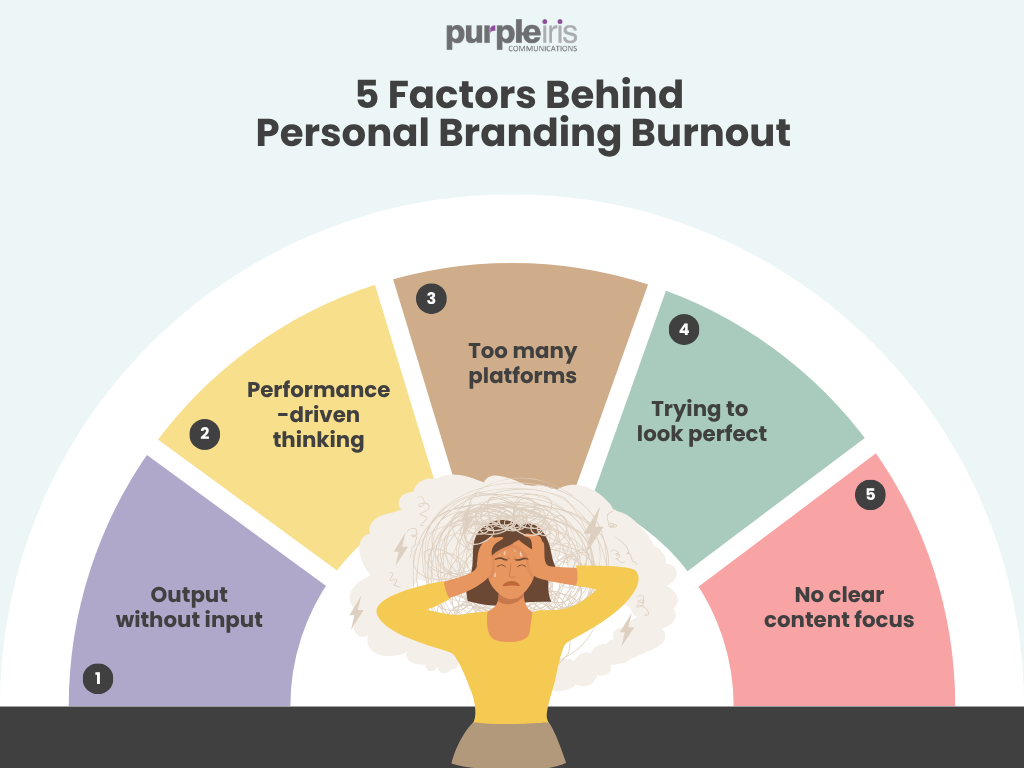
1. Your Output is Outpacing Input
Every personal branding playbook pushes consistency; post regularly, show up frequently.
It’s not incorrect guidance—but the underlying issue may be a mismatch between the effort to produce outcomes and the investment in developing the thinking that drives them. You are making withdrawals from a mental account without depositing anything back into it. Over time, the content becomes repetitive, forced, and harder to produce.
What looks like a content problem is almost always an input problem.
What to do:
Keep a simple running note or folder on your phone where you capture thoughts between meetings, observations from calls, or ideas triggered by something you read. Do not turn them into posts immediately. Let them sit. Develop them later into sharper points of view. One well-processed idea a week is better than a series of underdeveloped posts.
2. You Are Letting Performance Shape Your Thinking
There is a specific moment where things start drifting. A post performs well, and you decide to do more of that.
It feels logical. It slowly changes how you think.
You begin leaning toward formats that work. You simplify ideas because they get more reach. You avoid nuance because it does not travel as well. Over time, your content starts sounding like what performs, not what you actually think.
The numbers might still look good for a while. The process starts feeling hollow.
What to do:
Check performance in batches, not after every post. Decide your content direction before looking at analytics. If a post worked, understand why, but do not let that become your default template.
3. You Have Expanded Across Too Many Platforms
At some point, someone will suggest you start a newsletter. Someone else will say your content would land on Instagram. Another person will recommend a podcast.
Each suggestion makes sense on its own.
Taken together, they create overload.
Every platform has its own format, rhythm, and expectation. Managing even two platforms well requires more cognitive effort than one. That overhead builds quickly on top of your actual work.
What to do:
Pick one platform that is directly tied to your professional outcome. Focus your effort there. Treat every additional platform as optional until you have the time and system to support it properly.
4. You Are Trying to Look Perfect Instead of Being Real
Personal branding quietly pushes people toward polish. You want to sound sharp, clear, and always put together.
Over time, that turns into performance.
You avoid talking about things that did not work. You filter your voice to sound more certain than you actually feel. The brand looks strong from the outside, but it stops feeling like you.
That gap creates fatigue.
What to do:
Allow space for imperfection and being vulnerable in your content. Share what you are figuring out, not just what you have figured out. You do not need to package every thought into a lesson. Sometimes a raw observation builds more trust than a polished takeaway.
5. You Are Diluting Your Voice by Talking About Everything
Another subtle way personal branding burnout builds is by trying to have an opinion on everything.
You start expanding beyond your core themes because it feels like you should stay relevant. You comment on trends, industries, and ideas that are not directly connected to your work. Over time, your positioning becomes unclear, and creating content starts feeling heavier because there is no anchor.
When you talk about everything, it gets harder to stay clear on what you are really known for.
What to do:
Define 2–3 core themes you want to build depth in and stay close to them. Not every trend needs your take. Depth in a few areas builds far more clarity than spreading across many.
What Recovery Looks Like If You Are Already There
If burnout has already set in, pushing harder rarely fixes it. It usually makes it worse.
A few things that actually help:
- Step back when your thinking feels depleted
Do not force posts to maintain presence. Use that time to focus on work, conversations, and inputs that will eventually give you something real to say. - Audit what you are actually proud of
Look at the posts that felt good to write, not just the ones that performed well. That is where your real voice is. - Return at a lower cadence with stronger ideas
One thoughtful post a week is more sustainable than trying to maintain daily output. - Start engaging, not just posting
Personal branding is not a one-way street. If you expect engagement, you need to participate as well. Follow people in your space, respond to their ideas, and contribute to conversations. That interaction often sparks better thinking than posting in isolation. - Get support where needed
If you are juggling too many responsibilities, having a trusted partner to help structure and articulate your ideas can reduce pressure without diluting your voice.
The Professionals Who Last Play a Different Game
The professionals who build personal brands that last may not be the most prolific ones. They are the ones who structured their professional life so that thinking comes first, and content emerges as a result of it.
That is not a personality type. It is a practice. And it is available to anyone willing to stop treating their personal brand as a content production problem and start treating it as a thinking development one.
At Purple Iris Communications, we work with founders and B2B teams to turn real expertise into content that reflects how they think and wish to contribute to their professional community, without forcing volume or diluting voice. If you are building a personal brand and want it to last, that is the conversation worth having.
FAQs
1. How do I know if I am experiencing personal branding burnout?
You may be experiencing it if your content feels forced, ideas take longer to develop, posting feels like pressure, and you find yourself repeating the same thoughts.
2. How often should I post on LinkedIn for personal branding?
There is no fixed frequency. A sustainable approach is to post when you have something meaningful to share, even if that means fewer but more thoughtful posts.
3. How can I generate better content ideas consistently?
Capture ideas from your daily work, conversations, and observations in a simple note or folder. Develop them over time instead of forcing ideas on a schedule.
4. Do likes and impressions matter for personal branding?
They help with reach, but they should not guide your thinking. Meaningful engagement from the right audience is more valuable than high visibility alone.