
Every B2B startup has that one blog post.
It brought in traffic. People shared it. The sales team started sending it to prospects. For a while, it did exactly what good content is supposed to do.
Then something familiar happened.
The next campaign demanded attention. Another launch took priority. A fresh set of content ideas landed on the calendar. That blog slowly slipped into the archive, even though the questions it answered had not gone away.
This pattern repeats itself more often than most founders realize. Teams invest time, expertise, and budget into creating content, but very little of that effort compounds without a clear content strategy. Every campaign begins with a blank page, despite the business sitting on a growing collection of customer conversations, product insights, sales objections, webinar discussions, and industry perspectives.
The startups that build authority over time approach content differently. They treat every piece of content as the beginning of the next opportunity, and not the end of a marketing task. That continuous cycle is called a content flywheel. Once it starts turning, content begins working as a connected system that attracts attention, builds trust, and keeps creating value long after it is published.
What Is a Content Flywheel?
A content flywheel is a structured system where every meaningful interaction with your audience feeds future content, and every piece of content creates new opportunities to learn from your audience.
Unlike a traditional content calendar that focuses on publishing schedules, a flywheel focuses on continuity.
Think about the journey of a single customer question.
A prospect asks about measuring ROI from thought leadership during a discovery call. The marketing team turns that discussion into a detailed article. The founder shares key takeaways on LinkedIn. The sales team uses the article during follow-up conversations. Readers respond with new questions, revealing gaps that inspire another article.
One insight has now generated multiple touchpoints without requiring the team to invent another topic from scratch.
That is the power of a flywheel. It creates a continuous exchange between customer conversations, content creation, distribution, and learning. Each stage strengthens the next.
For startups and scaleups with lean marketing teams, this approach delivers something far more valuable than efficiency.
It creates momentum.
What a Content Flywheel Looks Like in Practice
HubSpot is one of the earliest B2B companies to demonstrate what a content flywheel looks like in practice.
Long before inbound marketing became mainstream, HubSpot invested heavily in educational content that answered the questions marketers and sales teams were already asking. Its blogs, guides, templates, certification courses, and HubSpot Academy helped professionals learn new skills long before they became customers.
That content attracted a steady stream of organic traffic and built trust with potential buyers. As more people used HubSpot, they shared their experiences, recommended its resources, earned certifications, and contributed to a growing community of advocates. Customer feedback, evolving market trends, and user behaviour then shaped the next generation of educational content, creating a continuous cycle of learning, engagement, and improvement.
Rather than treating content as a lead generation tactic, HubSpot used it to educate, delight, and retain customers. Every guide, course, and community interaction reinforced the next one, strengthening the brand’s authority while continuously attracting new audiences. That is the essence of a content flywheel: every piece of content creates value today while generating insights, trust, and momentum for tomorrow.
Another company is Notion. In its early years, Notion did more than publish product updates.
The company encouraged users to build templates, share workflows, create tutorials, and teach others how they used the platform. That community content became an extension of the brand itself. Every template gallery, YouTube tutorial, and productivity guide introduced new users to Notion without relying solely on paid marketing.
The flywheel became self-sustaining.
Users created content. That content attracted new users. Those users created even more content.
The lesson for startups is simple. A content flywheel does not have to depend entirely on your marketing team. Customers, partners, and employees can all contribute to it when you create opportunities for them to share their expertise.
The Four Stages of a High-Performing Content Flywheel
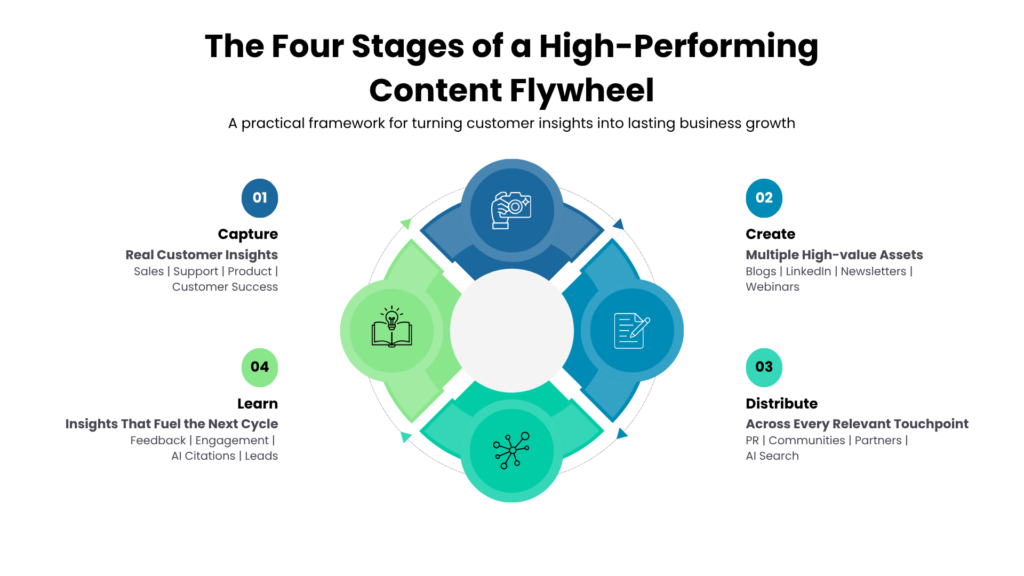
1. Capture Real Customer Intelligence
Every sales discovery call, onboarding session, product demo, support ticket, and customer interview contains language that real buyers use every day. That language becomes your strongest source of content ideas because it reflects genuine problems rather than assumed ones.
For example, if several prospects ask, “How do we measure ROI from thought leadership?” that question deserves far more attention than another generic article about content marketing trends.
Customer conversations give your content relevance before you even begin writing.
2. Turn One Insight into Multiple Assets
Many startups stop exploring a strong idea after one article.
That leaves significant value untapped.
Suppose your team publishes a detailed guide on product onboarding.
The guide can become LinkedIn posts highlighting key insights, short videos explaining common mistakes, newsletter content, sales enablement material, customer onboarding resources, and responses for AI-powered search experiences.
Repurposing is not about copying content across channels. It is about adapting one valuable idea for different channels and moments in the buyer journey.
This approach improves consistency while reducing the pressure to constantly generate new content topics.
3. Distribute with Purpose
Publishing is only the halfway point.
One of the biggest misconceptions in B2B marketing is that quality content naturally finds its audience. It rarely does.
Successful startups invest as much effort in distribution as they do in creation. That includes founder-led LinkedIn posts, email newsletters, customer communities, partner collaborations, PR opportunities, and sales outreach.
Distribution has become even more important in the AI search era. Third-party mentions in trusted publications, industry blogs, podcasts, and analyst reports help establish credibility beyond your own website.
Research by 5WPR found that 85.5 percent of AI citations come from earned media rather than brand-owned websites, making PR and earned media increasingly valuable for improving visibility across AI-powered search experiences.1
Every distribution channel introduces your content to a different audience. Each interaction generates new questions, comments, mentions, and citations that strengthen future content and reinforce your authority across both traditional search and AI-generated results.
Distribution is where the flywheel begins to gather speed.
4. Measure, Learn, and Feed the Next Cycle
A flywheel only works when it keeps learning.
Many teams measure page views and impressions, then stop there. Those metrics tell you how many people noticed your content. They do not explain whether it influenced business outcomes.
Instead, track signals that reveal momentum:
- Which assets generate the most qualified demo requests?
- Which LinkedIn posts spark meaningful conversations with buyers?
- Which questions keep appearing across sales calls?
- Which pages are earning backlinks, newsletter sign-ups, or AI citations?
These insights should shape your next content decisions. In other words, performance data is not the end of the process. It becomes the beginning of the next cycle.
Five Mistakes That Slow the Flywheel
Even strong content programs lose momentum when the system breaks.
Creating Before Listening
Keyword research matters, but customer conversations reveal the context behind those searches. Start with real buyer questions and validate them with search data.
Publishing Without Distribution
A great article shared once is a missed opportunity. Build a distribution plan before you write the first paragraph.
Obsessing Over Volume
Publishing four average blog posts every month rarely outperforms publishing one resource that continues earning traffic, backlinks, AI citations, and conversations.
Keeping Content Inside Marketing
Your sales, customer success, product, and leadership teams generate valuable insights every day. Treat them as contributors, not just stakeholders.
Failing to Refresh Successful Content
Markets evolve, customer expectations shift AI search changes how information is surfaced. Updating existing high-performing content often delivers stronger returns than constantly publishing new articles.
Why Content Flywheel Matter More in the AI Search Era
Search is no longer limited to ten blue links.
According to McKinsey, half of consumers already use AI-powered search, and traditional search traffic could decline by as much as 50 percent as AI answers move earlier into the buying journey.2
That makes authoritative, well-connected content more valuable than ever.
This changes the role of the content flywheel.
Every customer interview strengthens an article. Every blog post supports a newsletter. Every newsletter inspires a webinar. Every webinar creates new insights for future articles. Instead of isolated assets competing for attention, you build a connected body of knowledge that search engines and AI systems can understand, reference, and trust.
This is where SEO, Answer Engine Optimization (AEO), and Generative Engine Optimization (GEO) begin working together, creating a compounding impact.
Turn Content Into a Growth Engine
The next valuable idea inside your startup is probably already there.
It might be sitting in a sales call recording, buried in customer feedback, hidden inside a product discussion, or waiting in the comments below a LinkedIn post.
The opportunity is in building a system that ensures those ideas create value long after the first conversation.
That is what a content flywheel does. It turns a single insight into an article, which in turn sparks conversations in different customer touchpoints.
And those conversations reveal fresh questions that shape the next piece of content.
Over time, every asset contributes to a larger body of knowledge that builds trust, supports sales, improves discoverability, and positions your startup as a credible voice in its industry.
Building that kind of momentum does not happen by publishing more. It comes from having a thoughtful content strategy, a clear distribution plan, and a process that connects every piece of content to a larger business goal.
That is exactly how we approach content at Purple Iris Communications. We help B2B startups and scaleups build content ecosystems that attract the right audience, strengthen thought leadership, and continue delivering value long after they go live.
Looking to build a content strategy that keeps working beyond the publish button? Let us create a content flywheel that turns your expertise into long-term business growth.
Frequently Asked Questions About Content Flywheel
1. How is a content flywheel different from a content marketing strategy?
A content marketing strategy defines what you create, who you create it for, and the business goals it supports. A content flywheel focuses on how every content asset continues creating value after it is published. Together, they help B2B brands move from one-time campaigns to a system that compounds authority and demand over time.
2. How long does it take for a content flywheel to show results?
A content flywheel builds momentum gradually. While some businesses may see improvements in engagement and search visibility within a few months, meaningful business outcomes such as stronger authority, qualified leads, and organic demand often develop over a longer period through consistent execution.
3. Can AI-generated content become part of a content flywheel?
Yes, provided it is guided by human expertise. AI can accelerate research, outlining, and repurposing, but original customer insights, founder perspectives, and industry experience remain essential for building authority and trust.
4. How does a content flywheel support SEO, AEO, and GEO?
A content flywheel creates interconnected, experience-driven content around related topics. This strengthens topical authority for search engines while also increasing the likelihood of being referenced by AI-powered search experiences through well-structured, trustworthy, and regularly updated content.
5. Should startups prioritise creating new content or updating existing content?
Both are important, but updating high-performing content often delivers faster returns. Refreshing statistics, examples, keywords, and industry insights helps maintain relevance while extending the value of existing assets across search engines and AI search platforms.
References
- https://www.prnewswire.com/news-releases/85-5-of-ai-citations-come-from-earned-media–not-brand-websites-5w-releases-ai-and-the-israeli-brand-mapping-the-new-discovery-funnel-302771336.html ↩︎
- https://www.mckinsey.com/capabilities/growth-marketing-and-sales/our-insights/new-front-door-to-the-internet-winning-in-the-age-of-ai-search ↩︎