
Most B2B brands don’t realize their messaging is outdated until growth begins to slow. Pipeline quality weakens. Sales teams struggle to differentiate. Website traffic fails to convert.
These small inconsistencies, missed signals, and diluted messaging aren’t always product, market, or sales problems. Often, the issue lies with your brand message.
A CMO at a mid-sized technology solutions company once told us her biggest fear wasn’t a failed campaign. It was being asked, “What do we really stand for?” — and realizing there was no sharp, clear answer ready. Recovering from a failed campaign would be easier than rallying the organization around one brand message.
That moment of discomfort is often the wake‑up call leaders need. Our client prevented that moment by periodically evaluating her brand message and utilizing our expertise to ensure it stayed aligned with evolving buyers and business priorities.
Catching the signals early can be tricky. Messaging decay rarely happens overnight. It emerges in subtle ways that are easy to overlook until they begin affecting revenue, customer perception, and competitive differentiation.
And when your brand message drifts out of sync with who you are today, every marketing dollar risks being wasted.
We have seen this played out across B2B organizations, where we have orchestrated a message refresh aligned with the business vision. Whether driven by changing buyers, expanded offerings, acquisitions, or increased competition, there comes a point when a brand messaging refresh becomes a business necessity rather than a marketing exercise.
In this article, we outline seven signs it’s time for a brand messaging refresh, along with practical ways to assess where your messaging stands today.
1. Your campaigns are generating reduced engagement
When your marketing campaigns are getting fewer clicks, lower open rates, and weaker conversions, it’s mostly because the message no longer resonates with today’s buyers.
Today’s B2B buying decisions involve larger buying committees, more executive stakeholders, longer evaluation cycles, and greater scrutiny around risk, compliance, security, AI adoption, and business outcomes.
As a result, messaging that once resonated may no longer address the concerns that influence purchase decisions today. For example, a value proposition built around speed and efficiency may fall short when buyers are prioritizing resilience, governance, scalability, or measurable business impact. Ensuring your message is built for and reaches the real buyer is critical for driving impact.
A recent study found that 42% of senior B2B marketers say their top business priority this year is increasing brand awareness and reputation among decision-makers.1
When messaging fails to target the real buyers and reflect their evolving priorities, marketing campaigns become less effective, sales conversations become harder, and growth stagnates.
What to do:
Reassess your current Ideal Customer Profile (ICP), buying committee, and decision-making process. Compare that against how you targeted your audience in the last quarter. If there’s a mismatch, a refined marketing communications strategy can close the gap before your next campaign.
2. Different teams tell different versions of your story
Ask your CEO, a sales rep, and a customer success manager to describe your company in 60 seconds. If you get three different answers, your brand message is getting fragmented.
This often happens when new hires, products, or markets shift the messaging without cross-functional alignment. The result? Confusion for customers and diluted credibility.
This isn’t a small problem.
Research shows that maintaining brand consistency can increase revenue by 10-20%.2
Customers relate to brands that feel coherent and trustworthy, not confusing. Fragmentation isn’t just a communications headache; it’s a loyalty, credibility, and ultimately a revenue problem.
What to do:
Do a brand workshop with your sales, marketing, and customer success teams. Agree on one sentence that captures the essence of your brand. Build a strong employee communication program that cements this shared truth about what your brand delivers and for whom.
3. Buyers Don’t Recognize Your Full Capabilities
When prospects and customers only mention or inquire about a fraction of your services, overlooking newer offerings, something needs to change.
Your product lines have increased, and the industries you serve have expanded. The brand message that once worked perfectly now feels inadequate and doesn’t quite tell the whole story.
This creates a disconnect between perception and reality.
Take the example of Mailchimp, which started as a quirky email tool. By 2018, it had become a full marketing platform — automation, ads, landing pages, audience management. Yet its brand still screamed “email.” The company realized it was time for a brand refresh. Mailchimp sharpened its identity while keeping its playful personality intact, signaling to customers that the brand had grown up without losing its charm.
The same challenge affects many B2B companies. If clients only recognize a fraction of your capabilities, you are limiting growth opportunities before conversations even begin.
What to do:
Review the products, services, and capabilities added over the past 18–24 months. Then audit your website, sales decks, and elevator pitch. If your biggest revenue drivers aren’t even mentioned, that’s your refresh brief.
4. You Sound Exactly Like the Competition
Read your homepage next to three competitors’ homepages with the logos covered. If you can’t tell them apart, your buyers can’t either. This is increasingly common in crowded B2B categories — fintech, SaaS, professional services — where everyone converges on the same five adjectives, and no story stands out.
This isn’t just a branding issue. Weak differentiation directly affects pipeline quality, pricing power, and win rates. Buyers struggle to understand why your solution is meaningfully different, making decisions increasingly dependent on cost rather than value.
Stripe differentiated early by positioning itself not as another payments app, but as the payments infrastructure for the internet. The company focused its messaging around a simple promise: with just a few lines of code, you could enable global payments. That single claim, backed by proof from customers like Amazon, Lyft, and Shopify, helped Stripe dominate the category and become the default choice for internet‑first companies.
The strongest positioning is built around a claim only your organization can credibly make—and prove.
What to do:
Identify the one outcome, capability, area of expertise, or customer result that competitors cannot easily replicate. Back it with evidence — case studies, data, customer stories, and build your next quarter of content around it.
5. Market Perception Hasn’t Caught Up With Your Merger or Acquisition
Mergers, acquisitions, partnerships, and strategic pivots often transform the portfolio beyond the original brand promise. Yet many organizations continue communicating the same story they told before those changes occurred.
The risk is that without a refresh, customers cling to outdated perceptions. They may assume you are still the same company they knew before the acquisition. That gap between reality and perception stalls growth and undermines credibility.
A successful acquisition strategy should strengthen both business capability and market perception. If the second piece doesn’t happen, the full value of the transformation may never be realized.
What to do:
If your business strategy has pivoted — new markets, acquisitions, or offerings — your brand must pivot too. Audit your messaging against your current strategy. Ask: Does our story reflect who we are today, or who we used to be? If the answer leans toward the past, it’s time to evolve.
6. Your Content No Longer Reflects Your Positioning
Many organizations update their strategy faster than they update their content.
Leadership may have a clear vision of where the business is headed, but the website, thought leadership, case studies, and sales collateral continue telling an older story. This creates a disconnect between brand intent and what the buyer actually takes away.
In some cases, visual identity and messaging evolve separately, creating mixed signals about who the company is and what it stands for.
When content, positioning, and business strategy fall out of sync, credibility suffers.
What to do:
Conduct a content and messaging audit. Review your website, presentations, social channels, and sales assets. Ensure they consistently reinforce your current positioning, priorities, and growth strategy.
7. Your Internal Teams Describe the Business Differently Than Your Customers Do
One of the clearest indicators of messaging drift is when customers describe your company differently from how you describe yourself.
Internally, you may believe you are known for innovation, expertise, or transformation. Externally, customers may view you primarily as a service provider, a niche specialist, or a legacy vendor.
That gap signals a problem.
Positioning only works when the market understands and repeats it. If customers aren’t using the language you want associated with your brand, your message isn’t landing.
What to do:
Interview customers, prospects, analysts, and partners. Compare their descriptions with your intended positioning. Any major disconnects should inform your next messaging refresh.
Quick Brand Messaging Audit
A messaging audit is the first step toward refreshing your brand message. It should be led by marketing leadership together with sales and customer success, so the questions reflect both internal alignment and external market reality.
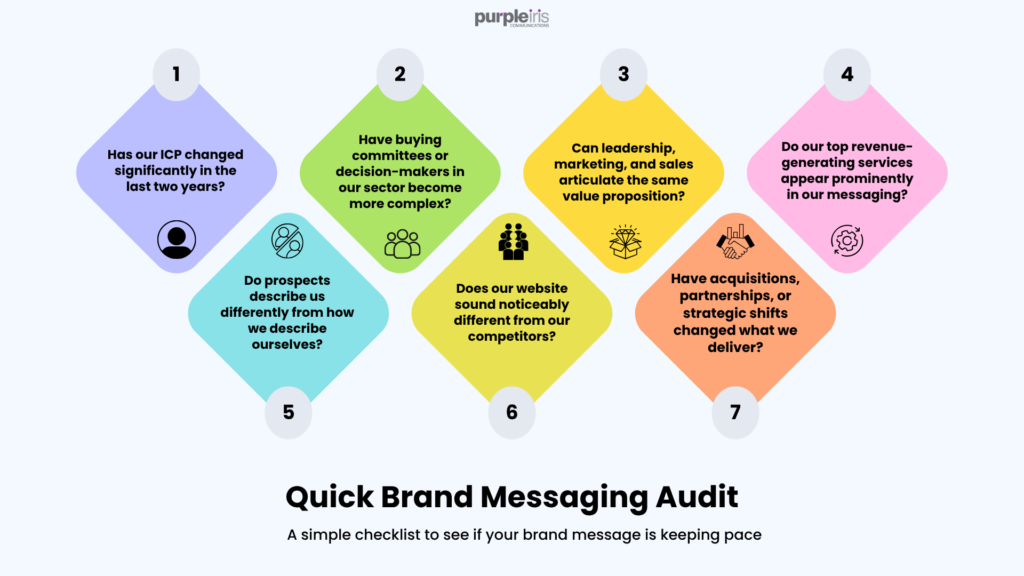
Start with these questions.
- Has our ICP changed significantly in the last two years?
- Have buying committees or decision-makers in our sector become more complex?
- Can leadership, marketing, and sales articulate the same value proposition?
- Do our top revenue-generating services appear prominently in our messaging?
- Do prospects describe us differently from how we describe ourselves?
- Does our website sound noticeably different from our competitors?
- Have acquisitions, partnerships, or strategic shifts changed what we deliver?
If the team answers in the affirmative to any of these questions, it’s time to evaluate your brand message.
A Brand Refresh is About Realignment, Not a Teardown
Before redesigning a website, launching a campaign, or investing in new content, check if your positioning, messaging, and narrative accurately reflect the business you are today. Be cognizant of the signs that it’s time for a brand message refresh.
However, refreshing your message isn’t about burning everything down. It’s about reviewing where your story and your business have drifted apart, and deliberately closing that gap.
In B2B, the differentiation comes not just from a strong portfolio of products and services. It comes from a brand message that is clear and credible, and that buyers trust and repeat.
That’s the work we do at Purple Iris Communications. We help B2B leaders pressure-test their messaging, sharpen their positioning, and turn it into content that moves buyers. The goal isn’t to reinvent what made your brand valuable, but to ensure it still resonates with the audiences you want to win today.
- https://business.linkedin.com/content/dam/business/marketing-solutions/global/en_US/site/pdf/wp/2025/2025-b2b-marketing-benchmark-trust-is-the-new-kpi.pdf ↩︎
- https://www.adobe.com/express/learn/blog/brand-consistency ↩︎
Frequently Asked Questions About Brand Refresh
What is a brand messaging strategy?
A brand messaging strategy defines how your company communicates its value, personality, and differentiation to customers. It ensures consistency across marketing, sales, and customer success.
How often should a B2B company refresh its brand message?
Most experts recommend auditing brand messaging every 18-24 months, or immediately after major events like acquisitions, market pivots, or audience shifts.
What are the risks of not refreshing brand messaging?
Outdated messaging can erode credibility, confuse customers, and waste marketing spend. Studies show that inconsistent brand communication can reduce revenue potential by up to 20%.
How does a B2B brand messaging refresh differ from a rebrand?
A refresh realigns your story with current strategy and audience without discarding your identity. A rebrand is a full overhaul — new name, logo, and positioning.
Can a brand refresh improve employee alignment?
Yes. A refresh clarifies the company’s narrative, helping employees communicate consistently and confidently, which strengthens trust with customers.