
If you have worked in B2B marketing long enough, you have probably seen this pattern: traffic grows, lead volume increases, dashboards look healthy, but pipeline quality remains a problem.
That is usually where the Account-Based Marketing (ABM) conversation begins.
ABM changes the direction of B2B marketing from broadcasting to precision. Instead of trying to reach everyone, companies start focusing on specific accounts with the highest revenue potential and building campaigns around them.
With enterprise buying decisions involving multiple stakeholders, longer evaluation cycles, tighter budgets, and significantly more competition for attention, the need for ABM has gained momentum.
Over the last few years, another shift has reshaped ABM entirely: AI.
Today, AI is influencing how teams identify buying signals, personalize content, prioritize accounts, automate research, map stakeholders, and even predict intent before a sales conversation begins.
This article explores what ABM actually is, why it has become critical in modern B2B marketing, and what an effective ABM content strategy looks like in practice.
What Is ABM
At its core, ABM is a focused growth strategy where sales and marketing work together to target high-value accounts through personalized campaigns, content, and outreach.
The keyword here is accounts.
Traditional lead generation focuses on a broad industry audience. ABM focuses on specific organizations or accounts and their buying committees. That changes everything.
In enterprise sales, a single buying decision often involves multiple teams evaluating the same solution from very different perspectives.
This is why effective ABM strategies combine account-level targeting with role-specific communication. The goal is to build relevance across the people involved in the decision-making process.
Why ABM Has Become So Important in B2B
As B2B buying becomes more complex, marketers are leaning on ABM to bring greater precision to their strategies.
ABM reframes the core marketing question from “how do we generate more leads?” to “how do we build trust with the accounts most likely to generate revenue?”
That reframing changes the role of content entirely, from traffic bait to targeted asset development.
This shift has also changed how companies approach ABM content strategy, especially in enterprise B2B environments.
Here are the key reasons why ABM is gaining in importance:
Personalization That Goes Beyond the Surface
Enterprise decision-makers receive hundreds of outreach attempts every month. Swapping in a company name or referencing a recent funding round does not move them. What registers is content that reflects the actual operational reality of their role — the compliance pressure a healthcare IT director is managing, the adoption risk a VP of Operations is trying to mitigate, the total cost calculation a CFO is running before any vendor conversation begins.
| Context | Generic Demand Gen | ABM Approach |
|---|---|---|
| Message to a healthcare CFO | “Our platform helps finance teams work smarter.” | “Healthcare CFOs managing compliance overhead are reducing audit prep time by 40% with automated documentation workflows.” |
Specificity Cuts Through When Everyone Sounds the Same
Most B2B categories are saturated with vendors publishing similar frameworks, trend pieces, and thought leadership. The content may be presented differently, but the messaging often sounds identical.
ABM sidesteps that noise by making specificity the strategy. When a target account receives content that directly addresses their industry pressures and buying concerns, it does not compete for attention. Companies that invest in that level of contextual relevance establish credibility before competitors enter the conversation.
| Context | Generic Demand Gen | ABM Approach |
|---|---|---|
| Content for a mid-market logistics company | “5 Ways to Optimize Supply Chain Operations” | “How mid-market 3PLs are managing last-mile cost volatility without expanding headcount — and what the data shows about where the savings are coming from.” |
Focused Spend, Stronger Returns
Traditional demand generation distributes budget broadly and waits for the right accounts to self-select. ABM allocates the same budget to accounts already identified as high-fit and high-value. Less is spent chasing leads that will never convert.
A Demandbase study found that top B2B marketers are achieving 81% higher ROI with ABM. 1
When marketing spend is aimed at the right accounts from the start, the funnel gets shorter, win rates improve, and the sales team spends time on opportunities worth pursuing.
| Context | Generic Demand Gen | ABM Approach |
|---|---|---|
| Campaign targeting | Broad industry audience; 10,000 impressions, 0.8% CTR, 80 leads, 4 qualified | 50 target accounts; coordinated outreach across 3 stakeholders per account; 6 accounts moved to active pipeline |
What an Effective ABM Content Strategy Looks Like
ABM content strategy is less about content quantity and more about strategic relevance.
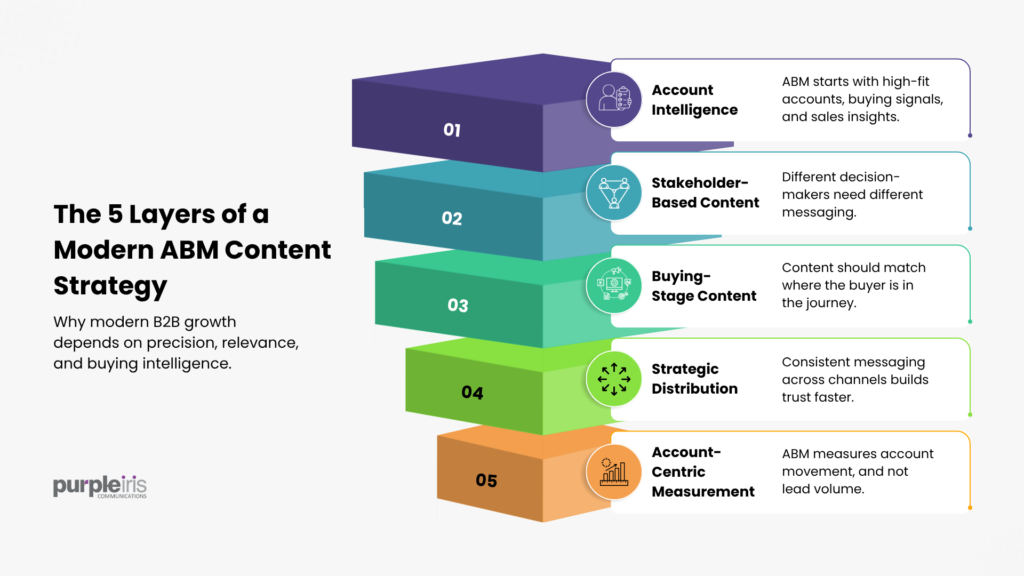
The strongest ABM programs follow five interconnected layers:
1. Account Intelligence Comes First
It starts with account-level marketing signals. Before a campaign starts, teams need clarity on:
- Which accounts matter most
- What business challenges are they facing
- Which teams influence decisions
- What signals indicate buying intent
- What competitors are they considering
- Where friction exists in the buying process
AI tools now help teams identify account activity, surface buying signals, and prioritize accounts faster. But technology alone does not replace contextual understanding.
ABM account selection often begins with SDR-led research, intent signals, and account qualification. Collaboration with customer-facing sales teams becomes equally important because they understand recurring objections, operational friction, buying concerns, and the realities shaping purchase decisions.
According to the Labs by Demandbase B2B GTM Report, organizations that align marketing and sales around buying groups achieve up to 2–3× higher win rates than teams still centered around individual leads.2
That alignment becomes far more effective when marketing builds content around real customer conversations instead of editorial assumptions alone.
For example, if enterprise prospects repeatedly ask, “How long will implementation take?”, that concern should shape landing pages, case studies, FAQ content, sales decks, and comparison pages.
Key takeaway: Account intelligence is an ongoing input that should continuously shape content, messaging, and outreach priorities.
2. ABM Requires Stakeholder-Based Content
Enterprise buying decisions rarely depend on one person.
Research from Gartner notes that buying groups now range from 5-16 stakeholders across multiple functions, each bringing different priorities and opinions into the decision-making process.3
For example, a cybersecurity company selling enterprise solutions to banks rarely deals with one decision-maker. There may be a CISO evaluating risk, a procurement head evaluating costs, an IT leader assessing integrations, or a finance team reviewing ROI. Each decision-maker enters the conversation with their own priorities, concerns, and definition of value.
This is why an effective ABM content strategy does not rely on one generic asset for the entire buying group.
Instead, it builds layered messaging systems where:
- executive content focuses on business outcomes
- technical content focuses on implementation and security
- operational content focuses on usability and workflow impact
- financial content focuses on ROI and efficiency
Unlike broader demand generation content designed for reach and awareness, ABM content is designed to deepen engagement within specific high-value accounts.
The goal is to help different stakeholders inside the same account move toward internal alignment and buying confidence.
Key takeaway: Map your content to roles before you map it to channels. If you cannot articulate what a CFO versus an IT Director needs from your content at each stage, your distribution strategy will be flawed.
3. Content Must Match Buying Stages
One of the biggest ABM mistakes is pushing bottom-of-the-funnel content too early.
A prospect exploring a problem does not want a product demo immediately. Similarly, an account evaluating vendors does not need another generic awareness blog. Strong ABM strategies align content with buying maturity.
Early Stage
Focus:
- Industry shifts
- Risk awareness
- Operational inefficiencies
- Market education
What works:
- Research-backed articles
- Industry reports
- Executive insights
- Small group events (e.g. webinars and roundtables)
Mid Stage
Focus:
- Evaluation support
- Process clarity
- Strategic comparison
What works:
- Solution frameworks
- Buyer guides
- ROI explainers
- Competitive comparison assets
- Custom landing pages tailored to industry pain points
Decision Stage
Focus:
- Confidence building
- Objection handling
- Internal buy-in
What works:
- Industry-specific case studies
- Security documentation
- Implementation walkthroughs
- Executive-level presentations built for a specific account’s strategic priorities
ABM works best when content behaves like guided decision support.
Key takeaway: Treat each buying stage as a distinct content brief. The job of early-stage content is to create resonance. The job of mid-stage content is to reduce uncertainty. The job of decision-stage content is to make the internal case easier to make.
4. Distribution Matters as Much as Content Creation
Enterprise buyers do not move through one predictable content path.
Some engage through LinkedIn thought leadership. Others through outbound outreach, webinars, analyst reports, retargeting campaigns, or sales conversations.
Strong ABM programs coordinate messaging across multiple touchpoints:
- personalized outreach
- executive newsletters
- retargeting campaigns
- custom landing pages
- sales enablement assets
- industry follow-ups
The goal is consistency.
When multiple stakeholders repeatedly encounter messaging that feels relevant to their business reality, trust starts compounding.
Key takeaway: Distribution in ABM is a coordinated engagement plan. Every channel should be carrying the same account-level message, rather than competing versions of it.
5. Measurement in ABM Looks Different From Traditional Marketing
ABM is account-centric, so success metrics need to stay that way.
The target accounts for an ABM campaign may be just 100 or even lower. If three target accounts move deeper into pipeline stages, that campaign may already be creating a meaningful revenue impact.
Strong ABM teams track:
- Account engagement depth
- Buying committee participation
- Sales conversation quality
- Pipeline velocity
- Revenue influence
The question shifts from:
“How many leads did this generate?”
to:
“Did this help target accounts move closer to a buying decision?”
That shift creates stronger alignment between marketing, sales, and revenue outcomes.
Key takeaway: Account progression, stakeholder coverage, and pipeline influence are the metrics that tell the real story.
Mistakes to Avoid
A lot of ABM campaigns look impressive on slides and underperform in reality. Here is why:
The List is Built on Bad Data
If the list relies on outdated CRM records or firmographic filters alone, teams end up spending on accounts with low buying intent while missing the ones already in-market. The list is the foundation, and it requires serious, data-driven construction.
Sales and Marketing Stay Misaligned
When marketing is optimizing for engagement metrics and sales is focused on deal progression, ABM becomes two parallel activities with no shared outcome. The programs that work build joint accountability around target account movement, pipeline influence, and revenue impact.
Content Feels Generic Beneath the Surface
A personalized subject line with a generic email body is still a generic email. Enterprise buyers see through it immediately. Real personalization means the core message reflects the account’s actual business pressures, not just their company name and a recent news hook.
What Strong ABM Content Requires Today
Modern ABM is becoming more intelligent, more targeted, and far more data-informed than traditional B2B marketing approaches.
AI now helps teams identify buying intent, prioritize accounts, surface engagement patterns, and personalize outreach faster than ever before.
At the same time, AI is flooding the market with repetitive B2B content. That makes original thinking even more valuable.
Enterprise buyers still respond to messaging that understands operational realities, internal pressures, buying complexity, and the human side of decision-making.
That is where strategy, context, and storytelling still matter deeply.
At Purple Iris Communications, we combine AI-assisted research and targeting with human-led strategic communication to help B2B brands build ABM content strategy that feels relevant, credible, and commercially aligned.
From account-focused thought leadership and sales enablement content to personalized nurture journeys and industry-specific messaging, we create content designed to move high-value accounts forward.
FAQs
What is an ABM content strategy?
An ABM content strategy is a targeted B2B marketing approach that creates personalized content and messaging for specific high-value accounts instead of broad audiences.
How is ABM different from traditional demand generation?
Traditional demand generation focuses on reaching large audiences, while ABM focuses on building deeper engagement with specific high-value accounts.
What type of content works best in an ABM strategy?
The most effective ABM content includes stakeholder-specific messaging, industry-focused insights, buyer guides, case studies, custom landing pages, and sales enablement assets.
How does AI improve ABM content strategy?
AI helps ABM teams identify buying intent, prioritize accounts, personalize outreach, analyze engagement patterns, and scale account research faster.
Who should be involved in building an ABM content strategy?
An effective ABM content strategy typically involves marketing teams, SDRs, sales teams, customer-facing stakeholders, and content strategists working together around shared account goals.