Internal branding has a big role to play in what employees take away every day about their organization’s purpose. A strong internal branding strategy acts as a common thread across touchpoints, delivering unified messaging and aligning teams toward the organization’s mission.
However, for many organizations, internal branding misses the target. It is created in a disjointed manner—a campaign launch, a town hall or a redesigned office space—without a central theme to reinforce the key messages.
The effort is evident. The intent is clear. But it fails to create an impact beyond visibility.
That is because internal branding is not defined simply by what is created, but by how people experience it.
Every day, employees pick up signals from what their leadership says and what they see around them. In that sense, internal branding is always on and closely tied to the overall employee experience.
The question isn’t if an organization is communicating. What matters is whether it is doing so with intent.
If an organization’s internal communication strategy feels active but not always effective, the gap may not be effort. It may be alignment.
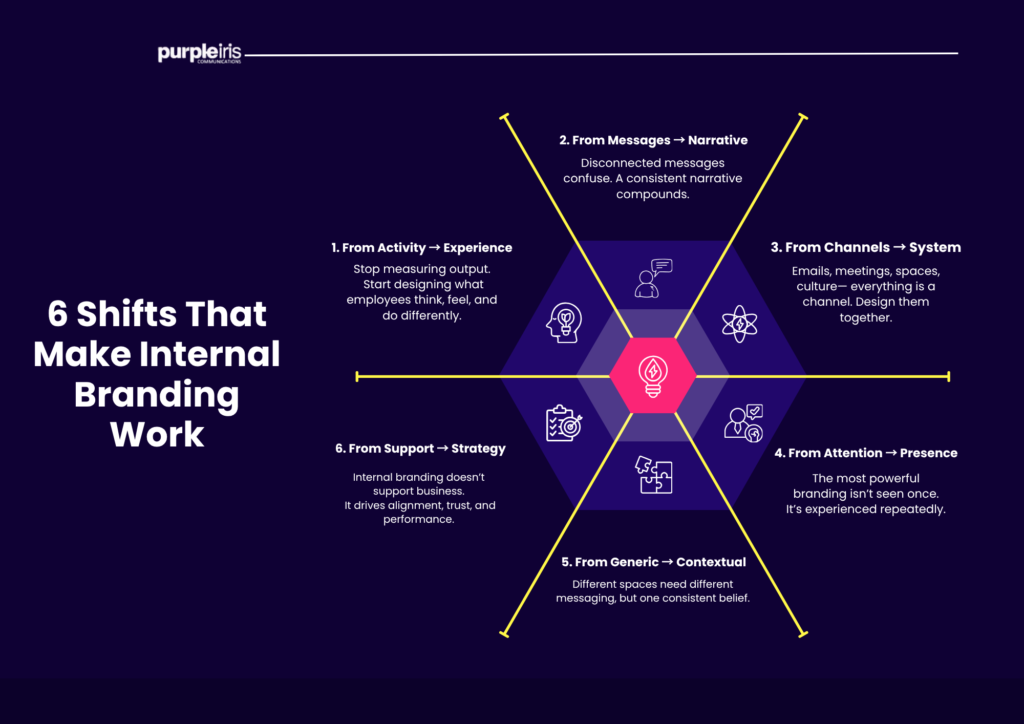
1. Start with Experience, Not Activity
One of the most common pitfalls in internal branding is measuring effort through activity. A packed communication calendar, frequent emails to employees, and polished town halls don’t always mean employees are more aligned, engaged or clear on what you are saying.
In his book, The Brand Gap, American author and brand strategist Marty Neumeier says a brand is not what you say it is; it’s what people perceive it to be.
In internal branding, that perception is shaped every day by what employees see, hear and experience across your workplace branding and communication efforts.
And so, before creating a new internal branding campaign, ask this question: what should employees think, feel or do differently because of it?
The purpose of internal branding is often to create a shift. That shift could be:
- Helping employees feel a stronger sense of belonging
- Building trust during uncertainty or change
- Aligning teams to a new strategic direction
- Reinforcing confidence in leadership decisions
Take the example of a global IT services company that underwent an AI-led transformation. Instead of feeding uncertainty around roles as it embraces AI, the organization grounded its communication in one clear idea: AI is here to strengthen human capability, not replace it.
That thought wasn’t confined to one channel. It surfaced in leadership messages, team conversations, learning sessions and within the physical workplace.
Over time, it informed people consistently and strengthened organizational alignment. That’s what clarity of intent does. Without it, even well-crafted communication can start to feel like background noise.
2. Build a Narrative, Not Isolated Messages
Communication isn’t experienced in silos.
An employee could move from an email to a meeting, notice something in the office, chat with colleagues and scroll through, say, a recognition post on company’s social media handles—all in a few hours.
When these moments come together, it gives employees a clearer idea of what the organization stands for.
For instance, consider an organization positioning itself as future-ready.
To build a strong narrative around the idea, it should show up across:
- Leadership communication that speaks about long-term direction
- Learning programs focused on emerging skills
- Workplace messaging that reflects innovation and forward thinking
- Recognition platforms that reward adaptability and experimentation
If even one of these falls apart, the narrative weakens. But when they align, the message compounds, driving stronger employee engagement.
This is where internal branding shifts from communication to experience design.
3. Design for Channels That Don’t Compete
Most internal communication channels compete for attention.
- Emails need to be opened
- Intranet content needs clicks
- Town halls require dedicated time
But some of the most powerful branding does not rely on attention at all. It works through presence and repetition.
Workplace environments, visual storytelling, everyday rituals and informal cues operate differently. They do not interrupt the workday but exist within it, making them powerful tools in workplace branding.
For example:
- An office corridor that consistently reflects the company’s core capabilities
- A cafeteria that subtly reinforces a cultural belief
- A leadership floor that communicates authority without excess
These aren’t brand assets employees see once and move on from. They encounter them again and again.
And that’s what makes the difference. Over time, repetition shapes perception far more effectively than a one-off message ever can.
4. Adapt to Context
Not every space or moment in the workplace serves the same purpose. Yet, internal branding often treats all communication forms as uniform.
In reality, context shapes how messages are received and contributes to the overall employee experience.
- A cafeteria is where employees decompress: keep messaging light
- A learning zone invites curiosity: focus on growth
- A leadership area demands restraint: communicate with subtlety
- A high-traffic corridor offers quick visibility: keep messaging sharp
In a workplace café, instead of generic branding, the messaging reframed breaks as part of performance:
Refuel your cup. Refuel your mind. Because the future favors the refreshed.
Such context-heavy communication blends with the space. At the same time, all these messages are anchored to a single belief about staying ahead of change.
5. Making it Work for Business Outcomes
Internal branding is often positioned as a culture initiative. However, its impact extends to business performance and employee engagement strategy. It influences how employees think, act and represent the organization to the outside world.
Gallup’s State of the Global Workplace 2025 Report highlights that engaged employees produce better business outcomes and have a measurable impact on organizational performance. However, in 2024, the global percentage of engaged employees fell from 23% to 21%, making the need for stronger alignment even more critical.1
McKinsey reports that 51% of employees who left cited a lack of belonging as a key reason.2
Consider three scenarios:
1. Client Experience
When clients walk through a workplace, they form impressions before conversations begin. If the environment clearly communicates capabilities, values, and credibility, it strengthens trust without a single slide being presented.
2. Talent Experience
In interview areas, branding can shape perception before the first question is asked. When candidates see real stories, employee initiatives, recognition, values in action, the organization does not need to “sell” itself. It simply needs to show itself.
3. Internal Alignment
When the same story shows up consistently across channels, employees begin to understand what the organization stands for. That clarity cuts through chaos and makes decisions easier across the board.
At that point, internal branding stops being a supportive tool and starts becoming a strategic enabler of an organization’s goals.
6. Reinforce Clarity During Change
Change is where internal branding is tested most.
During times of change, whether it’s the advent of advanced technology, restructuring or acquisitions, employees are trying to make sense of what it all means. They look for more than updates. That’s where internal branding becomes even more critical.
This is also where inconsistency can quickly become a problem. If leaders say one thing, the workplace reflects another, and team conversations suggest something else, it doesn’t take long for uncertainty to set in.
But when every touch point reinforces the same belief, clarity builds, strengthening internal branding strategy.
For example, in an organization that is integrating AI into its core offering, a single idea was used to anchor all internal branding:
Technology is powerful. Human thinking makes it meaningful.
This showed up across:
- Leadership communication
- Workplace messaging
- Training content
- Client-facing narratives
The consistency did more than inform; it reassured.
A System That Works Even When You’re Not Looking
Internal branding, in this case, does not just support change but helps employees navigate it with confidence.
Internal branding cannot be defined by a series of campaigns. It must be rooted in a system that operates continuously. It works:
- In the moments between meetings
- In the spaces employees move through every day
- In the consistency of what they see, hear and experience
In a hybrid world, where people aren’t in the office every day, it’s more about reconnecting, re-engaging and experiencing what the organization actually feels like.
And in those moments, every detail counts. Because ultimately, employees do not believe what organizations say occasionally; they believe what they experience consistently.
If internal branding is treated as a set of disconnected efforts, it adds to noise.
But when it is designed as a cohesive system, it becomes a force that shapes perception, builds trust and aligns people as the business grows.
Building this kind of internal branding consistency doesn’t happen by accident. For many teams, putting this system together while managing day-to-day priorities can feel complex. This is where the right partner can help, bringing structure, clarity and a sharp point of view to how your internal brand comes to life. At Purple Iris Communications, we partner with organizations to build internal branding that drives alignment, engagement and business impact.