Many early-stage founders spend months refining product messaging, go-to-market strategy, and investor narratives. Yet, one powerful messaging lever often remains underdeveloped: their own voice.
In B2B markets today, LinkedIn has evolved into an always-on credibility builder. Buyers scan founder perspectives before booking demos. Candidates evaluate leadership thinking before accepting offers. Investors observe how clearly founders understand their category before taking second meetings.
This shift is becoming even more structural. A recent Semrush study analyzing thousands of AI-generated responses found that LinkedIn is now the second most cited domain across major AI search tools, appearing in roughly 11% of answers.1 This means the perspectives founders share on LinkedIn are increasingly shaping how markets and even AI systems explain companies and categories.
Despite this shift, many founder profiles remain static and uninspiring. Some read like digital resumes, whereas others become timelines of product updates and hiring announcements. Very few turn into spaces where market thinking, everyday learning, and real business conversations take shape.
This gap matters more than it appears. According to the Content Marketing Institute, 85% of B2B marketers say LinkedIn delivers the highest value among social platforms.2
Still, founders often approach LinkedIn as a distribution channel rather than a space to share value, demonstrate expertise, and develop a distinct voice. The result is activity without meaningful positioning.
Building LinkedIn from scratch is therefore about shaping how your ecosystem understands what you are building and why it deserves attention. This guide explores how founders can do that step by step with clarity and intent.
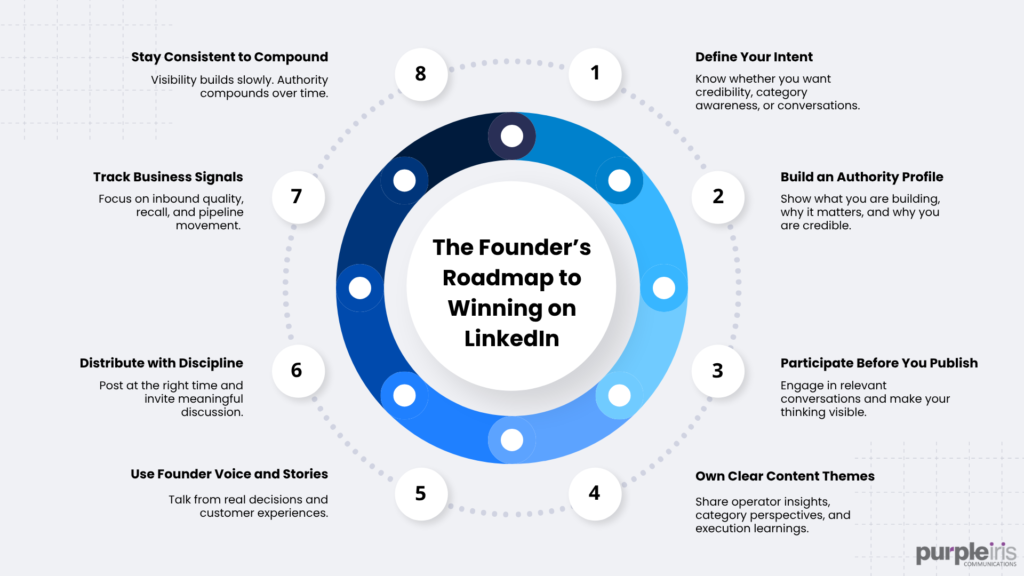
Step 1: Define the Strategic Role LinkedIn Will Play in Your Journey
Before updating your headline or writing your first post, answer a simple question. Why does your LinkedIn presence exist in the first place?
Early-stage founders usually fall into one of three situations:
- You are building credibility in a crowded category.
- You are creating awareness for a new problem space.
- You are opening conversations with decision makers.
Each scenario demands a different communication style.
For example, a founder building a SaaS product in shipping and logistics needs to offer sharp commentaries on how to protect margins and improve service levels at a time of geopolitical disruptions and oil price fluctuations. A founder building a new AI category needs to spend more time educating the market before talking about product features.
LinkedIn becomes powerful when it supports a clear business objective. When founders treat it as part of a larger communication system, their presence begins to create a strong narrative momentum. Aligning LinkedIn thinking with a well-thought-through content strategy or go-to-market communication priorities helps ensure that every perspective shared contributes to long-term positioning.
Step 2: Build a Profile that Signals Authority
Every meaningful LinkedIn interaction begins with a quiet moment of evaluation. Someone clicks on your name after seeing a comment, a post, or a message. In that instant, your profile becomes your first pitch, proof point, and sometimes your first filter.
A strong founder profile works as a positioning asset by communicating three things clearly:
- What you are building.
- Why it matters in the current market context.
- Why you are uniquely placed to build it.
Start with the headline and treat it as a high-visibility statement of value. Avoid generic identity markers like Founder at XYZ. Use this space to express value.
Instead of “Founder at FinEdge”, write something like “Building infrastructure that helps mid-market finance teams close books 40% faster.”
Use the “About” section to build authority. Think of it as a short narrative rather than a chronological summary.
Share the moment or pattern that first drew your attention to the problem. This could be a recurring customer frustration, an operational inefficiency you witnessed firsthand, or a market gap that became impossible to ignore. Move from observation to insight. Explain what existing solutions tend to overlook and how that affects teams on the ground.
When you articulate these dynamics clearly, your profile begins to feel less like a shorter version of your CV and more like your POV of the market you serve.
Finally, position your company as a response shaped by lived insight. Help the reader see that your solution is an informed attempt to address a tangible problem. Over time, this clarity builds confidence in visitors.
Step 3: Understand the Difference Between Presence and Participation
Creating a LinkedIn profile establishes visibility, whereas participation builds familiarity.
On the platform, recognition grows through interaction rather than passive presence. Thoughtful comments, meaningful exchanges, and consistent engagement signal relevance to the audience and the platform. Over time, these signals shape how widely your ideas travel.
Before focusing on publishing content, spend time participating deliberately. It may be by responding to perspectives shared by industry peers, adding context to ongoing discussions about market shifts, or asking informed questions that invite deeper viewpoints. Each interaction becomes a small but visible expression of how you think.
It also helps to identify a few key themes connected to your work and professional values, and make your perspectives visible within those conversations. Showing up consistently where practitioners are discussing these themes strengthens relevance and helps your voice become associated with what matters most.
This phase serves two important purposes:
- It helps you understand what conversations matter to your ecosystem and how practitioners frame real challenges.
- It builds early name recall, with your voice becoming familiar within relevant circles.
Founder communication on LinkedIn can function as a form of market-level personalization. Instead of broad messaging, you engage directly with the people who shape buying decisions, category narratives, and industry momentum, and thus grow your staying power.
Step 4: Build a Content Foundation Before Chasing Growth
Founders often ask how frequently they should post. The better question is what themes they should own.
Your LinkedIn content should sit on three clear pillars.
- Operator insights, which show how you think.
- Category education, which shows how well you understand the market.
- Execution transparency, which shows momentum and authenticity.
For instance, instead of posting “Excited to share that we launched our beta”, you can share “What we learned from our first 10 beta customers about implementation friction.”
This shift turns updates into learning assets.
A useful exercise is to list the 20 hardest conversations you have had with customers in the past quarter. Each conversation can become a meaningful post.
Step 5: Use Founder Voice and Storytelling to Build Trust Faster
On LinkedIn, trust is shaped as much by tone as by insight. Posts that feel overly polished or engineered for reach will not create meaningful engagement. Users respond better to perspectives that reflect real decisions, constraints, and trade-offs.
The founder’s voice carries weight because it emerges from responsibility. It is informed by pricing debates, hiring challenges, product bets, and investor scrutiny. Writing from these moments adds texture to communication. It signals that ideas are grounded in execution rather than abstraction.
Storytelling strengthens this effect by helping audiences process risk faster. B2B buying journeys are often long because stakeholders need reassurance that a solution has been stress-tested in real environments.
Stories do not need dramatic arcs, but clarity. To achieve that:
- talk about a real customer situation
- describe the operational context
- explain the tension or constraint
- share the outcome or the learning that followed
Founder storytelling positions you within that trusted category, especially in early-stage companies where brand recognition is still developing.
Consider a relatable scenario: a cybersecurity founder shares a post about losing an enterprise deal due to implementation friction. CTOs respond to the post with similar experiences and mitigation strategies. The conversation evolves into a practical exchange of insight. In that moment, LinkedIn shifts from a broadcast channel to a shared research environment.
Step 6: Build Distribution Discipline
Assuming that strong content will automatically find its audience is one of the most subtle ways founders limit their reach on LinkedIn.
Even insightful posts can disappear if distribution is left to chance. Visibility on the platform is shaped in real time. LinkedIn responds strongly to engagement velocity. The first 60 to 90 minutes after publishing often determine whether a post travels across networks or stays confined to a small circle.
When comments and reactions appear quickly, the platform takes that as a relevance signal. It then begins showing your post to users beyond your first-degree connections. When early interaction is missing, thoughtful posts may struggle to gain traction regardless of quality.
Timing is indeed critical. Most users observe strong engagement between Tuesday and Thursday, particularly during early work hours or as the workday begins to slow down. This is when professionals actively scan industry conversations and participate in discussions. Publishing during these windows increases the probability of early interaction.
Another signal LinkedIn values is conversation depth. A post that sparks 15 comments can outperform one that collects 80 reactions. Comments indicate cognitive engagement. They suggest the content has inspired a dialogue rather than casual scrolling.
Some ways to elicit participation are:
- End posts with a question that users can respond to.
- Share viewpoints that encourage agreement or thoughtful pushback.
- Surface operational tensions that many others will recognize from experience.
Consider a relatable scenario: A founder writes about long enterprise sales cycles and asks how others manage prolonged deal processes. Sales leaders share their own ideas. Others discuss stakeholder mapping techniques. The comments section turns into a knowledge exchange. Reach expands because relevance expands.
At a structural level, founders who consistently win on LinkedIn treat distribution as a repeatable system.
They tag stakeholders when context genuinely demands visibility. They convert strong-performing posts into carousel insights to extend lifespan. They share high-value perspectives in founder and operator communities where discussion already exists.
Step 7: Measure Impact Beyond Vanity Metrics
Follower growth and impressions are great, but they do not alone indicate business momentum.
What matters more is whether perception is shifting in ways that support pipeline, partnerships, and hiring. Founders should therefore pay attention to qualitative signals that reveal deeper engagement.
This may include:
- The nature of inbound messages you receive.
- Conversations that begin with a reference to a specific insight or post.
- Invitations to participate in industry discussions or panels.
In sales contexts, shorter discovery cycles or prospects demonstrating familiarity with your thinking reflect the hidden influence of consistent communication.
Many founders experience a defining moment when a potential buyer references a LinkedIn perspective during an early call. That interaction reveals that visibility has already done part of the work. Measurement then shifts from counting reactions to observing how communication shapes real business interactions.
Step 8: Stay Consistent Long Enough to Experience Compounding
LinkedIn rewards sustained perspective. Sporadic bursts of activity rarely create lasting recall.
Treat your presence with the same discipline you apply to product development. Observe how audiences respond to different themes. Refine your narrative as market conditions evolve. Over time, patterns begin to emerge. Certain insights attract decision-makers. Specific conversations lead to meaningful relationships.
Consistency transforms isolated posts into cumulative positioning.
A founder who shows up regularly with thoughtful viewpoints gradually becomes part of an industry dialogue. At that stage, LinkedIn begins to operate as a market positioning platform that supports growth across sales, hiring, and partnerships.
The Best Move Forward
Even with clarity and intent, execution becomes difficult. As companies begin to scale, a founder’s attention gets pulled in multiple directions. Hiring decisions demand urgency. Fundraising conversations require preparation. Product priorities evolve quickly. Customer expectations continue to rise. Communication, even when recognized as important, often gets pushed to late evenings or weekends.
This is where structured support creates disproportionate leverage.
A B2B-focused content partner can bring discipline and a strategic approach to founder communication. From identifying credible content pillars to shaping narrative arcs and building consistent distribution rhythms, the right collaboration ensures LinkedIn efforts remain aligned with business goals rather than becoming another scattered activity.
At Purple Iris Communications, we approach founder-led LinkedIn personal branding as positioning work rather than content production. We help leaders articulate market insight clearly, translate everyday experiences into valuable perspectives, and maintain consistency without diluting authenticity. We work toward preserving the founder’s true voice while strengthening its reach, relevance, and resonance.
For early-stage companies, LinkedIn offers a rare timing advantage. You can influence how your category is understood before competitors scale visibility. You can build familiarity and trust before brand investments increase. You can attract meaningful conversations that might otherwise require months of outbound effort.
Starting from scratch may feel gradual. With intention and the right structure, it becomes a powerful growth asset.