
By the time a B2B buyer speaks with a potential vendor, much of the purchasing decision may already be taking shape. According to the 2026 B2B Buyer Experience Report by 6sense, buyers first engage sellers almost 60% of the way through an average 10-month buying cycle. By then, 91% of buying groups have ranked their vendor shortlist, and the pre-contact favorite ultimately wins 81% of the time.
This has an important implication for B2B organizations. Buyers form opinions about a company’s expertise, credibility, and approach long before a sales conversation begins. Product information and promotional messaging have a role, but buyers also need perspectives that help them understand business challenges, evaluate competing approaches, and assess how potential partners think.
Thought leadership gives organizations an opportunity to contribute to these conversations. It helps them demonstrate their understanding of complex business problems, share lessons from experience, and offer ideas that buyers can use when evaluating important decisions.
Developing this kind of content requires more than a publishing calendar. Organizations need to identify perspectives worth sharing, surface the thinking behind their expertise, build arguments that withstand scrutiny, and communicate them in an authentic voice.
What makes thought leadership different from regular B2B content?
Thought leadership is about developing and sharing a distinctive, well-supported perspective on an issue that matters to a defined audience. It goes beyond describing a service, explaining a familiar concept, or repeating an established industry opinion. It contributes an interpretation, argument, or lesson that gives readers something new to consider.
Consider two possible article ideas about finance transformation:
- Why businesses need more resilient supply chains explains an established business priority.
- Why adding more suppliers does not automatically make a supply chain more resilient creates room to examine supplier concentration, qualification, geographic dependencies, visibility, and coordination challenges.
The second idea has greater potential for thought leadership. It points to a tension practitioners and decision-makers may recognize but have not fully examined. It also gives an experienced finance leader an opportunity to explain what they have observed and what they believe should change.
A useful thought leadership piece brings together three elements:
- Expertise: Knowledge grounded in professional experience, research, or a deep understanding of the subject
- A distinctive point of view: An observation, argument, or interpretation that adds something to the existing conversation
- Credibility: Evidence, reasoning, examples, or documented experience that give the audience a reason to take the argument seriously
These elements must be relevant to the reader. An insight becomes valuable thought leadership when it helps an audience understand a problem, question an assumption, or make a better-informed decision.
Thought leadership does not require a deliberately contrarian position. A perspective can be distinctive without being provocative. It needs to reflect something the author or organization genuinely understands and can offer insights on.
Finding and developing a distinctive point of view
Most organizations already have useful thought leadership material. It sits in customer conversations, implementation experience, product decisions, market observations, and the judgment of people who understand the business. The challenge is recognizing which parts of that knowledge deserve a wider audience.
Broad industry trends can provide a starting point, but they rarely make a perspective distinctive on their own. More valuable ideas often emerge from what an organization has seen up close.
Look for patterns in places such as:
- Customer conversations: Questions that keep coming up, recurring objections, and problems customers struggle to articulate
- Project and implementation experience: Assumptions that proved incorrect, decisions that created unexpected consequences, and lessons that changed how teams approach similar work
- Operational experience: Bottlenecks, hand-off failures, competing priorities, and practices that look sound in theory but fail in execution
- Market developments: New regulations, technologies, or business models that challenge established approaches
- Internal decisions: Choices that require leaders to balance competing goals, allocate resources, or reconsider long-standing beliefs
These sources help organizations move beyond familiar topics that industry commentators have already examined extensively. They reveal valuable insights and perspectives the business can add to industry conversations.
Build an inventory of useful insights
A practical starting point is to maintain an inventory of observations that teams collect across the organization. Create a reliable source of material that can be reviewed and developed over time.
| What to capture | Questions to ask |
| Recurring issue | What problems do customers or internal teams repeatedly encounter? |
| Existing assumption | What do people commonly believe about this issue? |
| First-hand evidence | What have we observed that supports or challenges that belief? |
| Business implication | Why does this matter to a decision maker? |
| Potential perspective | What do we believe should be understood or done differently? |
Discussions with subject matter experts can help develop these observations further. A key objective behind these sessions is to uncover the thinking behind an expert’s views rather than an explanation of a topic.
Useful questions include:
- What is everyone overlooking when they discuss this problem?
- Why does this issue persist despite the investment in solutions?
- What experience changed your mind about this subject?
Follow-up questions matter. When an expert says an approach does not work, ask what happened, under what conditions, and what they would recommend instead. This is where a general observation can become a credible point of view.
Turn the observation into an argument
Once you identify an idea, test and develop it further. A useful thought leadership argument should pass five checks:
1. Audience relevance: Does it address a problem or decision that matters to the intended audience?
2. Distinctiveness: Does it add something beyond what is already being said?
3. Credibility: Can the organization support the argument with experience, expertise, or evidence?
4. Timeliness: Is there a meaningful reason to contribute to this conversation now?
5. Practical value: Will the reader understand something differently or have a clearer basis for action?
An idea that fails one of these tests may need more research or a narrower angle.
For a structured approach to identifying, developing, and testing a distinctive Point of View (POV), download our guide to developing a distinctive POV for AI search.
The next step is to build a clear argument around your POV.
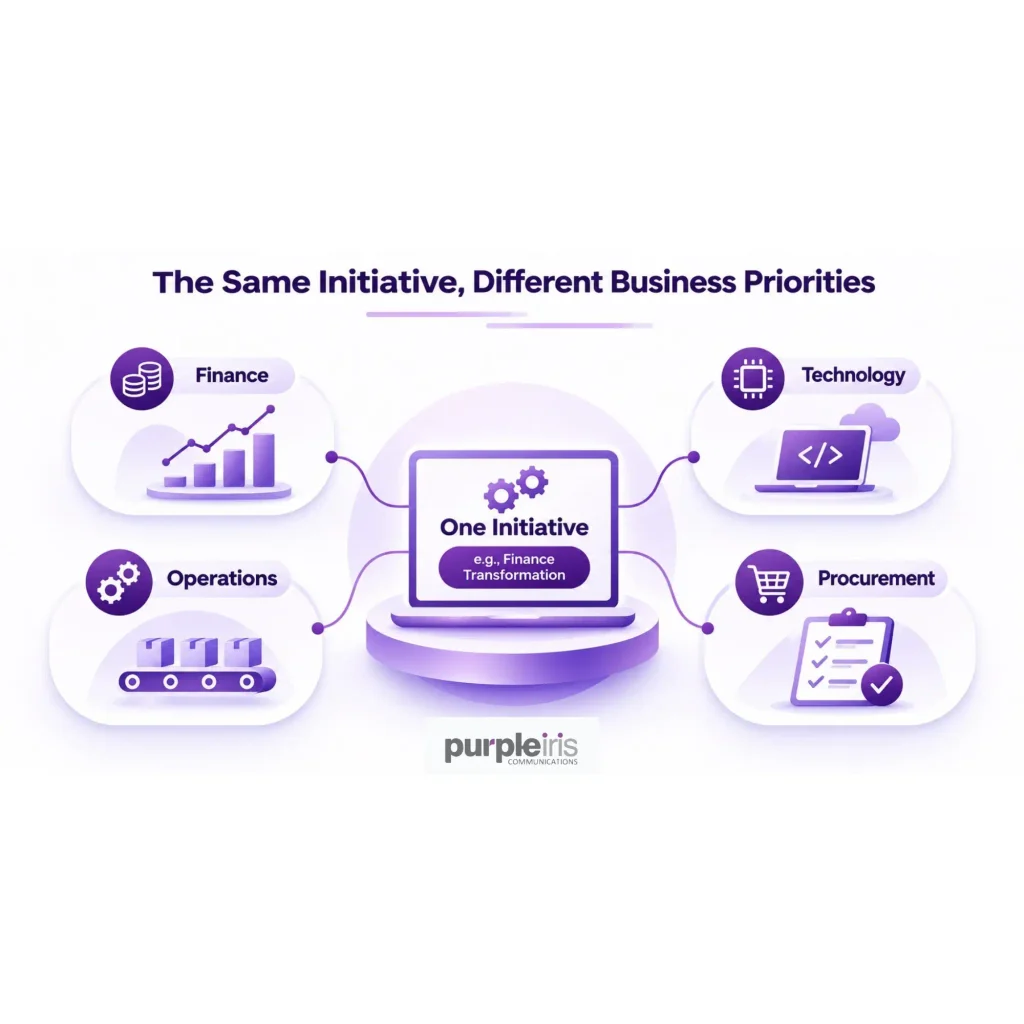
Start by defining the audience and the question the content needs to answer. A CFO, CIO, operations head, or procurement leader may look at the same business challenge through different lenses. Identify the decisions the content is intended to inform and what the decision maker needs to understand.
Then state the central argument in one or two sentences. For example:
Finance transformation programs often underdeliver because organizations treat technology implementation as the finish line. Realizing value also requires changes to process ownership, decision rights, and performance measurement.
This gives an article a clear direction. Next select research, examples, and expert observations to support the argument.
Prioritize original research, customer data, and experiences the organization can substantiate. Use expert interviews and credible third-party sources to strengthen the argument. Be clear about what the evidence establishes. Illustrative examples can make a point easier to understand, but they may not serve as an industry-wide pattern.
A convincing argument should also acknowledge practical constraints. An article about automation, for example, should consider process variation, exception handling, data quality, and the organizational changes needed to sustain efficiency gains.
Finally, explain what the argument means for the reader. What should they reconsider? Which decision needs more attention? What should they examine before committing resources?
This is particularly important in whitepapers and research reports, where the editorial task is to retain the substance of the research while giving it a clear narrative and business context. See Purple Iris Communication’s report writing services for more on developing research-led knowledge assets.
The 2025 Edelman-LinkedIn B2B Thought Leadership Impact Report highlights the influence of hidden buyers: stakeholders who help shape or approve a purchase internally but may not interact directly with potential vendors. This makes audience selection particularly important. A thought leadership program should account for the wider buying group and the different questions its members need answered.
Maintaining editorial quality and executive authenticity
AI can help organize source material, compare themes across documents, explore alternative structures, and edit drafts much faster than a manual process. However, thought leadership that sticks has little to do with production speed.
When everybody has access to the same secondary sources, what matters most is human judgment. An editor must determine which themes matter, whether the evidence supports the interpretation, and how the material should be framed for the intended audience.
A thought leadership content review should cover these four areas:
- Source accuracy: Are the sources genuine, current, and correctly represented? Can readers trace every material claim to its original source?
- Business context: Does the draft reflect the realities, constraints, and terminology of the industry?
- Distinctiveness: Does it contain an argument grounded in experience, or does it summarize familiar information?
- Voice and nuance: Does it preserve the expert’s judgment, qualifications, and natural way of expressing an idea?
In the case of executive ghostwriting, writers must account for an additional layer: capturing and maintaining a recognizable executive voice. That means understanding how a leader sees the world, how they frame problems, the issues they choose to address, the experiences that have shaped their judgment, and the language they naturally use.
Build a voice brief before developing a content program
Start by reviewing the executive’s presentations, interviews, speeches, and articles. Structured conversations can reveal details these materials may not capture.
A practical voice brief should record:
- Core themes: The subjects and business questions the executive consistently returns to
- Point of view: Their beliefs, predictions, preferences, and positions on important industry issues
- Professional experience: Decisions, projects, setbacks, and lessons that support those views
- Natural expression: Vocabulary, sentence patterns, analogies, and phrases that feel authentic
- Boundaries: Subjects, tone, and language they want to avoid
The writer’s job is to articulate and refine the executive’s thinking. The executive is responsible for validating the argument and approving the finished piece. The writer brings research, structure, and editorial craft; the executive brings the experience and judgment that make the argument their own.
For a closer look at how this collaboration works, read Common Ghostwriting Myths That Hold Leaders Back and explore executive ghostwriting services.
Choosing the right formats and distribution channels
The idea should determine the format. The question is which format will communicate the perspective effectively and reach the people who need to hear it.
| Format | Best suited to |
| Executive articles and opinion pieces | Contributing a focused argument to an industry or business conversation |
| Social media posts and articles | Developing a consistent point of view through owned channels |
| Whitepapers and strategy guides | Exploring a complex challenge through research, analysis, and recommendations |
| Industry and market reports | Presenting original data, trends, and analysis |
| Newsletters | Maintaining an ongoing relationship with a defined audience |
| Podcasts, webinars, and keynotes | Explaining a perspective through conversation or live discussion |
Plan distribution before publication
Even strong thought leadership needs a deliberate distribution strategy to reach its intended audience.
Most programs combine three types of channels:
- Owned channels: The organization’s website, blog, newsletter, and resource library
- Executive channels: The leader’s LinkedIn presence, professional networks, and speaking opportunities
- Earned channels: Contributory columns in the media, industry publications, interviews, and podcasts
Each channel serves a specific purpose. A company blog provides a permanent home for a detailed perspective. A media article introduces it to a new audience. An executive’s LinkedIn post can extend the discussion and invite responses.
Adapt the idea to each channel beyond the content format. A specialist publication and a mainstream business publication may require different narratives, evidence, and levels of technical detail. The central argument should remain consistent, but its presentation should reflect the publication and its readers.
What effective thought leadership looks like in practice
The following examples showcase work Purple Iris Communications has carried out for three clients. They show how we have helped a global enterprise, a Singapore-based PR agency representing startup founders, and Project Management Institute (PMI) turn specialized expertise into thought leadership and research-led knowledge assets.
Scaling executive thought leadership across enterprise domains
A global provider of business transformation and operational excellence solutions wanted to strengthen its digital visibility across strategic service lines and emerging business topics. Its expertise spanned several industries and practice areas, which posed an editorial challenge in producing a consistent stream of publication-ready content relevant to different target groups.
The engagement combined research, AI-assisted content synthesis, narrative development, drafting, and editorial oversight. Articles addressed CXO challenges, industry trends, and decision-making priorities while meeting publication expectations.
The program delivered:
- 35 executive-level articles across seven practice areas
- 25+ placements across industry-specific, technology, finance, manufacturing, supply chain, and business publications
- A 95%+ acceptance rate among submitted articles
The engagement shows how a structured editorial process can help an organization communicate expertise across multiple domains. Read the enterprise content marketing case study.
Turning founder expertise into publication-ready thought leadership
A Singapore-based PR and communications agency needed editorial support for its startup founder clients. The agency wanted to place opinion articles by founder-CEOs of fintech, workspace design, and AI companies in leading business and mainstream publications. The founders had considerable domain expertise but limited experience articulating their views for external audiences.
The work involved founder interviews, identifying a topic, and ghostwriting in each founder’s voice.
The engagement delivered nine thought leadership articles across six leading publications in Asia, including The Straits Times, The Business Times, Gulf News, BusinessWorld, YourStory, and Deccan Herald.
The case demonstrates why earned-media thought leadership requires both subject expertise and an understanding of the publication’s readers and editorial expectations. Read the Singapore PR agency case study.
Turning research into accessible knowledge assets for PMI
Project Management Institute (PMI) had substantial research capabilities and subject matter expertise. It needed editorial development to make industry papers and technical findings more accessible to business audiences.
Across a 15+ year engagement, Purple Iris Communications supported PMI with whitepapers and other knowledge assets. The work involved developing content from scratch, restructuring existing research, sharpening key takeaways, and translating technical findings into reader-friendly business narratives.
One outcome was the Playbook for Project Management in Data Science and AI Projects, which PMI developed with NASSCOM. (National Association of Software and Service Companies). The asset recorded 1,500+ downloads within a few months.
The engagement shows how editorial development can extend the value of existing research and make complex expertise more accessible. Explore the PMI knowledge-assets case study.
Measuring more than content output
The number of articles published or reports produced indicates what a thought leadership program has delivered. It does not however establish whether a program has achieved its intended purpose.
Measurement should begin with the business objective. An organization looking to strengthen executive visibility will evaluate its program differently from one using research-led assets to educate buyers or support sales conversations.
A practical measurement framework distinguishes between three levels:
| Measurement level | What to evaluate |
| Outputs | Articles, reports, whitepapers, publication placements, speaking opportunities, and other agreed deliverables |
| Audience signals | Readership, relevant engagement, downloads, sharing, comments, and interaction from intended audiences |
| Business indicators | Qualified enquiries, sales conversations, use of content by sales teams, and other relevant commercial signals, where tracked |
Choose measures that reflect the objective. For executive visibility, relevant publication placements and engagement from the right audience may matter more than page views. For a research report, downloads and target-account engagement may be more useful. For sales enablement, track how sales teams use the content in conversations and how it contributes to buyer education.
Agree on objectives, baseline measures, reporting methods, and review periods before the program begins.
Attribution also requires careful interpretation. A buyer may encounter an executive article, read a report, attend a webinar, and speak with a sales representative before making a decision. Isolating the contribution of one asset can be difficult. Measurement should therefore connect individual content signals to the wider communication and business objectives.
Turning organizational expertise into a body of thought
Thought leadership develops when an organization consistently contributes useful perspectives to conversations its audience cares about. That requires a process to identify insights, test their value, develop defensible arguments, preserve the voices behind them, and choose the right channels.
AI can support selected parts of this work, but people remain responsible for the thinking, evidence, and editorial quality.
A sustained program gives buyers a clearer understanding of how a business thinks, what it has learned, and how it approaches the problems that matter.
Purple Iris Communications brings together research, editorial judgment, industry understanding, and writing craft to help organizations and business leaders develop this kind of thought leadership. Explore our thought leadership content services to learn how we support executive articles, opinion pieces, research-led assets, and broader authority-building programs.
Your expertise deserves more than another article. It deserves a point of view that gives the right audience a reason to listen.
Discuss your thought leadership approach.
Frequently Asked Questions About B2B Thought Leadership
1. Should B2B thought leadership be company-led or executive-led?
Both approaches serve different purposes and work best when they reinforce each other. Company-led thought leadership communicates institutional expertise, research, and perspectives on industry developments. Executive-led thought leadership brings individual experience, judgment, and professional insight into those conversations. Organizations should establish shared themes and editorial priorities while allowing executives and subject matter experts to contribute perspectives grounded in their own experience. This creates consistency without making every contribution sound like corporate messaging.
2. Who should own thought leadership within a B2B organization?
Marketing or corporate communications teams typically coordinate thought leadership programs, but the responsibility for developing credible ideas should extend across the organization. Subject matter experts contribute technical knowledge, business leaders provide strategic context, and marketing teams identify audience needs, develop content, and manage distribution. A designated editorial owner can bring these contributions together, maintain quality standards, and ensure that individual pieces support the organization’s broader communication priorities.
3. How frequently should a B2B organization publish thought leadership content?
There is no universal publishing frequency for thought leadership. The right cadence depends on the organization’s objectives, access to subject matter experts, research requirements, and available editorial resources. A smaller number of well-developed articles may deliver more value than frequent content built around familiar industry talking points. Organizations should establish a sustainable editorial calendar that balances planned contributions with timely responses to relevant industry developments.
4. How can organizations ensure thought leadership content does not become promotional?
Start with the audience’s business challenge rather than the organization’s products or services. A thought leadership article should examine an issue, present a defensible perspective, support its arguments with evidence, and offer useful implications for the reader. Product capabilities and service offerings can provide context where relevant, but they should not drive the central argument. A useful editorial test is whether the content would still offer value to the reader even if the organization and its solutions were never mentioned.
5. How long does it take for a thought leadership program to build credibility?
Thought leadership credibility develops through sustained contributions rather than a single article or campaign. The timeline depends on factors such as the organization’s existing reputation, the quality and consistency of its perspectives, the relevance of its publications, and its ability to reach the intended audience. Early indicators may include engagement from relevant industry stakeholders, invitations to contribute to external publications, and increased interest in an organization’s research. Stronger indicators of influence, such as recognition for particular areas of expertise and meaningful participation in industry conversations, generally require continued effort.
References:
https://6sense.com/buyer-experience-report-2026
https://www.edelman.com/expertise/Business-Marketing/2025-b2b-thought-leadership-report