

A buyer spends 20 minutes with your content.
They read your blog. Explore your website. Maybe even download a guide.
Then they leave.
No inquiry.
No demo request.
No sales conversation.
Not because they did not find the content useful. They probably did.
They leave because learning something is not the same as deciding something. Most content helps buyers understand a topic. Far less of it helps buyers evaluate options, resolve uncertainty, and commit to a direction.
That is the difference between content that just informs and content that generates leads. The latter does more than educate. It helps buyers make confident decisions.
Your content gets traffic. Your team publishes consistently. People engage. Yet buyers leave without taking the next step because nothing in the experience helps them feel confident enough to move forward.
That is why many marketing teams end up asking the same question:
“Why isn’t our content generating leads?”
The answers they get are usually familiar. Publish more consistently. Improve your SEO. Write stronger calls-to-action. Create better lead magnets. Distribute your work more effectively.
These tactics improve discoverability.
For buyers to choose your business, your content must build certainty.
Discovery creates awareness. Decisions create leads. Confusing the two is where many content strategies fall short. Content creates impact when it moves buyers from curiosity to conviction.
The distinction matters even more because buyers now complete much of their evaluation independently. Today’s buyers have no shortage of information. Before speaking to a salesperson, they compare vendors, consult AI, and explore expert opinions. Recent Gartner research shows that 61% of B2B buyers prefer to complete much of this evaluation internally before engaging sales.1
Because buyers spend most of their journey researching independently, content must guide them toward a decision.
Only then can you create content that generates leads by becoming part of the buyer’s decision-making process.
Attention Doesn’t Create Buying Intent
Every day, buyers consume valuable content from companies they never contact. The 2025 B2B Buyer Experience Report involving nearly 4,000 respondents found that buyers add their preferred vendors to their shortlist even before the first sales conversation, and four out of five deals are made with vendors from that list.2
Put simply, buyers are using information to narrow choices, not merely to learn about a category. They are looking for analyses, insights, and perspectives to help decide who deserves a place on their shortlist. This is the reason why attention earns visibility, while perspective earns preference.
Traffic, time on page, downloads, shares, and engagement tell you people noticed your content. They do not tell you whether buyers moved any closer to choosing you.
If your content attracts attention but rarely generates conversations, do not just ask how many people consumed it. Ask what changed after that.
Reading is an activity. Choosing is a commitment.
Every Lead Begins as a Series of Unanswered Questions
Every meaningful buying decision begins with multiple uncertainties.
Recognizing the problem is only the beginning. Buyers still have to resolve questions like:
- Is this the right approach?
- Is now the right time to act?
- Can this company actually deliver?
- What happens if we proceed with the wrong partner?
These questions rarely get answered all at once. They are resolved gradually through every interaction a buyer has with your brand.
Even well-executed marketing campaigns can leave buyers better informed but not better equipped to reach a conclusion.
The most effective content removes at least one barrier standing between a buyer and a decision. Over time, those answers compound into conviction, changing not only what buyers know but also how they compare alternatives.
What Your Content is Teaching Buyers to Do
Many content strategies are designed to attract attention, demonstrate expertise, and improve search visibility. The goal is not simply to enhance online discoverability, but to create content that generates leads by helping buyers make confident decisions. Those goals matter, but buyers are trying to satisfy buying intent, not search intent. Content that ranks well does not automatically help buyers move closer to a decision.
If your content consistently generates traffic but does not generate leads, ask yourself these four questions.
1. Does your content make the next decision easier?
Here is an important question for marketers: What decision became easier after someone consumed my content?
If the answer is “none,” your content probably informed buyers without moving them any closer to becoming customers.
The content that removes delays in decision-making helps buyers understand the trade-offs more clearly, feel more confident narrowing their choices, or know exactly what question to ask next.
Taking the buyer toward a decision is not about a sharper CTA. It is more nuanced–adding a customer example, acknowledging a common objection, or comparing two approaches.
Before you write, identify the one decision your content should make easier. Then evaluate every example, comparison, customer story, and insight against that objective. If it does not remove hesitation, it probably does not belong.
2. Does my content introduce a new perspective?
The most effective articles do not stop at answering the question someone searched for. They change the question buyers ask next by giving them a better way to tackle the problem.
Imagine two companies writing about the same topic. One publishes an article titled “What Is RevOps Transformation?” The other publishes “Why Most RevOps Transformation Programs Fail Before They Deliver ROI.” Both educate, but only one changes how buyers think about the challenge before they begin evaluating solutions.
If buyers leave with the same questions they arrived with, you have educated them. If they leave asking better questions, you have influenced how they will reach a conclusion.
Review your highest-performing articles and ask a simple question: Does this explain the topic, or does it challenge the reader to think about it differently? Aim for every major piece to introduce one interpretation buyers are unlikely to encounter elsewhere.
3. Does my content help buyers navigate complexity?
Expertise explains what is possible. Judgment explains what makes sense in a particular situation.
Consider a finance leader researching AI adoption. One article lists 10 AI use cases in finance. Another explains why automating invoice processing delivers value faster than deploying AI for forecasting, and under what circumstances that advice changes. Although both demonstrate expertise, only the latter helps the buyer confidently approach a complex choice.
That is what turns expertise into practical guidance buyers can act on.
Every educational article should end with one practical takeaway buyers can immediately apply to their own situation. If readers understand the topic but still don’t know what to do next, the article hasn’t done enough.
4. Does every piece reinforce the same point of view?
Buyers rarely remember individual articles. They remember brands that consistently stand for something.
Every article, case study, webinar, and insight should reinforce the same core belief. That does not mean repeating the same message. It means approaching different topics through the same lens until buyers begin to associate your brand with a distinct way of thinking.
Think about a consulting firm that believes operational simplicity creates competitive advantage. Whether it writes about AI, customer experience, or digital transformation, every article reinforces that belief.
This is how authority compounds over time.
Decide what your brand wants to be known for before deciding what it wants to publish. Then make every piece reinforce that belief from a different angle. Consistency builds familiarity, but conviction builds authority.
Ultimately, content that generates leads does one thing exceptionally well: it removes uncertainty at every stage of the buying journey.
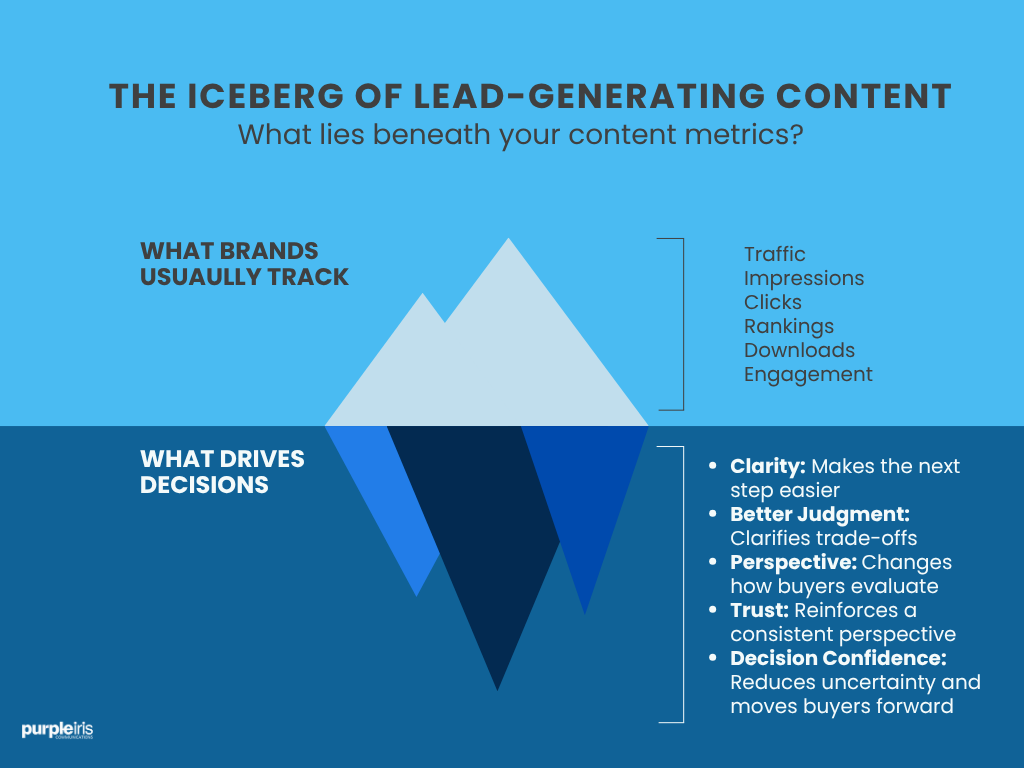
The Three Jobs Every Lead-Generating Article Must Do
For content to help generate leads, it must perform three jobs.
1. Change how buyers understand a problem
The strongest content introduces a perspective that reshapes how buyers understand the problem. When buyers begin asking better questions, they are already making better decisions.
2. Help buyers filter through the noise
Content that offers clarity of thought acts as a guide for buyers as they navigate a sea of sameness, especially when buyers are inundated with content that repeats familiar ideas without adding perspective. Your content must highlight what matters most, present bold arguments, and be evidence-based, so buyers develop trust in your expertise.
3. Build conviction to act
A customer story that removes uncertainty about implementation. A comparison article that clarifies competing approaches. A practical framework that makes evaluation easier.
None of these pieces closes the sale on their own. Together, they create a strong push to act.
When content consistently performs those three jobs, lead generation becomes more predictable.
What is The Right Question to Ask?
Today’s buyers have more information than they have ever had. What they often lack is clarity in the direction to take.
That is where content creates its greatest impact.
Recent LinkedIn and Edelman research found that decision-makers value thought leadership that offers original insights, helps them understand business challenges, and provides practical guidance they can apply.3
That aligns with the central idea of this article. Content creates commercial value when it helps buyers think more clearly, select a direction more confidently, and reach decisions with less uncertainty.
In essence, stop asking whether your content is getting seen and start asking whether it’s becoming part of how buyers decide.
The answer to that question will tell you far more about your future pipeline than your traffic dashboard ever will.
At Purple Iris Communications, we believe most lead-generation problems are content strategy problems in disguise. Through our content consulting services, we help B2B brands diagnose what’s holding their content back, uncover the gaps that prevent buyers from moving forward, and build content strategies that create clarity, trust, and long-term brand authority.
If you’re ready to understand why your content isn’t generating leads—and what to do about it—we’d love to start that conversation.
Frequently Asked Questions About Content That Generates Leads
Why is my content getting traffic but not generating leads?
High traffic indicates that your content is being discovered, but it doesn’t necessarily mean it’s influencing buying decisions. Many organizations optimize their content for visibility through SEO, keywords, and distribution. Lead generation happens when content also reduces uncertainty, builds trust, and helps buyers feel confident enough to move forward. If your content attracts readers but doesn’t shape how they evaluate the problem, it may generate attention without generating pipeline.
How can I create content that generates leads?
Start by designing your content around buyer decision-making rather than information delivery. The most effective B2B content strategy answers important questions, introduces a distinctive perspective, demonstrates sound judgment, and reinforces that thinking consistently across customer touchpoints. When content consistently makes the next decision easier, qualified leads become a natural outcome.
What is the difference between search intent and buying intent?
Search intent reflects what someone wants to learn or discover. Buying intent reflects how someone evaluates options before making a purchase. Content optimized only for search intent helps people find answers. Content that also addresses buying intent helps them compare alternatives, reduce uncertainty, and gain clarity in their decision. The strongest content strategies account for both.
Why doesn’t educational content automatically create buying intent?
Educational content increases knowledge, but buying decisions depend on more than information. Buyers also need confidence that they understand the problem correctly, trust the framework being presented, and believe they’re making the right choice. That’s why content should move beyond teaching concepts to helping buyers interpret information and evaluate decisions.
How does thought leadership help generate B2B leads?
Effective thought leadership offers more than expertise. It provides a clear point of view that helps buyers understand complex problems in a new way. Over time, consistent thought leadership builds credibility, strengthens brand authority, and increases the likelihood that buyers will choose your organization when they’re ready to act.
What should I measure instead of traffic and engagement?
Traffic, impressions, and engagement remain useful indicators of visibility, but they don’t reveal whether your content is influencing buying decisions. A stronger measure is whether each piece of content reduces uncertainty, strengthens buyer confidence, and makes the next decision easier. Organizations that evaluate content this way are better positioned to build trust, improve lead quality, and create sustainable demand.
References
- https://www.gartner.com/en/newsroom/press-releases/2025-06-25-gartner-sales-survey-finds-61-percent-of-b2b-buyers-prefer-a-rep-free-buying-experience ↩︎
- https://6sense.com/science-of-b2b/buyer-experience-report-2025/?__cf_chl_f_tk=DdygMnUXCWpAj1OMaNJmPN53to_PIia3CRzg0dBKa9E-1782888599-1.0.1.1-do13587cyYMGd88oQC7MfYHNWQjFVcSlgbQz6.wozes ↩︎
- https://www.edelman.com/sites/g/files/aatuss191/files/2025-06/2025%20B2B%20Thought%20Leadership%20Impact%20Report%20One%20Pager_FINAL.pdf ↩︎