
A decade ago, brand messaging lived primarily on websites, brochures, and sales presentations.
Today, it lives everywhere. Search engines analyze it, AI systems summarize it, and prospects encounter it through LinkedIn posts, webinars, landing pages, podcasts, review platforms, and sales conversations.
That creates a challenge many startups overlook. Ask the CEO, the content lead, the SDR, and the customer success manager to each describe what the company does and why it matters — in one minute. You will rarely get the same answer twice.
We often see this during content consulting engagements, where businesses invest heavily in content production but discover that different teams are communicating different versions of the same story.
That is the problem a messaging house framework is built to solve.
What is a Messaging House?
A messaging house is a structured framework that organizes everything a brand says into a single, coherent architecture.
For growing startups, this structure often becomes the bridge between founder-led communication and scalable brand communication.
It is typically visualized as a house because every message has a specific role to play.
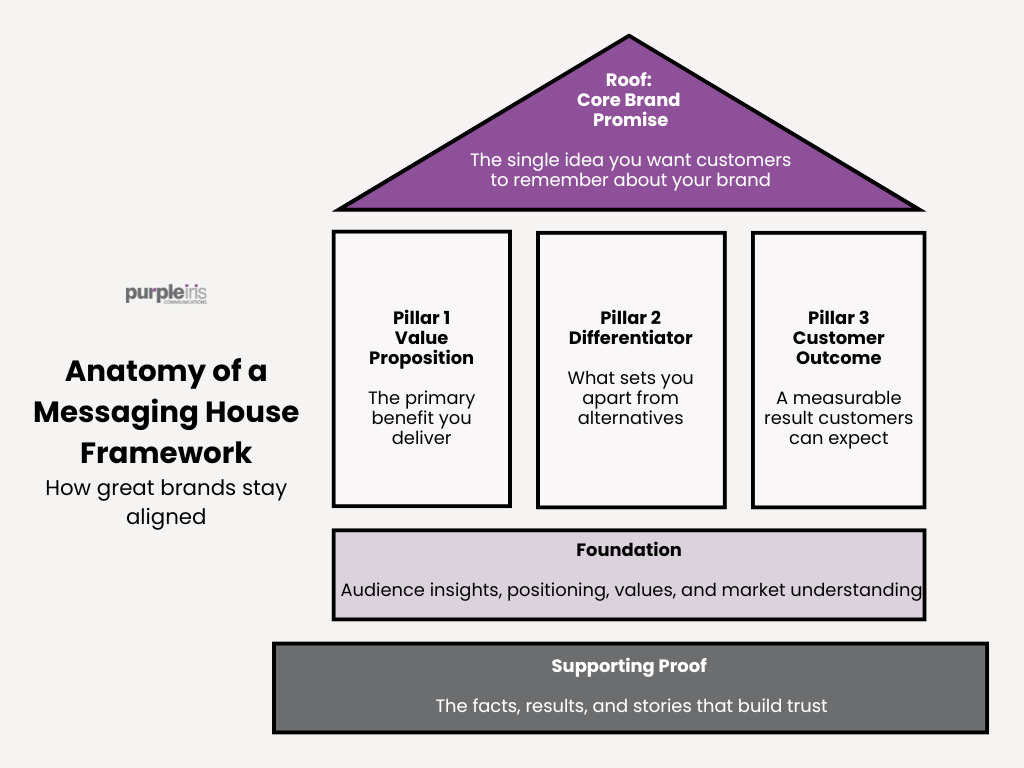
The Roof: Your Core Brand Promise
The roof sits at the top because it represents the single idea your company wants to be known for.
This is the message that should remain consistent across your website, sales conversations, thought leadership content, and marketing campaigns. It captures the primary value customers can expect from your business.
For example, a project management software company might build its messaging around a promise such as helping teams deliver work faster without adding complexity.
The roof answers the question:
Why should customers care about your company?
The Pillars: The Reasons to Believe
The pillars support the roof, just as key value propositions support your overarching promise.
Most messaging houses contain three to five pillars. While the specifics vary by business, the strongest pillars typically answer three questions:
What value do we deliver?
Your primary value proposition.
What makes us different?
Your key differentiator in the market.
What outcome can customers expect?
The measurable impact your solution creates.
For the same project management software company, the pillars might look like this:
- Value Proposition: Faster collaboration across teams
- Differentiator: A simpler workflow than traditional project management tools
- Customer Outcome: Fewer project delays and improved operational efficiency
Together, these pillars provide substance behind the promise. Without them, the roof becomes a claim without context.
The pillars answer:
Why should customers believe your promise?
The Foundation: Strategic Context
Every strong house needs a foundation.
In a messaging house, the foundation contains the strategic inputs that shape the messaging. This may include audience insights, market positioning, mission, vision, competitive differentiators, customer pain points, and brand values.
Customers may never see this part directly, but it influences every message built above it.
The foundation answers:
What strategic truths are our messages built upon?
Supporting Proof: Evidence That Builds Credibility
Many messaging house frameworks stop at claims.
Strong messaging houses go further by attaching proof to every pillar.
This proof can include customer success stories, case studies, product capabilities, certifications, performance data, analyst recognition, or measurable outcomes.
For example, if a pillar claims to improve productivity, supporting proof could include real-world results, such as a 30% reduction in project delays.
The proof answers:
Can we back up what we are saying?
The real strength of a messaging house lies in how these components connect.
The roof provides direction, the pillars provide substance, the foundation provides strategic grounding, and the proof provides credibility.
When all four elements work together, companies move beyond isolated marketing messages and create a communication system that can be used consistently across every customer touchpoint and brand asset.
Slack is the most instructive example. When Slack launched publicly in 2013, it entered a space where 70 to 80 percent of companies said they were using “nothing” for internal communication — a mix of email threads, Skype, and SMS. Rather than positioning against existing tools, Slack built its roof message around a single, memorable idea: “Where work happens.” That message held across every channel, every sales conversation, and every piece of content from day one.
The result was 8,000 sign-ups within the first 24 hours of launch — without a sales team, and almost entirely through word of mouth. (Source: The Growth Playbook) The consistency of that message meant that early adopters could evangelize the product accurately, without needing Slack to be in the room.
This example shares the same underlying pattern: a clear, specific roof message decided early, held consistently, and used as the filter for every communication decision that followed. For startups and scaleups, that discipline is what makes growth legible to buyers, investors, and new hires at the same time.
Why Brands Invest in Messaging Houses
A messaging house is often viewed as a branding exercise. It is a business alignment tool.
This becomes particularly important as organizations expand their Marketing Communications efforts across multiple channels and audiences.
When every customer-facing channel communicates the same core narrative, prospects understand the value faster, trust builds easily, and teams spend less time debating how to position the business.
The impact can be measurable. A May 2026 analysis by NP Digital, based on data from 100 businesses using omni-channel marketing, found a strong relationship between message consistency and conversion performance. Businesses with a message consistency score near 90 achieved conversion rates approaching 2.7%, while businesses scoring around 20 saw conversion rates closer to 0.6%.1
The gap explains why messaging houses have become increasingly important for growing organizations.
Here are some of the most significant reasons brands invest in them:
Scaling Without Losing Clarity
Startups often communicate effectively when the founder is involved in every conversation.
Growth changes that.
As new employees join, messaging becomes fragmented. Different interpretations emerge. Customer-facing teams begin emphasizing different benefits.
A messaging house preserves consistency while allowing the organization to scale.
Aligning Sales and Marketing
One of the most common friction points in B2B organizations occurs when sales and marketing communicate different stories.
Marketing talks about features.
Sales talks about outcomes.
Leadership talks about vision.
Customers hear all three.
A messaging house creates a shared language that keeps every function aligned around the same narrative.
Supporting Rebrands
Many companies focus on visual identity during a rebrand while overlooking communication strategy. New logos and websites can improve appearance, but they cannot solve unclear positioning.
A messaging house helps organizations define what they want audiences to remember before creative assets are developed.
Launching New Products or Services
Product launches often fail because the communication is focused heavily on features and specifications. The messaging is lost on customers who care about outcomes.
A messaging house ensures that every launch connects product capabilities to meaningful business value.
Where Most Messaging Houses Break Down
Getting a messaging document built is not the hard part. The failure happens in converting that into action across channels.
Messaging frameworks fail when they are treated as deliverables rather than operating systems. A 40-slide brand document lands in a Google Drive folder, gets referenced during onboarding, and disappears from daily practice within two months. The framework becomes ornamental.
Three things prevent this:
1. Ruthless simplicity
If your sales team cannot internalize the roof message and three pillars without referring to a document, the framework is too complex. The goal is memorability, not comprehensiveness.
2. Cross-functional ownership
A messaging house built exclusively by marketing will have limited traction with sales. The best frameworks are built with input from sales, customer success, and product — and owned jointly. When sales reps see their own objection-handling language reflected in the framework, adoption follows naturally.
3. Version discipline
Markets shift, positioning evolves, competitors launch, categories get redefined. A messaging house built in 2022 for a pre-AI era is going to feel off-brand today. Quarterly reviews and annual refreshes must be part of the operating model.
The GEO Angle
Generative Engine Optimization is changing how brands get discovered and evaluated.
AI search tools such as ChatGPT, Perplexity, and Google AI Overviews synthesize information from multiple sources. They favor brands whose messaging is consistent, specific, and reinforced across the web.
Consider a cybersecurity company. Its website describes it as a threat detection platform. Executives position it as a resilience partner. Case studies frame it as a compliance solution.
Each message may be accurate. But together, they create ambiguity.
AI systems struggle to determine which narrative best represents the company.
A messaging house reduces that ambiguity by creating a consistent framework. The result is a stronger brand signal, clearer positioning, and a greater likelihood of being represented accurately in AI-generated responses.
The Practical Starting Point
You do not need a six-week brand strategy engagement to build a messaging house. A one-day workshop with marketing, sales, and customer experience can generate the raw material. Start with these questions:
- What is the one thing we want a buyer to remember about us after any touchpoint?
- What are the three business outcomes we reliably deliver for customers?
- What proof do we have that those outcomes are real and repeatable?
From those answers, the architecture almost writes itself. The harder work — and the more valuable work — is the editorial discipline of cutting what does not belong.
A messaging house is ultimately a decision about focus. Every brand has more to say than it should say. The framework is what decides what makes it through — and in what order buyers encounter it. That editorial control is not a creative constraint. For B2B brands operating in a self-directed, AI-influenced buying environment, it is a commercial advantage.
At Purple Iris Communications, we work with B2B startups, SMEs, and growing brands to build messaging frameworks that can be easily adopted by their sales, marketing, and content teams. From the core positioning down to the content that carries it across channels, we make sure clarity shows up consistently wherever a buyer encounters the brand.
FAQs
Why do growing startups need a messaging house framework?
As startups scale, different teams often develop their own ways of describing the business. A messaging house framework creates a shared narrative that helps maintain consistency across hiring, product launches, sales conversations, and marketing campaigns.
How is a messaging house different from brand positioning?
Brand positioning defines how a company wants to be perceived in the market. A messaging house framework translates that positioning into clear messages that teams can use consistently across channels and customer interactions.
Who should be involved in creating a messaging house framework?
The most effective messaging houses are built collaboratively. Marketing, sales, leadership, product teams, and customer success teams should all contribute insights to ensure the framework reflects real customer conversations and business priorities.
When should a company update its messaging house framework?
A messaging house should be reviewed whenever there are significant business changes, such as entering new markets, launching new products, repositioning the brand, or responding to shifts in customer expectations and industry trends.
How long does it take to build a messaging house framework?
The timeline depends on the complexity of the business. Many startups and SMEs can develop an initial messaging house through workshops and stakeholder interviews, then refine it over time based on customer feedback and market response.
References: