

B2B marketing teams are producing more content than ever before. Blog output is up, distribution is broader, and formats continue to expand. But the impact is not keeping pace with the volume.
The issue lies in how content investment is structured. Many organizations still rely on the 70-20-10 rule, allocating effort across educational, thought leadership, and promotional content. But it falls short in aligning content with how buyers make decisions.
| What is the 70-20-10 rule in B2B content? |
The 70-20-10 rule in B2B content marketing is a framework that allocates: – 70% (core content): SEO-driven blog posts, how-to guides, and case studies that target common search queries and known use cases. This is where most teams invest their time and budget. – 20% (differentiated content): Thought leadership pieces, industry reports, and opinion-led content. These are used to build credibility and position the brand. – 10% (experimental content): Previously unexplored formats such as podcasts, webinars, short-form video, or AI-driven tools. These are treated as test initiatives and usually run with limited resources. A typical example is a SaaS company that publishes weekly SEO blogs (70%), quarterly reports or POV articles (20%), and experiments with a podcast or video series (10%). |
Most B2B content is concentrated at the awareness stage, while critical decision-stage assets are limited or disconnected from earlier touchpoints. This creates a gap between engagement and conversion.
An effective B2B content strategy starts with buyer intent and aligns investment to move them forward. This article examines where the 70-20-10 rule works, where it falls short, and what is a more practical model to apply today.
Where the 70-20-10 Rule Comes From
The 70-20-10 model has been used in different contexts to guide how effort is allocated across core work, emerging initiatives, and new ideas. It gained wider adoption in business through companies like Google, where leaders described a similar approach to balancing core priorities with adjacent and experimental work.
In marketing, the model is typically applied as a portfolio approach. The majority of effort goes toward proven, reliable content that drives consistent results. A smaller portion is invested in differentiated or high-value content that builds authority. The remaining share is reserved for experimentation with new formats, channels, or ideas.
This structure helps teams avoid over-investing in untested ideas and provides a simple way to plan and communicate content priorities across teams.
Where the Model Breaks in Practice
The 70-20-10 model creates balance, but it does not reflect how B2B buyers move from research to decision. This leads to gaps that directly affect pipeline and conversion.
Content is balanced, but not aligned to buyer intent
Teams often miss key decision-stage needs.
For example, a company may publish multiple awareness-stage articles on a topic but have limited content that compares solutions, explains implementation, or answers pricing questions. Buyers engage, but do not find what they need to move forward.
High volume does not translate to pipeline
A large share of content focuses on attracting traffic but does not influence buying decisions.
For instance, a guide that ranks well for a broad keyword may drive consistent visits, but if it does not connect to a clear use case or next step, it has limited impact on lead quality or conversion. This is why content strategy for pipeline growth often underperforms despite strong traffic metrics.
Fixed ratios ignore market and category differences
Stable, asset-heavy sectors may benefit from a larger share of proven content. In contrast, fast-moving categories such as SaaS or AI require more frequent updates, stronger differentiation, and higher investment in emerging formats. A fixed 70-20-10 split fails to accommodate these differences.
Experimentation is treated as a cap, not a lever
Teams test new formats but rarely scale what works. For example, a webinar or podcast that generates qualified conversations may remain in the “experimental” bucket instead of becoming a core channel. This slows down learning and delays growth.
The Core Shift From Content Mix to Buyer Intent
The 70-20-10 model focuses on balancing content types. But buyers usually move through different stages: understanding a problem, evaluating options, and making a decision.
| What is buyer intent, and why does it matter? |
| Buyer intent refers to the stage a prospect is in when researching, evaluating, or selecting a solution. Content aligned with intent reduces friction in the decision process and improves conversion rates. |
Here are the three stages:
- Discovery:
The buyer is defining the problem.
Example: “How to reduce invoice processing time?”
- Validation:
The buyer is comparing approaches or solutions.
Example: “Best tools for invoice automation”
- Decision:
The buyer is selecting a vendor.
Example: Case studies, pricing details, implementation steps
In essence, an intent-based content strategy ensures that content is available at each stage and is connected in a way that helps buyers make purchasing decisions.
A More Practical Way to Allocate Content Investment
Instead of fixed ratios, content investment should be aligned to what drives movement across the buying journey. A simple way to do this is to structure content around four functional areas.
Demand Capture (Search-aligned content)
As the name suggests, this area focuses on topics buyers are already searching for.
Examples:
- “How to reduce invoice processing time”
- “Best tools for accounts payable automation”
This type of content drives discovery and brings qualified visitors into the funnel. It remains an important part of any B2B content strategy, but it should not dominate the mix.
Decision Support (Conversion-focused content)
This is content that helps buyers evaluate options, understand implementation, and justify investment.
Examples:
- Case studies with quantified outcomes
- Implementation guides
- ROI breakdowns
- Product comparisons
Authority Content (Trust and differentiation)
This content revolves around providing original insights and informed perspectives.
Examples:
- Industry analysis
- Founder POV
- Expert-led breakdowns
This is especially important in markets where buyers are evaluating novel, complex solutions or multiple similar solutions.
Experimentation (Learning and scaling)
This is where teams learn what works, not immediate ROI.
Examples:
- Webinars
- Podcasts
- Interactive tools
The key is to scale what performs. If an experiment consistently generates qualified leads or engagement, it should move into the core investment areas.
This model is not about replacing one ratio with another; it is about ensuring that content supports discovery, builds trust, and helps buyers make decisions.
How to Apply This Model
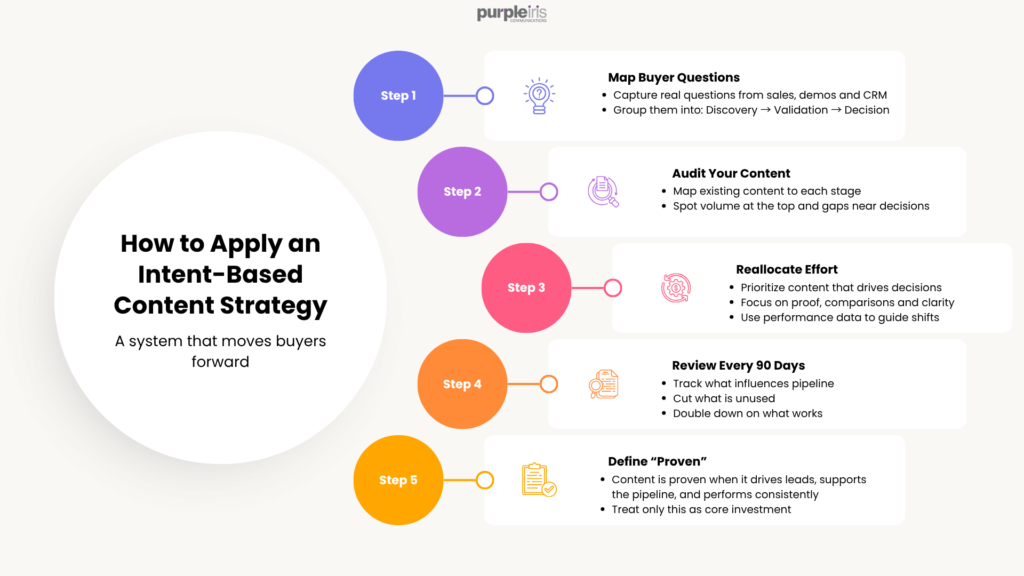
A shift to intent-based content investment does not require a full reset. It can be implemented in a few structured steps.
Step 1: Map buyer questions across stages
List out the questions buyers ask at each stage of the journey.
Source inputs from:
- Sales calls
- Demo conversations
- FAQs
- CRM notes
Group these into:
- Discovery (problem definition)
- Validation (solution comparison)
- Decision (vendor selection)
Example:
For a finance automation product:
- Discovery: “How to reduce invoice errors?”
- Validation: “What are the best invoice automation tools?”
- Decision: “How long does implementation take?”
Step 2: Audit existing content
Review your current content against these stages.
Identify:
- Areas with high volume (usually discovery)
- Gaps (often validation and decision)
Step 3: Reallocate based on performance
Shift effort toward content that supports decision-making.
Prioritize:
- Case studies with clear outcomes
- Comparison content
- Implementation clarity
Use data to guide decisions:
- Conversion rates
- Time on page
- Sales usage of content
Step 4: Review every 90 days
Avoid fixed annual plans.
Evaluate:
- What content is influencing your pipeline
- What is not being used
Reallocate effort based on performance, not assumptions.
Step 5: Define what “proven” means
Not all high-traffic content is high-impact.
Define clear criteria:
- Consistent lead generation
- Contribution to the pipeline
- Predictable performance over time
Only then should content be treated as “core” investment.
When the Rule Still Works
Though the 70-20-10 rule has lost its relevance in today’s complex buying environment, it remains useful in specific situations.
- Early-stage teams:
When there is no structured content plan, the model provides a simple way to get started and avoid over-investing in promotional content. - Teams building consistency:
It helps maintain a steady publishing rhythm and ensures a mix of content types without overcomplicating planning. - Internal alignment:
The model is easy to explain to stakeholders and can serve as a high-level guideline for content marketing budget allocation.
As content programs mature, relying on fixed ratios becomes limiting. Teams need to move from a static mix to a more flexible approach based on buyer needs and performance data.
From Content Balance to Decision Impact
The 70-20-10 rule creates structure, but it does not guarantee impact.
At Purple Iris Communications, we work with B2B teams to turn content into a reliable growth lever. From building search-aligned content that captures demand and creating high-quality assets that support conversion to developing long-term content strategies that deliver measurable outcomes, we focus on aligning content investment with an organization’s business goals.
The shift is about producing content that moves decisions forward, not just fills the calendar.
FAQs
1. Why does B2B content fail to generate leads even when it gets traffic?
Most content is focused on awareness and not on helping buyers evaluate or make decisions. Without decision-stage content, traffic rarely converts into pipeline.
2. How do you align B2B content with the buyer journey?
By mapping buyer questions across discovery, validation, and decision stages, and creating content that directly supports each stage.
3. What type of B2B content actually drives conversions?
Content that helps buyers make decisions, such as case studies, product comparisons, ROI breakdowns, and implementation guides.
4. How can we identify gaps in my B2B content strategy?
Audit your content against the buyer journey and look for missing or weak content in validation and decision stages, where most conversion gaps exist.