
J. R. Moehringer, ghostwriter of Prince Harry’s memoir Spare, disagreed with the royal over the inclusion of a sentence about an incident during his military training. Moehringer removed the line, and Prince Harry brought it back repeatedly.
After a capture simulation during the training in which Harry had been beaten, left cold, and deprived of sleep, he had made a dramatic comeback. When Moehringer asked why the incident mattered so much, Harry said that he had always been challenged intellectually. The comeback showed how sharp his mind was, even while being physically and mentally exhausted. He wanted readers to know that.
Moehringer argued against keeping the sentence, explaining that writing a memoir meant prioritizing what resonated with readers. After a brief discussion, Prince Harry understood the rationale and said, “I see your point.”
This shows the challenge ghostwriters face–balancing what an author wants to say and what matters to the audience. Writers, including a B2B ghostwriter behind authored articles, need to respect a leader’s intent, and yet, have the confidence to push back when needed. Strong editorial judgment is critical to back their rationale.
A successful creator understands the author’s voice deeply enough to provide constructive feedback and shape the narrative to achieve the intended objectives. A genuine partnership between the ghostwriter and the leader to understand how the leader thinks–much beyond what is on the creative brief–is critical to accomplish this task.
However, B2B content partnerships don’t always work this way. Ghostwriters create authored articles and Points of View (POV) with little participation from the leader under whose byline a piece will appear. The marketing team owns the deliverables, and the content agency executes the task. This lack of a collaborative approach shows up in the form of content that is bland and lacking in a distinctive voice.
Ghostwriting thought leadership content requires a framework that ensures a leader’s voice is transferable so it remains authentic over time.
The Business Costs Nobody Tracks
Thought leadership matters because it delivers greater returns over time by building a strong, visible voice. When prospective buyers see a leader’s perspective before a sales conversation, they show up with more information and are already leaning toward making a purchase.
Prospective employees may align with a leader’s vision and values and be drawn toward the organization based on the stand a CEO or founder takes on critical issues. Investors who read an analysis from a company’s CXO come to board meetings with a clear sense of the quality of thinking in the room.
However, to build this kind of influence, a leader needs an identifiable voice. That voice should be consistent across platforms, match how the leader communicates in private, and stay steady throughout their time in the role. If these requirements are not met, voice drift happens.
Voice drift in the context of thought leadership is when the public persona of an individual, often leaders who have published content under their name, is not an authentic reflection of what they think, believe, or value. Voice drift takes place when, over time, a leader’s writing loses individuality.
Voice drift often takes place when a leader delegates content creation to an in-house resource or an outsourced partner with minimal briefing. When a ghostwriter bases authored articles on secondary research alone, the result will likely be generic and bland. Over time, the leader’s voice will fade, and the content will sound like anybody else in the industry.
Voice drift is an ongoing challenge many leaders face, but there is no way to measure or monitor it.
Take the case of a tech startup founder who has built a sizeable social media following with her unconventional thinking and bold stance on common issues that startups face. A subject the founder often raised was change management. She felt that project failure could be addressed if leaders took responsibility for change management. The founder’s content stood out because it named a problem that few spoke about, and it felt real. However, with business pressure growing, the founder engaged an agency to manage her social media account. The plan ticked the usual boxes–a regular posting schedule, the key themes to cover, and how to engage with followers and peers. But one thing they did not account for–a regular brainstorming touchpoint. As a result, the agency put out content that was accurate but safe and lacking in personality.
This example shows how voice drift builds up. Engagement plateaus. Conversations feel different from before. The leader’s voice does not sound the same. But without a system to track voice drift, no one knows when the change started, and more importantly, how to fix it.
Why Agencies Lose a Leader’s Voice
Moehringer describes his role as the “air in someone else’s trumpet.” The instrument and the air belong to the author. The ghostwriter’s responsibility is to help the trumpet sound accurate. And that can happen only through a process that Moehringer calls “immersion”.
Immersion involves deep conversations and interactions with the author’s close contacts. While working with B2B leaders, immersion can take place in the form of extended editorial interviews or a review of existing internal communications.
There is a risk of losing the leader’s voice when:
- Writing guidelines tell you what to include, not how the leader sees things.
The guidelines cover the topic, the audience, and keywords to use for Search Engine Optimization (SEO). None of these tells a writer what the leader genuinely believes, which arguments they find worth making, or the analogies they use to explain something. So the writing ends up based on someone else’s ideas.
- The leader usually comes in at the end of the process.
Most founders and senior executives focus on daily operations, leaving little time to build a culture of thought leadership. As a result, thought leadership content is often outsourced to agencies. Leaders provide direction on topics, and agencies handle research, writing, and drafts for approval.
However, many leaders find it challenging to translate their beliefs into clear, actionable content that writers can use. Even if their ideas are well-formed, turning them into material that others can communicate and apply requires a different skill set, one that many leaders have not developed.
- Agencies take a piecemeal approach.
Agencies are often focused on meeting client expectations on volume, timeliness, or meeting immediate targets such as SEO goals. Voice effectiveness is not a criterion that is measured or tracked. As a result, there is little incentive to connect with leaders regularly and understand their thinking.
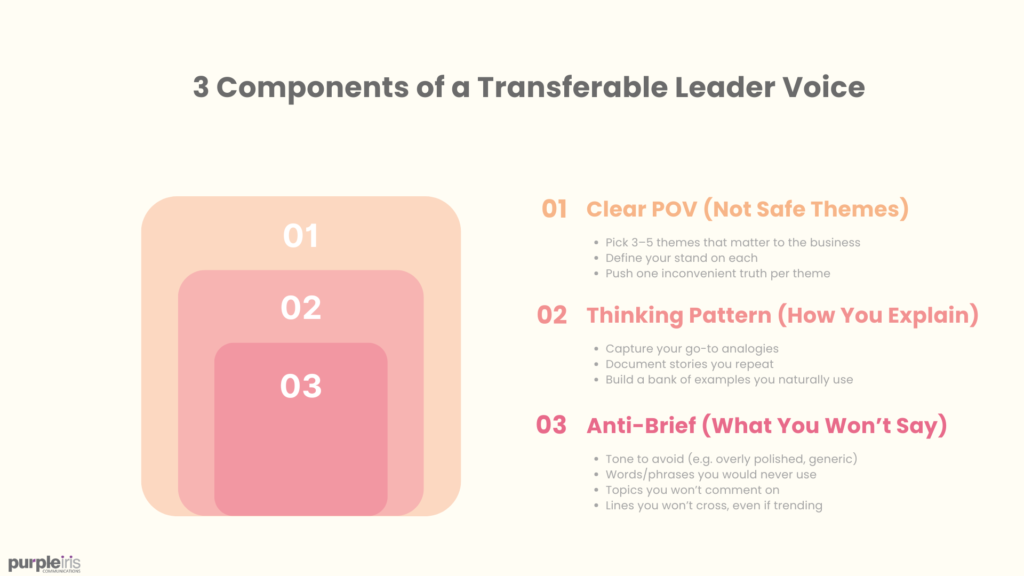
Three Components of a Transferable Leader Voice
Before an agency comes on board, the organization needs to prepare the ground. There needs to be honest conversations between the organization’s leaders and its marketing team on the overarching content strategy.
1. The leader’s position on the issues that matter most
Start by mapping out the most pressing themes, industries, and technology topics shaping your organization today. For each, develop a written position that the leader is ready to stand behind and defend.
Avoid generic statements such as “we are for responsible AI” or “our talent is our most important differentiator.” These are placeholders, not real positions. A genuine position is one that the leader is willing to defend publicly, even if it invites disagreement, and is grounded in direct experience and conviction.
A practical test can be calling out uncomfortable truths that others avoid. For instance, a CFO believes finance transformation fails because it starts as a tech project rather than an operating model shift. Or an HR head believes in a four-day work week and has productivity data to make a case for it. Sometimes it takes a bold and controversial stance to create recall value.
The strength and clarity of each position will determine whether your content stands out, gets lost in the noise, or comes across as gimmicky. These positions cannot be outsourced or manufactured by an agency. The leader must own them, with the agency as a co-developer and execution partner.
2. A working library of the leader’s own language
This component focuses on how leaders communicate. Every leader develops a set of go-to analogies and stories they use to explain or address different challenges.
For example, a logistics entrepreneur might compare supply chain disruption to a river system. An IT executive could draw on their experience deploying an AI solution whenever discussing AI transformation. A sales leader may return to their first customer conversation as a touchstone for future client discussions.
These stories and analogies are not just add-ons. They shape how leaders think and communicate, and are often what make a leader’s voice stand out.
As part of onboarding, the agency should build a library of these stories and analogies. This starts with structured conversations: reviewing past materials, asking the leader what they said, why they said it, and how they might say it now. It’s important to notice which analogies come up naturally, how often certain stories are repeated, and where language becomes more precise or less clear. The outcome is a practical reference tool for capturing the leader’s authentic style.
3. The anti-brief
An effective anti-brief makes clear what the leader will not say or discuss. Beyond listing out off-limits topics, the anti-brief sets out boundaries that define the leader’s voice.
The first boundary is tone of voice. Some leaders are direct and blunt, while others are more measured and qualify their statements. If the content does not reflect the leader’s natural tone, their voice will be lost. The anti-brief should specify which tones do not fit the leader.
The second boundary is language. Every industry has buzzwords and overused phrases. The anti-brief should explicitly name these phrases.
The third boundary covers issues the leader will not address publicly. Some topics may be too sensitive or politically charged. Even if the leader has strong views, these may not be suitable when representing an organization.
Working within the anti-brief helps the ghostwriter understand how to represent the leader’s voice.
How to Brief an Agency the Right Way
A well-constructed brief covers three essentials: the content to include, the intended audience, and the actions or outcomes it should drive. These elements form the foundation of an effective brief. Including the leader’s voice in the brief is equally important.
1. Make a voice audit collaborative
The starting point for an agency is often a review of published material. The agency studies the leader’s LinkedIn posts, speeches, op-eds, or internal memos. They look for recurring themes, common phrases, metaphors, and signs of authentic versus rehearsed brand language.
The client reviews the agency’s findings and shares feedback. This process becomes a core aspect of the voice development brief.
2. Define minimum viable involvement
For most leaders, this means providing the core argument for each piece in a concise paragraph. Everything else is built around that core argument. The organization provides the premise, and the agency builds a structure that supports the argument.
3. Assign one editorial owner inside the agency
Designate a senior in-house resource as the single point of contact for the agency. This person is involved in all discussions during the briefing stage, has access to the leader, and is responsible for conducting voice audits periodically. Equally important is their ability to articulate feedback and guide the agency from time to time in case of voice drift.
Voice Protection Checklist
To ensure consistency in a leader’s voice, ask the following questions before publishing:
- Does the content present a position or merely explore the subject?
- Are the examples included in the content opinion-based with identified points, or generic and politically correct?
- Does the content in question defend the position the leader usually takes?
- Is the language consistent with the brief?
- Is the leader qualified to make the arguments?
Clear signals of voice drift are when a leader reads a finished piece and feels it does not reflect their perspective, even if they cannot explain why. Or if the byline is changed and nobody can tell the difference.
What Comes Next
Today, AI has made it easier to create content. Ideas and opinions are just a prompt away. But the documented, defensible specifics of how a leader sees their industry cannot be reproduced. No AI model will create it from a topic brief. That perspective is built over time and is the only durable point of differentiation for an organization or its leaders.
To build a personal brand that grows and stays consistent, leaders need to first define their voice. Organizations need to build their perspectives before sending out agency briefs. The brief is simply a by-product of this process.
At Purple Iris Communications , we help leaders develop editorial systems that capture their perspectives and develop them further over time. We take a collaborative approach to ensure leaders either communicate their position with our writers from time to time or co-develop it with us. Working with a content agency with a highly experienced team of writers like us helps organizations ensure their leaders’ voice stay consistent and authentic at all times and across channels.