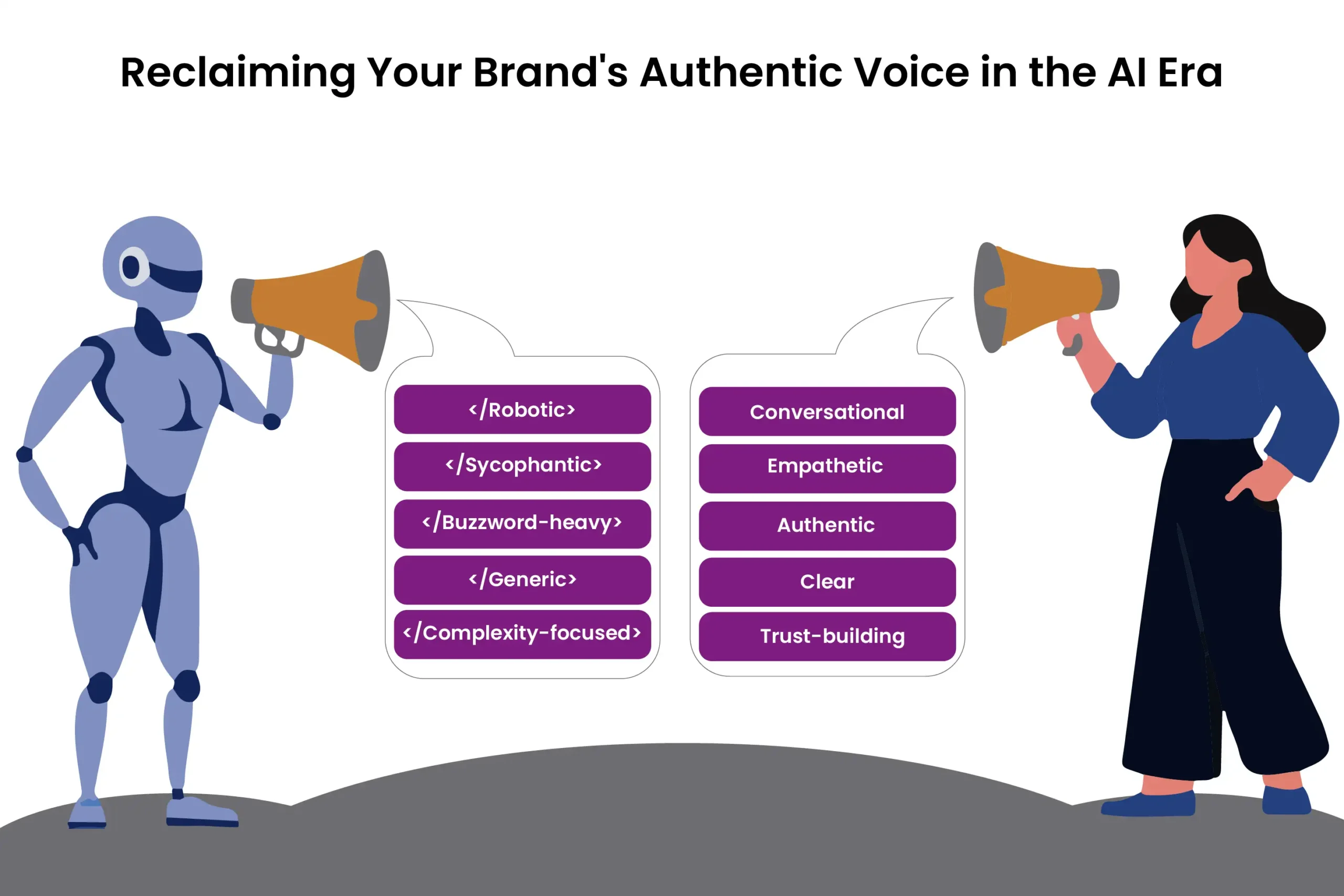
In late April 2025, OpenAI rolled back an update to ChatGPT that made its AI suggestions sound overly sycophantic—so much so that users began calling it fake, inauthentic, and downright annoying. OpenAI admitted the tone had become “too flattering.”
If an AI platform designed to be helpful can lose trust by over-correcting its personality, imagine what happens when we humans use buzzword-heavy, personality-lacking writing in B2B marketing. Our words don’t get labeled as “sycophantic”; they get ignored or lost in the noise.
That is a problem. Your audience—buyers, company founders, or subject matter experts—needs to feel your content. They look for content they can trust, that offers clarity of thought, and has a human touch.
Like OpenAI realized, sounding robotic can cost you far more than just eye rolls. You will lose attention and ultimately, credibility unless you make AI writing human.
Check out our earlier piece where we dive into strategies for protecting content authenticity.
How do you write like a human in B2B marketing?
Let’s explore how to write for a B2B audience and make AI writing human that influence new thinking and inspire actions in the age of robotic content.
Start with clarity, not complexity
You have probably come across a company profile that reads like it was written by a legal department, not a marketer. The write-up uses big words and convoluted sentences that tell a lot without actually saying anything.
In B2B, clarity is not about simplifying ideas—it is about simplifying how we express our ideas. Clear writing reflects clear thinking. And in a world filled with noise, clarity cuts through like a sharp blade.
In the above example, by taking a more human approach, we convey the message better.
Agency Tip: Before publishing, hand your copy to someone outside your industry. If they get it, you are on the right track.
Check out our article on how infographics are great at communicating complex ideas clearly.
It’s not just what you say; it’s how you make them feel
Tone is the handshake before your reader decides to scroll further. Get it wrong, and even the best offer will fall flat. Get it right, and you have earned five more seconds—and maybe a sale.
A common mistake? Sounding too stiff in the name of sounding smart.
There’s nothing wrong with sounding professional, but the best B2B content also sounds intentional, relatable, and real.
Consider this:
“Schedule a discovery call with our consultants to explore synergies.”
Vs.
“Let’s talk about what’s slowing your team down, and how we might help.”
The second feels like a conversation. The first feels like a pitch from 2009.
Agency Tip: Read your copy aloud. If it sounds salesy, tone it down. If it sounds like a conversation, go with it.
Speak to the pain before pitching the product
A founder once told us: “If I have to guess what a product does, I close the tab.”
That’s fair.
Your prospects are not just looking for features. They are scanning for signs that you get it. That you have walked in their shoes, or at least listened long enough to understand the blisters.
Rather than starting with what you sell, start with what they are struggling with.
For example:
“We help SaaS companies reduce churn” isn’t as compelling as: “Tired of seeing users drop off after onboarding? We help keep them engaged from day one.” Jeff Bezos says it succinctly: “Start with the customer and work backward.” That is true for product teams and B2B writers.
Agency Tip: Start every brief or outline by answering this: What’s the business problem we’re solving?
Show, don’t oversell
“Industry-leading.” “Revolutionary.” “Game-changing.”
We have all used them. But do they actually land? Rarely.
Buyers don’t want buzzwords—they want proof. And proof does not need a parade.
Instead of:
“We transformed customer experience for a global brand.”
Try:
“We helped a fintech brand reduce support tickets by 25% within 2 months.”
As the saying goes, “Facts tell, stories sell.” A simple before-and-after can build far more trust than a bold claim with no backup.
Agency Tip: Build a library of bite-sized wins. These proof points make great additions to emails, decks, and elevator pitches.
Format for real readers, not ideal ones
Most B2B content is written for a version of the reader who has all the time in the world. But your actual audience? They are skimming between calls, juggling tabs, or reading on a phone while waiting for coffee.
Respect their time.
Structure matters more than ever:
- Keep paragraphs short (2–3 lines)
- Use headers that guide the eye
- Break complex thoughts into bullets
- Highlight key insights
Think of your reader as someone who wants to understand you, but does not have the time to work for it.
Agency Tip: Preview your draft on mobile. If it feels like work to scroll or process, it is time to trim.
Make your final line feel like a next step, not a full stop
How many times have you seen B2B content wrap up with “Let’s connect,” or “Book a demo”? And how many times have you actually clicked it?
Here’s the truth: Most readers are not ready to buy when they finish reading. But they might be ready to learn something more. That is your window.
Instead of a hard CTA, give them a soft win:
- “See how we helped reduce churn for an edtech company.”
- “Download a quick checklist to audit your onboarding flow.”
These are not just links. They are trust-builders.
Agency Tip: Ask yourself: If this were the only piece of content a reader saw, would they walk away better informed? If not, add something valuable.
Balance expertise with empathy
In B2B, it is easy to focus on numbers—leads, conversions, cost-per-click. But behind every KPI is a person trying to meet a goal, impress a manager, or just get through a busy quarter.
If your writing forgets the human on the other side, it risks sounding robotic.
Check out our article on empathetic writing, Empathy is what turns information into influence.
Instead of:
“Improve operational efficiency across departments.”
Try:
“Free your teams from tedious busywork—and give them time for the work that matters.”
Here are some questions to ask yourself before you hit the share button.
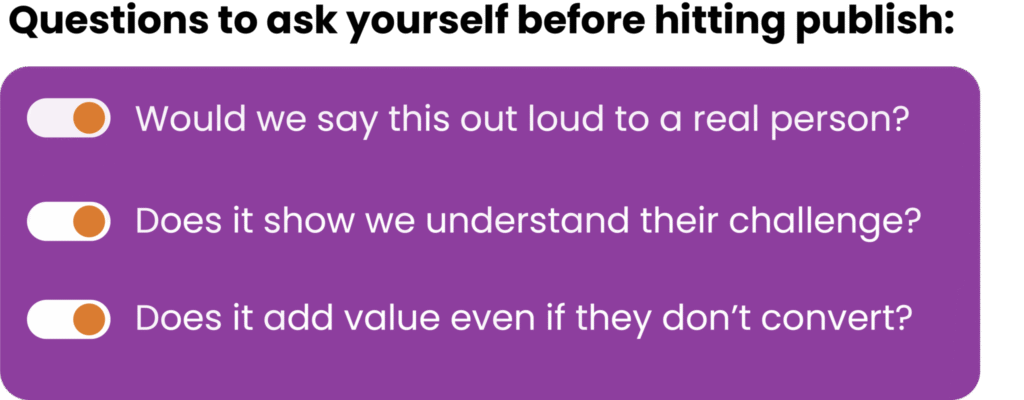
As Simon Sinek says, “People don’t buy what you do; they buy why you do it.” That is as true for software buyers as it is for sneakerheads.
Agency Tip: After every key benefit, ask: “Why does this matter to them?” Write that down too.
Human-proof your AI writing
AI or human? How many times do you ask yourself this question every day? AI is an incredible tool. But when your content sounds like it was written by a tool, you have lost the thread.
Use AI to speed up your research or ideate. But let your writing reflect your own point of view, judgment, or tone.
Think of it like this: AI can write what you want to say. But only you know how to say it in a way your audience cares about.
The most effective B2B content is not just about clarity but also about emotional intelligence, being experience-driven, and being unmistakably human.
Agency Tip: Think of AI as a starting block—it can kick off your research or a rough draft, but only your human instinct can shape it into something meaningful.
Final Thoughts
AI can write fast. But the content that sticks? That still comes from a place only humans know.
B2B content cannot sound robotic. Writing needs to respect the reader’s time, pain points, and intelligence. Be useful. Be clear. And do not be afraid to be human.
At Purple Iris Communications, we help B2B brands bring clarity, credibility, and character to their content. Because when you write like a person, people respond.
Check out our services and how we can add value to your organization’s marketing.