In the past, a founder’s role in content was limited to an official photo in the annual report and a carefully crafted quote for press releases. Marketing teams handled the rest, making sure everything matched the founder’s vision and stayed on brand. Now, this approach is quickly becoming outdated.
B2B buyers now care more about authenticity than standard company messaging. They are looking for leaders’ expertise before making a decision as they sort through countless similar products and AI-generated content. The 2024 LinkedIn B2B Marketing Benchmark report found that 72% of top marketers link their success to strong visibility for executives and thought leaders.1
This shift highlights a growing lack of trust in the market and a weaker connection between buyers and businesses. The responsibility of trust-building now starts right at the top. Rather than a brand-led approach, the founder’s voice carries more weight in this scenario.
The Shift to a Founder-Centric Model
From building a brand for the company, B2B marketing has now evolved to grow the founder’s personal brand in parallel. Today, a founder’s personal brand can bring in prospects and revenue along with the company’s brand since buyers are looking for trustworthy figures behind a logo, rather than the logo alone.
This shift has led to the rise of founder-led marketing, where the founder’s voice, expertise, and storytelling drive growth. But fast-growing companies know that over-reliance on the founder for marketing creates a bottleneck. The company’s business agenda demands the founder’s full-time attention. Such conflicting priorities limit the company’s ability to grow its brand.
Instead of founder-led marketing, a founder-plus model is often more productive. This approach combines the authenticity and trust of the founder’s voice with the reach and staying power of a strong corporate brand. The founder’s content serves as a trust engine, building credibility for both the founder and the company, facilitating long-term growth.
Founders Embracing Their Creator Persona
Entrepreneurs today see value in growing their personal brand and taking an active role in creating and sharing their thoughts, stories, and insights directly with customers and employees.
1. NVIDIA: Jensen Huang
Jensen Huang, founder of NVIDIA, sends out quick, direct “Top 5 Things” emails to employees.2 These internal messages, which include key company priorities, show how much he values sharing information equally with everyone. The emails highlight his belief that being direct and open is the best way to share information in today’s content-led ecosystem.
2. Thrive Global: Arianna Huffington
Arianna Huffington, co-founder of The Huffington Post, started Thrive Global after her own experience with burnout. She has used her story to build a strong narrative for the company, earning trust with the community and creating a brand based on honesty and personal experience.
3. Airbnb: Brian Chesky
As a co-founder of Airbnb, Brian Chesky uses essays, talks, and open letters to share his vision with customers and employees. This approach helps build a strong bond between Airbnb and its community. Chesky shows that being open and honest as a founder is essential to building trust with a startup community.
Creating a Scalable Content System for Founders
If you are a founder who wants to publish regularly, the first step is to build a scalable system that goes beyond your own efforts. It needs a mindset shift from considering content creation as a series of tasks to a strategic function that directly impacts hiring, revenue, and reputation.
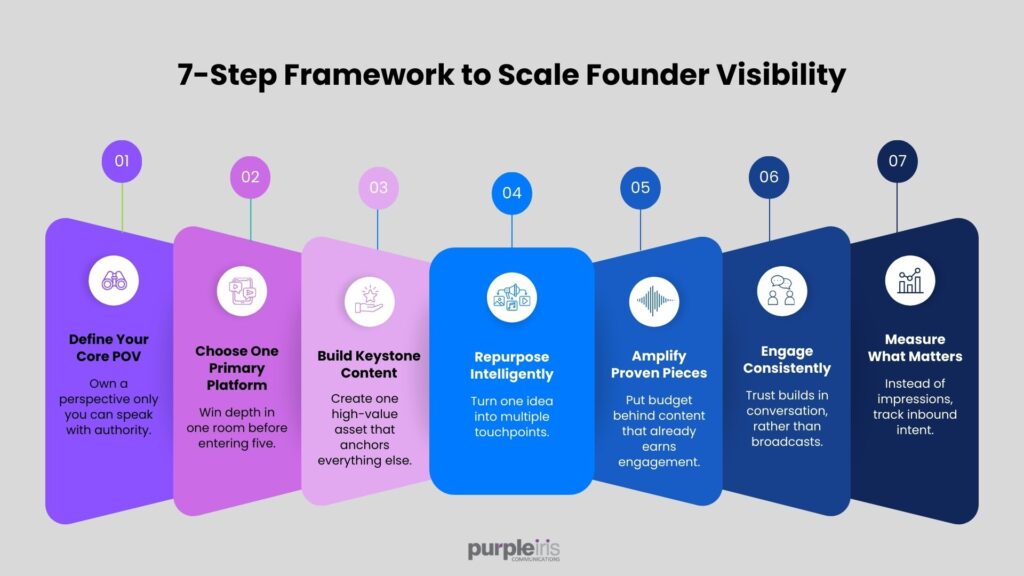
A successful founder-plus model is about building a system that scales your influence and its impact on the business. To create this kind of model, follow these seven steps:
1. Identify Your Core Narrative
Before you write your first thought leadership piece, fix the storyline that only you, as the founder, can tell.
- What is the one inconvenient truth about your industry that no one is talking about?
- What is the fundamental market shift that makes your solution a must-have, not just a nice-to-have?
- What is the legacy you want to build beyond revenue and market share?
This story will be the thread that ties all your content together.
2. Choose Your Primary Platform
Pick one primary platform where your audience is most active, and focus on building your voice there before branching out. It could be LinkedIn, X, or your own blog. Some leaders work toward publishing bylines in traditional print titles or online platforms that offer greater visibility.
3. Develop Keystone Content
Create recurring, high-value pieces of content that anchor your strategy. This could be a weekly newsletter, a monthly founder Q&A video, or a podcast where you interview industry experts. Your keystone content will be the main source for all the other content you create as part of the founder-plus model.
4. Create a Repurposing Engine
Turn one key piece of content into dozens of smaller pieces. A podcast can become audiograms, quote cards, and blog posts. A newsletter can be split into LinkedIn posts and X threads. Building this repurposing engine is how you scale your presence without spending more of your own time.
5. Amplify Your Best Content Beyond Organic Reach
Organic reach is powerful, but it has limits. Use targeted paid promotions to get your top-performing content in front of new, like-minded audiences. Boost only the content that has already proven to work.
6. Engage in Conversation
Founder-led content is a two-way street. Respond to comments on your posts, join industry conversations, and ask your audience questions. This is how you build a community and keep your audience engaged.
7. Measure What Matters
Likes and followers are nice-to-have metrics. But also track the metrics that show trust and influence. Count the number of inbound messages from your ideal customers, the quality of comments and discussions on your posts, and how often other industry leaders share your content.
Transitioning to the Founder-Plus Model
Looking ahead, the most successful leaders will be the ones who embrace their new role as thought leaders for their companies. These leaders will look for ways to scale their own voice as an extension of the brand. While they might track likes or followers, the real measure of success will be the trust they build with their audience.
Shifting from a founder to a creator does not mean you need a big budget or a large team. Start by identifying your core message and choosing the best platform to share it. Founders have more tools than ever to create content, but it still takes real courage to share your point of view and share stories that show vulnerability. Besides the challenge of publishing consistently, founders sometimes struggle to articulate their thoughts or are worried that they might inadvertently say something biased or insensitive.
That is where a professional writing agency comes in as a trusted partner.
At Purple Iris Communications, we help executives transition into their new role as thought leaders. We support you with strategy and content so you can build a personal brand that drives business results. Whether you want to sharpen your message or strengthen your leadership profile, we work with you to make sure your voice reaches the right audience, without adding to your workload.