The use of empathy in communication has been a part of corporate discourse for a while now. Empathy may very well be the compass that guides brands into their customers’ hearts and minds and the glue that binds an organization together.
While a dose of empathy in communication can elevate the tenor of conversations, it may not come easily to many of us. Old habits and beliefs that are baked into our subconscious reveal themselves in the way we speak or write, whether we like it or not.
But can we change our ways? Of course, we can.
Do we know how to change? Well, not always.
Empathy vs Sympathy: Know the Difference
Psychiatrist Alfred Adler defines empathy as the “seeing with the eyes of another, listening with the ears of another and feeling with the heart of another.” Or, in other words, experiencing the world as though you are walking in someone else’s shoes.
This ability to visualize a situation from the perspective of others gives us emotional intelligence and makes us more effective communicators.
However, before you start working on infusing more empathy in your communication, understand what it truly means. Empathy is often confused with sympathy. While both have their roots in the Greek word “pathos”, meaning feelings, there is a difference. This is how Merriam Webster defines the two: “Sympathy is when you share the feelings of another; empathy is when you understand the feelings of another but do not necessarily share them.”
When A loses a close family member, we feel for her and show our sympathy. However, we are not in that situation and, therefore, are detached from it. Whereas when B is nervous on stage and is fumbling through a presentation, we are empathetic toward him. We can easily put ourselves in B’s shoes and understand what he is going through. However, when A joins back work and is unable to meet her commitments, we see ourselves in her situation and become empathetic toward her.
Empathy in Leadership
Two of the greatest leaders and changemakers in the world–Mahatma Gandhi and Nelson Mandela–are known for their empathetic leadership. Gandhi went to great lengths to live the life of the oppressed so as to understand their pain. Mandela used empathy to understand his oppressors’ perspectives better. Among recent political leaders, former New Zealand Prime Minister Jacinda Ardern often spoke about the need for empathy and kindness to underpin leadership.
One of the most prominent business leaders to have embraced empathy is Microsoft CEO Satya Nadella. One of the first tasks he undertook as CEO was to do an organizational reboot and place empathy at its cultural pivot. And today, as AI takes center stage in the world of business, Nadella believes empathy, Emotional Intelligence (EQ), and human collaboration have a bigger role to play.
Another leader who has spoken often about empathy is Apple CEO Tim Cook. In a commencement speech at Massachusetts Institute of Technology (MIT), Cook told graduates to embrace empathy and work toward serving humanity through technology.
However, empathy is not just about doing good. It is also good for the business. Businesssolver’s 2025 report on the State of Workplace Empathy shows that 89 percent CEOs and 74 percent of employees believe a company’s financial performance is tied to empathy.
Empathy in Communication
One of the key indicators of being empathetic is in the way we write or speak. It is about keeping the other person’s situation, perspective, or emotions in mind while framing how we express ourselves.
If you want to fit into the workplace of the future, you will need to become more empathetic in the way you communicate. In today’s world of AI-led communication, it has become even more important for organizations to use empathy to build brand authenticity.
Here are some simple yet effective strategies to get you started on the path to empathetic communication.
Brand communication
Writing with empathy starts with imagining that you are the consumer of that content. Empathetic communication is about understanding the pulse of the reader or the buyer and being thoughtful in how you connect with them.
Amazon’s award-winning campaign, Ads That Work as Hard as You, found appeal because of its empathetic tone. The central thought behind the campaign is the promise that the company is solving real-world problems by putting itself in the customers’ shoes.
Marketing content
Overly promotional content falls in the category of non-empathetic communication. Such content focuses on your company and its offerings and leaves the customer out. To acquire an empathetic tone, turn the content around to focus on the buyer.
Scenario 1:
Our best-in-class cloud solutions with high scalability and advanced security features are powering remote work.
Scenario 2:
Empower your remote teams with cloud solutions that are highly scalable and offer advanced security features.
Both sentences deliver the same message – how today’s businesses with remote teams need the company’s cloud solutions. But by changing the focus from the company to the user, the tone softens and gets more empathetic.
Email communication
Give your email a once-over by reading it from the perspective of the receiver – checking for tone of voice. Is the tone too harsh? Is it too soft and hence not assertive enough?
Let’s assume a manager wants to tell a team member to stay back and finish some work before leaving for the day.
Scenario 1: “Rachael, you must complete the report before you leave today. I need it tomorrow.”
Scenario 2: “Rachael, I’m so sorry but just that the report is needed tomorrow. Do you mind completing it before you leave?”
Scenario 3: “Rachael, I understand that you are working hard on the report, and I truly appreciate your effort. Please complete it today so that I have it tomorrow.”
The tone in the first instance is harsh and aggressive. In the second, you are not only being apologetic but also hiding behind passive voice and not saying that you need the report. The third one is a strong example of empathy – humane yet clear and assertive communication.
What is the right balance? There is no templatized script to include empathy in communication. But re-looking at what you have written from the recipient’s point of view is always a good guide.
| Non-empathetic tone | Empathetic tone | Reason |
| “This is how it is. Such things happen.” | “It must be tough for you.” | Change of focus from you being understanding to the person who is going through a tough situation. |
| “That was a terrible job.” | “I expected you to do a better job. What happened?” | Instead of blaming the person for a job badly done, you are saying that she has the potential to do a better job and you’re giving her a chance to explain. |
Spoken communication
Think of how you can speak with empathy in both small group settings, such as a meeting, or a larger group setting, such as while addressing a company townhall.
We often equate strong verbal communication with being fluent in the language and speaking with confidence. But there are many other nuances that we overlook, such as being more humane.
Have you sometimes felt that while you spoke, the other person heard you but did not really listen? Or you were in the audience, and the presenter rambled on without noticing that the audience was not paying attention?
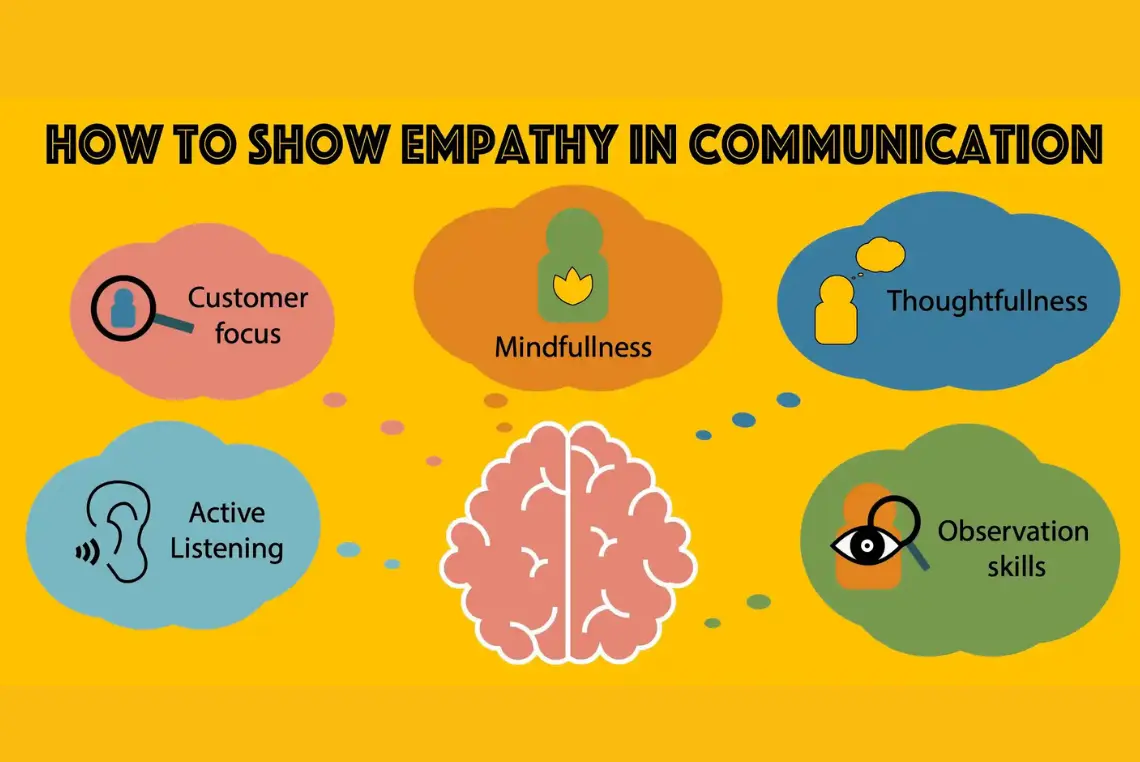
Being empathetic is to watch out for non-verbal cues that you have lost the listener. Are they fidgeting too much or looking at their phones? Sometimes people bob their head a lot without waiting for you to even complete a sentence. That indicates that the other person is not really listening.
So, how can you be an empathetic speaker?
Know the audience: Make your presentation or talking points relevant to the listener. Marketing spiel does not interest the audience. The most engaging presentations are the ones that look at a problem from the other person’s point of view and subtly bring in the solution. Present facts in the form of stories to make them more relatable to your audience.
Look for visible cues: Is your voice bordering on intimidation? What effect is it having on the receiver? If you are receiving meek monosyllabic answers, the receiver is probably nervous in your presence. Do self-checks from time to time in order to become more responsive and empathetic.
Listening with understanding and mindfulness: Listening is one of the most underestimated and underutilized skills in communication. Do you listen to understand or listen to reply? If it’s the latter, it means you are ready with a response even before the speaker has finished. In order to develop empathy in communication and understand others, practice active listening. Be mindful of the circumstances, be present in the moment, and listen to understand. That way, you will observe better and provide the right response.
Rhetorical questions may be an effective tool in a speech, but that is an unempathetic way to communicate. It precludes an effective response since the response is included in the question. For instance, “Do you expect me to believe you did not start the fire?” Instead, ask: “Who started the fire? Was that you?”
Effective communication is a lot more than the substance; the tone equally matters. A message delivered with an empathetic tone has a higher degree of effectiveness. Choose your words well and always keep the recipient in mind while writing or speaking. Empathy in communication is a skill that is hard to find but not impossible to learn. Practise it as a power skill that will make you fit for the future of work.
Find out how we embed empathy in our approach for Marketing Communications and Employee Communications.