
Every B2B business understands the role that content plays in its success–growing its voice in the market, articulating its value proposition to buyers, and engaging with them meaningfully. However, to achieve these goals, a B2B content strategy must underpin all content creation efforts, followed by a content marketing plan that drives focused outcomes.
Think of content strategy as the architectural blueprint of a house and content marketing as the welcoming front porch.
Content strategy addresses all the foundational aspects of what you are building–why you are creating content, who will consume it, what it will look like, where it will reside, and how all the pieces fit together.
Content marketing draws people in—it ensures your brand is approachable and visible, and promises an engaging experience that makes buyers curious about what is inside.
In the absence of a content strategy, what teams create risks becoming directionless and hit-and-miss at best. Without content marketing, even the most valuable content remains undiscovered, and all the effort that goes into it is pointless.
Content Strategy: The Foundation Worth Building
Content strategy answers the hard questions before you create anything.
- Who are we talking to?
- What are their business problems or intent at different stages of their journey?
- How do we measure success of our content assets?
This is the point where most teams stumble, simply because strategy is not the “attractive” part of the work. Nobody gets excited about audience research or setting a content lifecycle process from creation to publishing and archiving. But without this groundwork, you are creating content and crossing your fingers that it somehow lands.
Think about a real scenario. A SaaS company selling marketing automation software identifies three buyer personas: the marketing director looking for quick ROI, the marketing ops manager drowning in technical implementation, and the CMO looking for data-driven insights for strategic alignment. Each persona needs fundamentally different content addressing different pain points at different funnel stages.
With a content strategy, the company can clearly define a structure: topics mapped to which personas, content formats that serve different buying stages, and different content pieces that interconnect to move prospects through the journey. It establishes the rules, priorities, and frameworks that guide every piece of content.
A content strategy pushes leaders to answer key questions beforehand: Does it support a specific business objective? Will it rank for keywords our target personas actually search for? How does it connect to our other content assets?
Content Marketing: Strategy in Motion
Once you have a strategy figured out, content marketing is the execution layer. This is where you decide what to publish and when, and how to distribute and promote the content. Content marketing helps you expand your reach with the content you have produced.
Content marketing is inherently tactical. For example, it focuses on:
- What format works best?
- Which channels should we use for distribution?
- How do we optimize for search?
- How do we measure performance?
Effective content marketing requires constant iteration based on performance data. You publish a piece, see how it performs, learn from that data, and adjust your approach. This is the feedback loop that makes content marketing work.
Here’s a concrete example. Your content strategy might dictate that you need thought leadership content targeting decision-makers in mid-market B2B companies. Content marketing provides input to the content creation team to enhance its value–for example, what high-intent keywords to use to optimize it for search, or how to repurpose it for LinkedIn or YouTube, or how to promote it through email marketing.
A variety of skills come together to make an organization’s content deliver value. You need writers who can translate complex ideas into clear prose, designers who can visualize data in a compelling way, content marketers who conduct technical optimization, and social media managers who can leverage different platforms effectively.
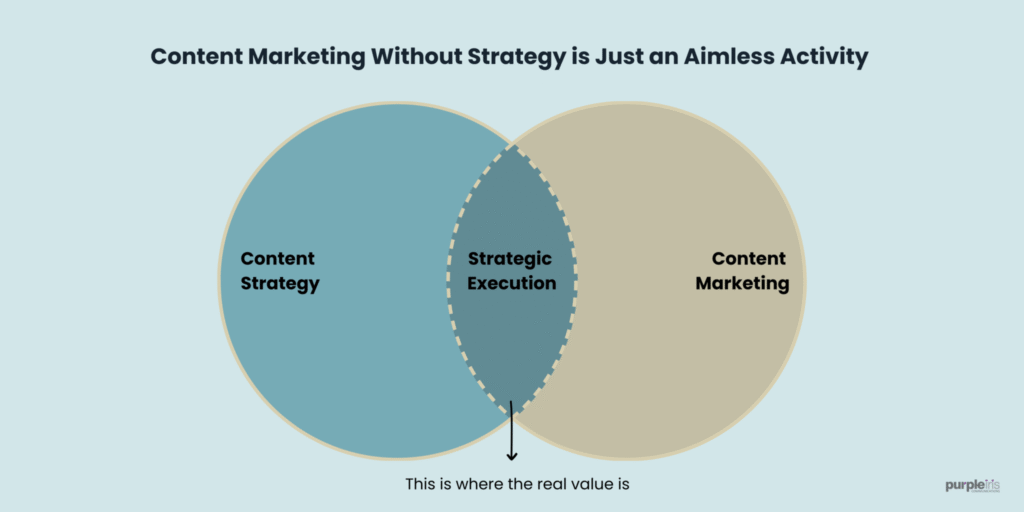
Bridging Strategy and Execution: How to Make Both Work Together
Organizations need to create a cohesive system in which content strategists, content creators, and content marketers complement each other and work toward shared goals. It is equally important that they learn from one another: strategy must guide execution and execution must inform strategy.
Here is a framework to build that integration.
1. A Foundation That Simplifies Work
Teams need tools they can use every day, so they don’t have to reinvent the wheel each time.
- Create practical assets, such as persona quick sheets, decision drivers, messaging pillars, and a simple content priority scorecard. These tools help creators make faster decisions.
- Ground your strategy in real audience insight. Talk to customers about how they research, their search triggers, and the tone they trust.
- Tie every strategic decision to measurable business outcomes. Measure how content influences sales cycles, qualification, and deal momentum. When creators see this link, their work becomes more intentional.
2. Making Feedback an Always-On Practice
Your strategy is a living system that grows with new insight. Feedback loops are critical in keeping your strategy current.
- Set up a simple loop. Marketing shares what the audience is responding to. Strategy interprets that data and adjusts direction. The cycle repeats. Quarterly check-ins work well.
- Which themes triggered meaningful engagement? Which personas surprised you? What friction points showed up in the funnel? This level of reflection keeps strategy current.
- Agree on a shared vocabulary. If your strategist suggests high intent content, your creators should understand what that looks like in terms of tone, structure, examples, and CTA logic. Without common definitions, teams talk past each other.
- Experiment often and update the strategy based on what you learn. If assumptions are wrong, shift quickly.
3. Teams That Complement Each Other
The best content outcomes come from teams that blend planning with execution. You need people who can think long-term and execute quickly. Hybrid talent creates fewer handoffs and delays.
- Make strategists part of production conversations. Make creators part of strategic workshops. When both sides understand context and constraints, execution becomes sharper, and strategy becomes more grounded.
- Create clear ownership. Someone must own direction, and someone else own delivery. But they should operate as one unit, not two disconnected lanes.
4. An Editorial Calendar as a Strategic Dashboard
Most calendars tell you what is being published. A strategic calendar also adds rationale behind each content piece.
- Add tags for persona, funnel stage, business priority, and core theme. This helps everyone see alignment at a glance.
- Keep space for timely ideas. A portion of your calendar should be flexible so your team can respond to shifts in the market or fresh insights from sales. Rigid calendars age fast.
- Review the calendar quarterly with a strategic lens. Are you investing in the right personas? Are you overproducing low-impact content? Is your mix supporting the goals you set? This audit keeps execution connected to outcomes.
Strategic Execution is the Real Differentiator
Content strategy and content marketing go hand in hand. The real work is in building a system where both feed into each other continuously, where your strategy evolves based on what marketing learns, and your marketing sharpens based on what strategy defines.
However, this is not about perfecting your framework before you start producing content. It is about starting with enough strategic clarity to guide your first steps, then letting execution teach you what to refine. The best content programs are built through periodic reviews and iterations.
If this is the direction you want your content program to move toward, you do not have to do it alone. At Purple Iris Communications, we help B2B companies strengthen their strategic foundation and create and amplify content that reflects that clarity.