Leaders are increasingly expected to have a public point of view. That perspective can shape how customers, employees, investors, and other stakeholders understand both them and the businesses they lead.
Yet there is a practical problem: turning insights into content that drives thought leadership is not on top of their agenda. And rightfully so.
Executive visibility matters. So does executive time.
But that’s not all. Misconceptions about ghostwriting also keep leaders from using it effectively.
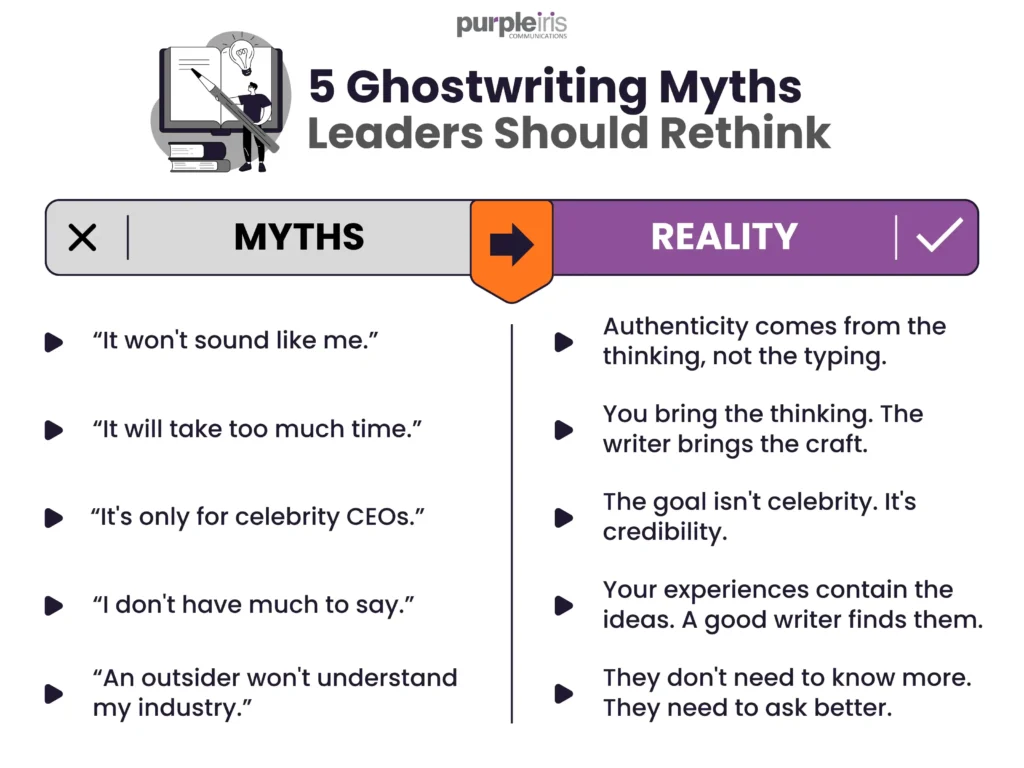
Myth 1: If I don’t write it, it won’t sound like me
Leaders do not want their content to sound like it came from a communications team. They want it to sound like them.
But sounding like the leader does not require the leader to write every sentence.
The executive needs to remain the source of the perspective: the experiences, judgments, opinions, language, and stories that make the content distinctive. The writer’s job is to draw those elements out and shape them without losing what makes the voice recognizable.
Deloitte’s 2025 research on CEO storytelling found that stories can help leaders build connection and authenticity, particularly when they draw on real experiences and communicate what those experiences mean.
The writer needs access to the leader’s thinking, not just the subject they want to discuss.
Harvard Business Review’s 2025 guidance on executive communication makes a related point: senior leaders need to edit their communication carefully because their words carry greater weight.
Ghostwriting, done well, adds editorial support without taking ownership of the message.
The boundary should be clear: the writer can sharpen an idea, but should never have to invent one.
Myth 2: It will take too much of my time
An executive does not need another recurring task on the calendar titled “write this week’s LinkedIn post.”
PwC’s 2026 Global CEO Survey found that CEOs spend 47% of their time on issues with horizons of less than one year, compared with 16% on decisions looking more than five years ahead.
A workable cadence to create executive content without consuming the leader’s time might look like this:
Capture ideas as they arise → discuss them in a recurring conversation → let the writer research and develop them → give the executive a focused review window.
A voice note after a customer meeting can capture an observation while it is still fresh. It does not need to be polished. A few minutes of unfiltered observations can give the writer material that a carefully prepared brief often misses.
From there, the writer takes on the production work: researching the subject, developing the argument, drafting the piece, and refining it based on the executive’s feedback.
The executive’s involvement can then stay focused on the parts only they can provide: the experience behind the idea, the judgment to challenge the argument, and the final say on what gets published.
Myth 3: It’s only for celebrity CEOs
Executive ghostwriting is sometimes associated with only high-profile founders and CEOs building large personal brands.
But most businesses do not need their leaders to become celebrities. They need the people who matter to the business to understand what those leaders stand for and have more reasons to trust them.
That includes prospective buyers evaluating a complex purchase, employees trying to understand where the organization is headed, candidates deciding whether they want to join the organization, and partners assessing whether a company understands their market.
Forrester’s 2025 research found that 82% of B2B buyers trust coworkers and management within their organizations as information sources. It also found strong levels of trust in independent experts, including industry peers, analysts, vendor executives, and customers.
PwC’s 2025 Global Workforce Hopes and Fears highlights that workers with the highest levels of trust in top management were 63% more motivated than those with the lowest levels of trust.
Executive content plays a critical role in trust creation. It gives buyers, employees, and other stakeholders a clearer view of how the organization thinks and where its leadership stands. Over time, that clarity of thought compounds into confidence in a leader’s ability to direct the business and the organization’s ability to deliver value.
Myth 4: I don’t have much to say
Leaders have years of experience running a business, managing projects and clients, growing a team, and building work culture. What may seem routine to an experienced individual may hold useful lessons for someone else.
A customer conversation can reveal a broader market shift. A simple decision can expose a problem others in the industry are also facing. A recurring question from employees can point to a leadership issue.
AI can generate dozens of plausible article topics about an industry. The harder task is recognizing which observation from a leader’s experience contains an idea worth developing.
Executive ghostwriters listen for the ideas underneath the anecdotes: an assumption worth challenging, a pattern worth examining, a lesson worth sharing, or a prediction the leader is willing to defend.
Gartner’s 2025 research on B2B thought leadership makes the same fundamental distinction. Thought leadership can be a powerful form of B2B content, but only when it establishes a strong point of view that resonates with customers.
The executive does not need to arrive with a finished article idea. They need to bring their experience to the conversation. The writer needs to know what to listen for.
Myth 5: An outsider won’t understand my industry
A writer who does not understand the business, its customers, or the language of the industry can easily produce something that sounds polished but says very little.
Industry fluency does not mean memorizing a glossary of technical terms. It means understanding enough of the context to ask better questions, recognize what is worth exploring for the target audience, and translate specialist knowledge into content consumable by a non-technical individual.
That means understanding the regulatory or operational context, being on top of market developments, researching the competitive landscape, reviewing customer and company material, and learning how buyers and practitioners actually describe their problems.
It also means knowing how to use a language familiar to practitioners without making it a barrier for other stakeholders who have surface-level knowledge of the subject.
Harvard Business Review’s 2025 research on business jargon argues that abstract language can create confusion and misalignment rather than clarity.
That matters because understanding an industry is only half the job. The other half is making its complexity useful to the intended audience. Forrester’s research on B2B content emphasizes the importance of objective, credible, current information that helps buyers understand trends and make decisions.
The writer does not need to know the industry better than the executive. They need to know enough to help the executive articulate it better.
The value of a collaborative approach
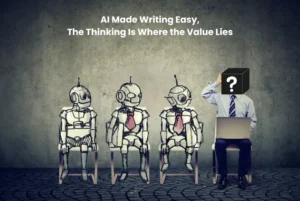
AI has made competent content easier to produce. It has not made executive experience, judgment, or a defensible point of view any easier to replicate.
For leaders, the value of ghostwriting is less about producing more content and more about giving their own thinking a clear, credible form. Experienced ghostwriters know how to use a leader’s point of view as a guide and build on it further by presenting disparate thoughts and ideas into a powerful narrative.
At Purple Iris, we see executive ghostwriting as a collaboration between industry expertise and editorial craft. Our role is to draw out what leaders know, test and develop their ideas, bring the right research and context to the conversation, and shape those insights into content that remains recognizably theirs. We turn the expertise already sitting inside an organization into clear, credible perspectives that those on the outside understand and value.
Frequently asked questions
- Can ghostwriting be authentic?
Yes. Ghostwriting can be authentic when an executive’s ideas, experiences, and perspective remain the source of the content. The ghostwriter’s role is to articulate and refine those ideas without inventing them.
- How much time does executive ghostwriting require?
The time commitment depends on the cadence, but it can be concentrated around conversations, idea capture, and final review while the writer handles research, drafting, and refinement.
- Why do executives use ghostwriters?
Executives use ghostwriters to turn their expertise and perspectives into consistent public-facing content while keeping their involvement focused on the thinking, feedback, and decisions only they can provide.
- What does an executive ghostwriter actually do?
An executive ghostwriter interviews the leader, identifies ideas worth developing, researches the subject, builds the argument, drafts the content, and refines it based on executive feedback.
- Can a ghostwriter understand a specialized industry?
Yes. A good ghostwriter does not need to know the industry better than the executive, but needs enough industry knowledge to ask intelligent questions, conduct relevant research, and explain complex ideas clearly.
References:
- https://www.deloitte.com/content/dam/assets-zone3/us/en/docs/programs/2025/us-ceo-stories-that-drive-action.pdf
- https://hbr.org/2025/08/the-best-leaders-edit-what-they-say-before-they-say-it
- https://www.pwc.com/gx/en/1/issues/c-suite-insights/ceo-survey.html
- https://www.forrester.com/blogs/b2b-buyers-rate-their-most-trusted-information-sources/
- https://www.pwc.com/gx/en/issues/workforce/hopes-and-fears.html
- https://www.gartner.com/en/documents/6455207
- https://hbr.org/2025/11/jargon-is-hurting-your-strategy
- https://thoughtleadership.forrester.com/go/forrester/customer-centric_content/?lang=en-us